Health systems have stopped shopping for point solutions. H1 2026 data show the winners are the platforms that integrate seamlessly into clinical and operational workflows — and the ventures that get bought, not funded, are increasingly being acquired by other infrastructure players.
KEY TAKEAWAYS
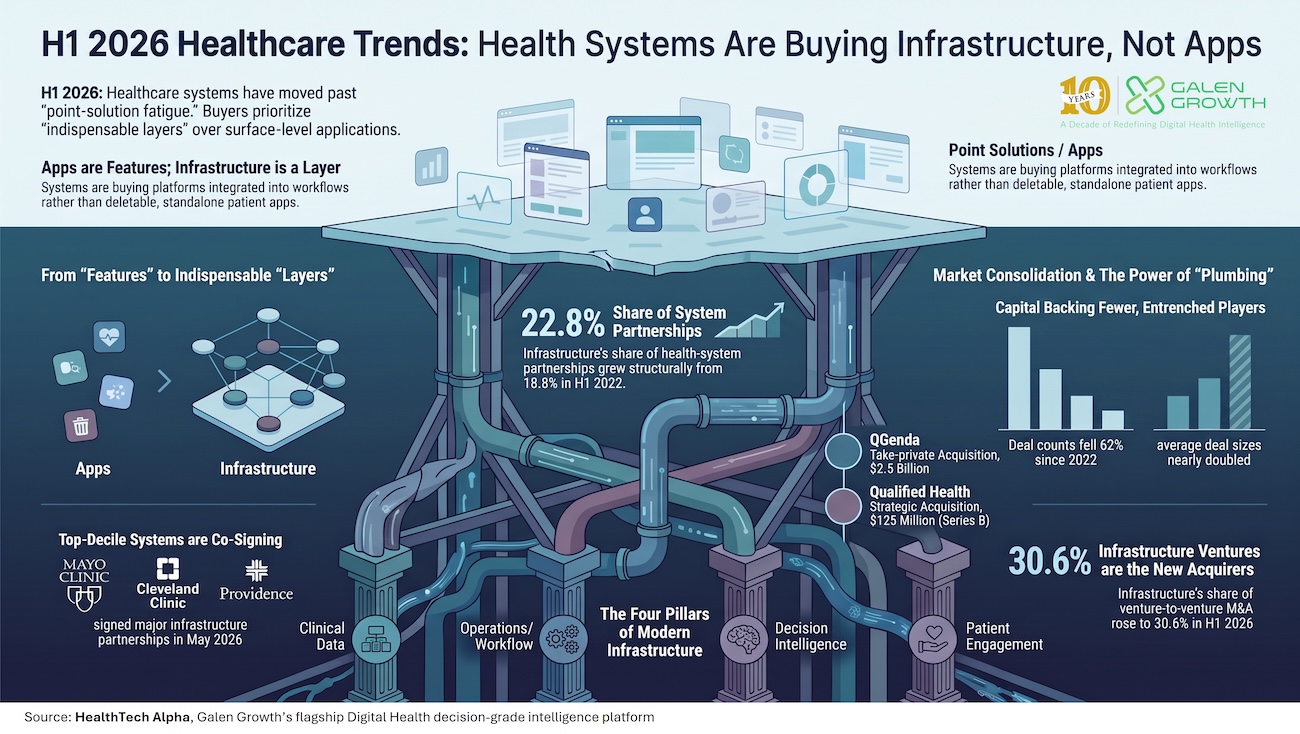
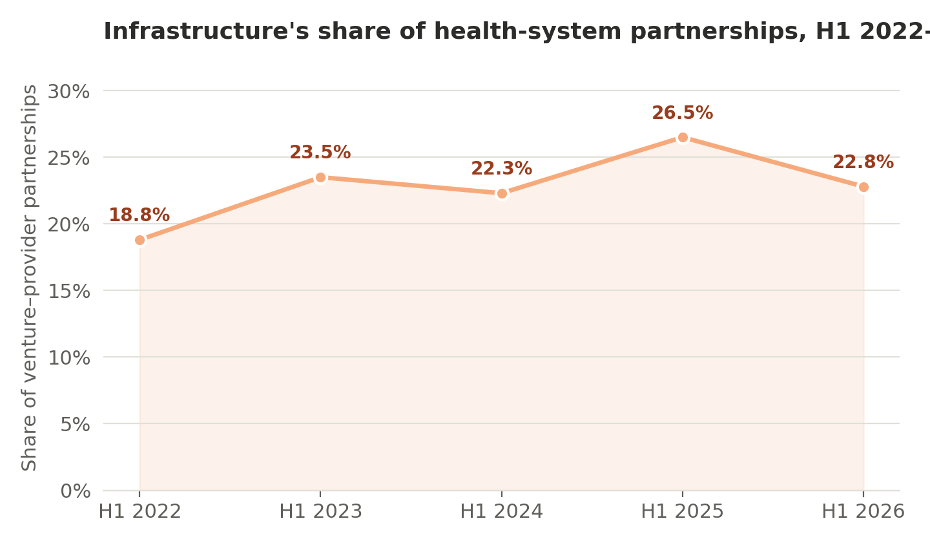
- The market is not rewarding infrastructure with more dollars — it’s rewarding it with adoption. Infrastructure’s share of digital health financing dollars was volatile across H1 2022–H1 2026 (11.3% to 18.0% to 10.2%), but its share of health-system partnerships climbed structurally, from 18.8% in H1 2022 to 22.8% in H1 2026, peaking at 26.5% in H1 2025.
- Point-solution fatigue is consolidating the infrastructure category itself: H1 infrastructure deal count fell 62%, from 189 rounds in H1 2022 to 72 in H1 2026, even as average deal size roughly doubled — capital is backing fewer, more entrenched platforms.
- Health Management Solutions ventures are becoming the acquirer of choice inside the sector itself: their share of venture-to-venture M&A rose from 16.7% in H1 2022 to 30.6% in H1 2026, while Patient Solutions and Telemedicine — the next two most active acquirer clusters — stayed flat or declined over the same period.
- Strategic buyers are absorbing infrastructure rather than funding it early: Waystar’s acquisition of Iodine Software ($1.25bn, July 2025) and the Francisco Partners/Hearst Health-backed take-out of QGenda ($2.5bn, August 2024) are the two largest Health Management Solutions transactions on record in this dataset.
- Named health systems are now co-signing the infrastructure thesis directly: Cleveland Clinic and Providence Health Care both partnered with interoperability platform Kno2 in May 2026, while Mayo Clinic backed Bayesian Health the same month.
For years, the digital health pitch to hospitals was a feature: a symptom checker, a scheduling widget, a patient-facing app that lived one tap away from being deleted. That pitch is largely dead. What health systems are buying in H1 2026 is not a feature — it’s a layer. Something that sits underneath clinical documentation, claims adjudication, staff scheduling or care coordination and becomes structurally difficult to rip out.
This is not a hypothesis. It’s what the partnership and M&A data show. Across the H1 windows we tracked from 2022 through 2026, ventures in this cluster have taken a growing share of every health-system partnership signed, and have become the most active acquirer of other digital health companies in the market.
Throughout this analysis, infrastructure refers to a specific, defined slice of the market: HealthTech Alpha’s Health Management Solutions cluster, spanning four categories — Clinical Data Infrastructure, Healthcare Operations & Workflow, Clinical Decision Intelligence, and Patient Engagement.
Health systems have stopped shopping for apps
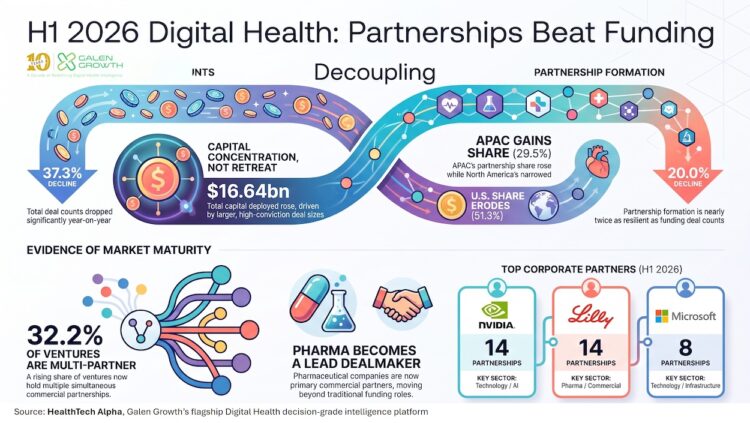
The clearest tell is who health systems are choosing to work with. In H1 2022, infrastructure ventures accounted for 18.8% of all venture–health system partnerships tracked by HealthTech Alpha. By H1 2025, that had climbed to 26.5%, before settling at 22.8% in H1 2026 — still four full percentage points above where the category started.
Kno2, a clinical data infrastructure venture, signed partnerships with both Cleveland Clinic and Providence Health Care in the same week in May 2026. Bayesian Health partnered with Mayo Clinic days later. Rad AI, operating in the same cluster, partnered with Yale New Haven Health in June. These are not pilot logos for a press release — Mayo Clinic, Cleveland Clinic and Providence do not attach their names to point solutions they expect to churn within eighteen months. A partnership with a top-decile academic medical centre is itself a signal that the underlying platform is expected to become permanent.
This is the practical meaning of “infrastructure”: not a marketing category, but a purchasing pattern. Health systems are integrating fewer things more deeply, rather than adding more things loosely.
Capital is consolidating into fewer, larger infrastructure bets
Financing tells a more complicated story than partnerships do, and it’s worth being honest about the complication rather than smoothing it over.
Infrastructure’s share of total digital health financing dollars has not risen in a straight line. It moved from 11.3% of H1 dollars in 2022 to a peak of 18.0% in H1 2025, then fell back to 10.2% in H1 2026 — a reminder that dollar share is a noisy signal in any single half-year and shouldn’t be over-read on its own.
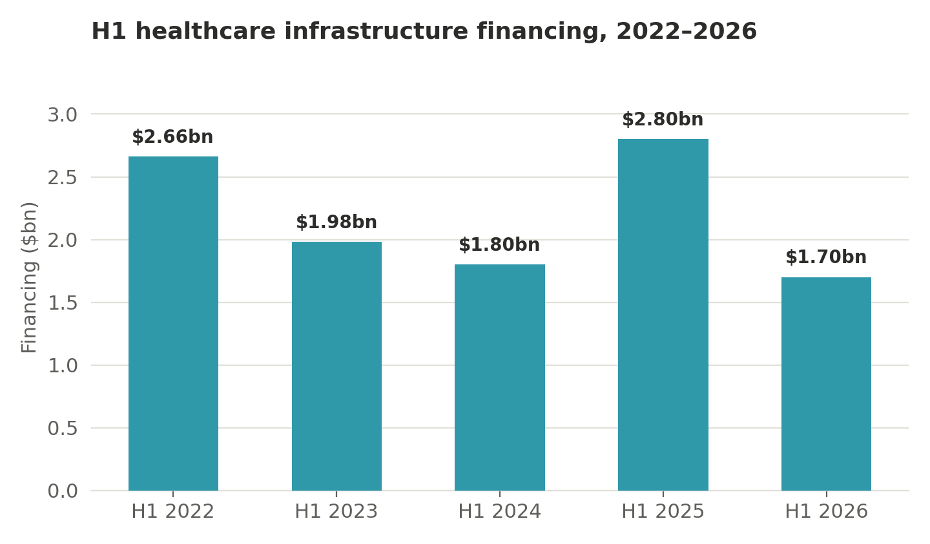
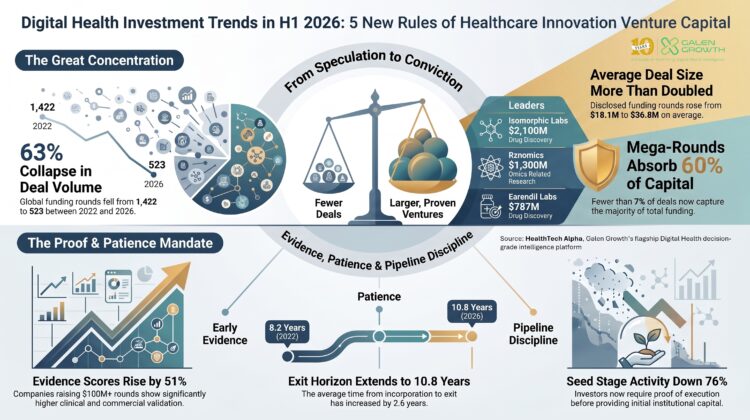
What has moved in a straight line is deal count. Infrastructure financing rounds fell every single H1 period on record: 189 in 2022, 171 in 2023, 146 in 2024, 123 in 2025, and 72 in 2026 — a 62% decline in deal volume over four and a half years. Average infrastructure deal size, meanwhile, rose from roughly $14.1m in H1 2022 to $23.6m in H1 2026. Fewer companies are getting funded in this category, and the ones that do are getting materially larger cheques. That is consolidation, not retreat — capital concentrating behind infrastructure platforms that already have distribution, rather than spreading thin across a crowded field of early-stage entrants.
| Venture | Category | Round | Amount | Date |
| Qualified Health | Healthcare Operations & Workflow | Series B | $125m | 25 Mar 2026 |
| Assort Health | Healthcare Operations & Workflow | Series C | $120m | 24 Jun 2026 |
| Zarminali Health | Healthcare Operations & Workflow | Series A | $110m | 21 Jan 2026 |
| Latent | Healthcare Operations & Workflow | Series A | $80m | 18 Mar 2026 |
| Chamber Cardio | Healthcare Operations & Workflow | Series A | $60m | 4 Feb 2026 |
Across the H1 2022–2026 window, Andreessen Horowitz and General Catalyst each led nine infrastructure rounds — more than any other private investor tracked in the category, alongside sustained public and philanthropic backing from Horizon Europe, NIH SBIR and UK Research and Innovation grant programmes, which together led 60 infrastructure deals over the period.
Point solutions are being absorbed, not funded
The infrastructure thesis has a second, sharper data point within the M&A market itself: infrastructure ventures are no longer just being bought — they’re doing the buying.
When we trace M&A acquirers back to their own HealthTech Alpha venture profiles — isolating the subset of digital health M&A in which the acquirer is itself a tracked venture, rather than a private equity firm, health system, or outside strategic — a clear pattern emerges among the three most active acquirer clusters. Health Management Solutions’ share of venture-to-venture M&A rose from 16.7% in H1 2022 to 30.6% in H1 2026, now comfortably the largest of the three. Patient Solutions held roughly flat across the period (12.5% to 11.1%, with a mid-period bump to 18.2% in 2024), and Telemedicine’s share fell by more than half, from 13.9% to 5.6%.
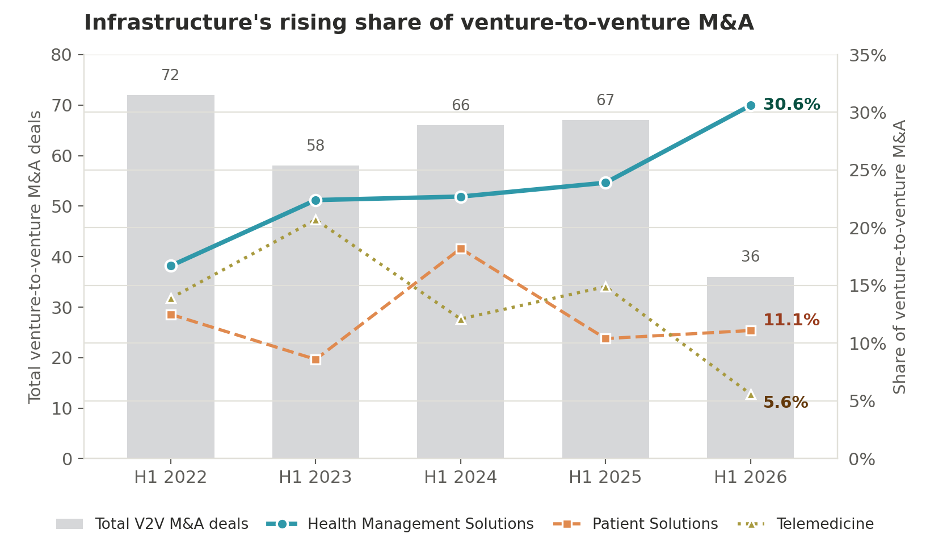
That is a materially different story from the dollar-volume charts above. It says that when a digital health venture goes shopping for another digital health venture, it is increasingly an infrastructure company doing the shopping — and increasingly likely to buy something it can fold directly into an existing platform, rather than a standalone consumer product.
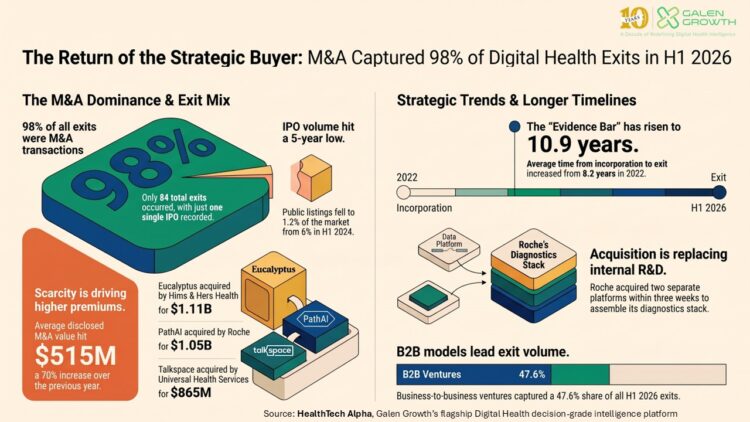
The two largest deals in the underlying dataset put scale behind that pattern. Waystar’s $1.25bn acquisition of revenue-cycle infrastructure venture Iodine Software in July 2025, and the $2.5bn take-private of scheduling infrastructure venture QGenda by Francisco Partners and Hearst Health in August 2024, are the two largest Health Management Solutions transactions in the dataset — larger than every H1 2026 infrastructure financing round combined. Truepill was acquired by LetsGetChecked in the same window.
The pattern underlying these deals is consistent with the argument in The Return of the Strategic Buyer, our 21 July analysis of digital health exits: acquirers are not buying features; they’re buying an embedded position. QGenda and Iodine Software were not consumer-facing products competing for attention — they were the scheduling and clinical-documentation logic that hospital operations had already been built around. Buying them wasn’t expansion into a new market; it was buying the plumbing a much larger platform depended on.
For founders building point solutions rather than infrastructure, the implication is uncomfortable: both the buyer pool and the exit logic increasingly reward embeddedness, not user counts — and increasingly, the buyer at the table is another infrastructure company, not an outside acquirer.
What this means
For health systems and providers: the data confirms what procurement teams already feel — vendors that integrate into scheduling, documentation or care coordination workflow are increasingly the ones with staying power. Treat a Health Management Solutions partner less as a pilot and more as an infrastructure decision from day one, because both the partnership data and the M&A data suggest these vendors have the strongest staying power and the deepest acquirer interest.
For payors: the same operational-embeddedness logic that is winning with providers applies directly to claims, utilisation management and care coordination infrastructure. Watch which vendors your competitors are locking in — infrastructure partnerships compound switching costs faster than point-solution contracts do.
For founders: building a point solution is no longer a viable end-state strategy on its own. The M&A data rewards embeddedness — QGenda and Iodine Software were bought because hospital operations had already been built around them, not because they had the most users — and increasingly your most likely acquirer is another infrastructure platform, not an outside strategic. Plan the roadmap toward becoming operationally indispensable, not just adopted.
For investors: Health Management Solutions’ rising share of venture-to-venture M&A (16.7% to 30.6%) signals a deepening, self-reinforcing buyer pool inside the category — infrastructure companies are increasingly each other’s most natural acquirers, which strengthens the exit case for backing infrastructure early relative to categories like Telemedicine, where the acquirer base is visibly thinning.
Frequently asked questions
What counts as “infrastructure” in this analysis?
Ventures in HealthTech Alpha’s Health Management Solutions cluster — spanning Clinical Data Infrastructure, Healthcare Operations & Workflow, Clinical Decision Intelligence, and Patient Engagement — as distinct from patient-facing apps, wellness tools and other point solutions.
Is infrastructure attracting more investment dollars than other digital health categories?
Not consistently. Its share of H1 financing dollars ranged from 10.2% to 18.0% across 2022–2026 with no clear upward trend, but its share of health-system partnerships rose from 18.8% to 22.8% over the same period — adoption is the stronger signal, not fundraising.
What is venture-to-venture M&A, and why does it matter?
It’s M&A activity in which the acquirer is itself a digital health venture rather than a private equity firm, health system, or outside strategic. Health Management Solutions’ share of this activity rose from 16.7% to 30.6% between H1 2022 and H1 2026, indicating that infrastructure companies are increasingly buying one another rather than being acquired exclusively by outside players.
What’s the largest infrastructure acquisition in this dataset?
Francisco Partners and Hearst Health’s $2.5bn take-out of scheduling platform QGenda in August 2024, followed by Waystar’s $1.25bn acquisition of Iodine Software in July 2025.
Why is Telemedicine’s share of venture-to-venture M&A declining?
HealthTech Alpha data shows Telemedicine’s share of venture-to-venture M&A activity fell from 13.9% in H1 2022 to 5.6% in H1 2026, consistent with the sector consolidating around a smaller number of scaled players rather than continuing to actively acquire.
Data source and methodology
Data source: HealthTech Alpha by Galen Growth, accessed July 2026, covering venture financing, venture–corporate partnership activity, and M&A activity from 1 January 2022 to 30 June 2026 (H1 periods only). Funding figures exclude IPO, M&A, SPAC, Post-IPO Equity, Delisted and Secondaries transactions throughout, except where M&A is analysed directly. “Infrastructure” refers to ventures tagged under HealthTech Alpha’s Health Management Solutions cluster (Clinical Data Infrastructure, Healthcare Operations & Workflow, Clinical Decision Intelligence, and Patient Engagement). Figures are in USD; H1 2026 figures may be revised upward as recently completed rounds and deals are disclosed after this analysis was prepared.
This analysis is provided solely for informational purposes and was prepared in good faith on the basis of public information available at the time of publication without independent verification. Numbers will be updated from time to time to reflect information identified after the event. Galen Growth does not guarantee or warrant the reliability or completeness of the data nor its usefulness in achieving any particular purposes. Galen Growth shall not be liable for any loss, damage, cost or expense incurred by any reason because of any person’s use or reliance on this report.
Related Galen Growth analysis
- The Maturity Era: Digital Health Funding, H1 2026
- Re-Architecting Healthcare Delivery with AI — Digital Health 2026 Report
- The Investable Core — Health Management Solutions Funding 2026
How to cite this analysis
About Galen Growth
Galen Growth is the digital health intelligence firm behind HealthTech Alpha, the leading ontology-driven platform tracking the global digital health ecosystem. With operating entities in the US, Europe and Asia, we combine large-scale labelled data, auditable GenAI research and explainable analytics to advise pharma, medical device, insurance, health system, investor and startup clients.