H1 2026 shows that digital health investors haven’t stepped back—they’re changing the rules.
Digital health venture capital is operating under a new set of rules that increasingly influence broader healthcare investment.
Over the past four years, digital health has moved beyond the extraordinary funding conditions that characterised the post-pandemic investment boom. Investors are no longer competing to back the largest number of promising companies. Instead, they are concentrating capital behind a smaller group of ventures that have demonstrated the evidence, commercial maturity and execution capability required to justify larger, longer-term commitments.
KEY TAKEAWAYS
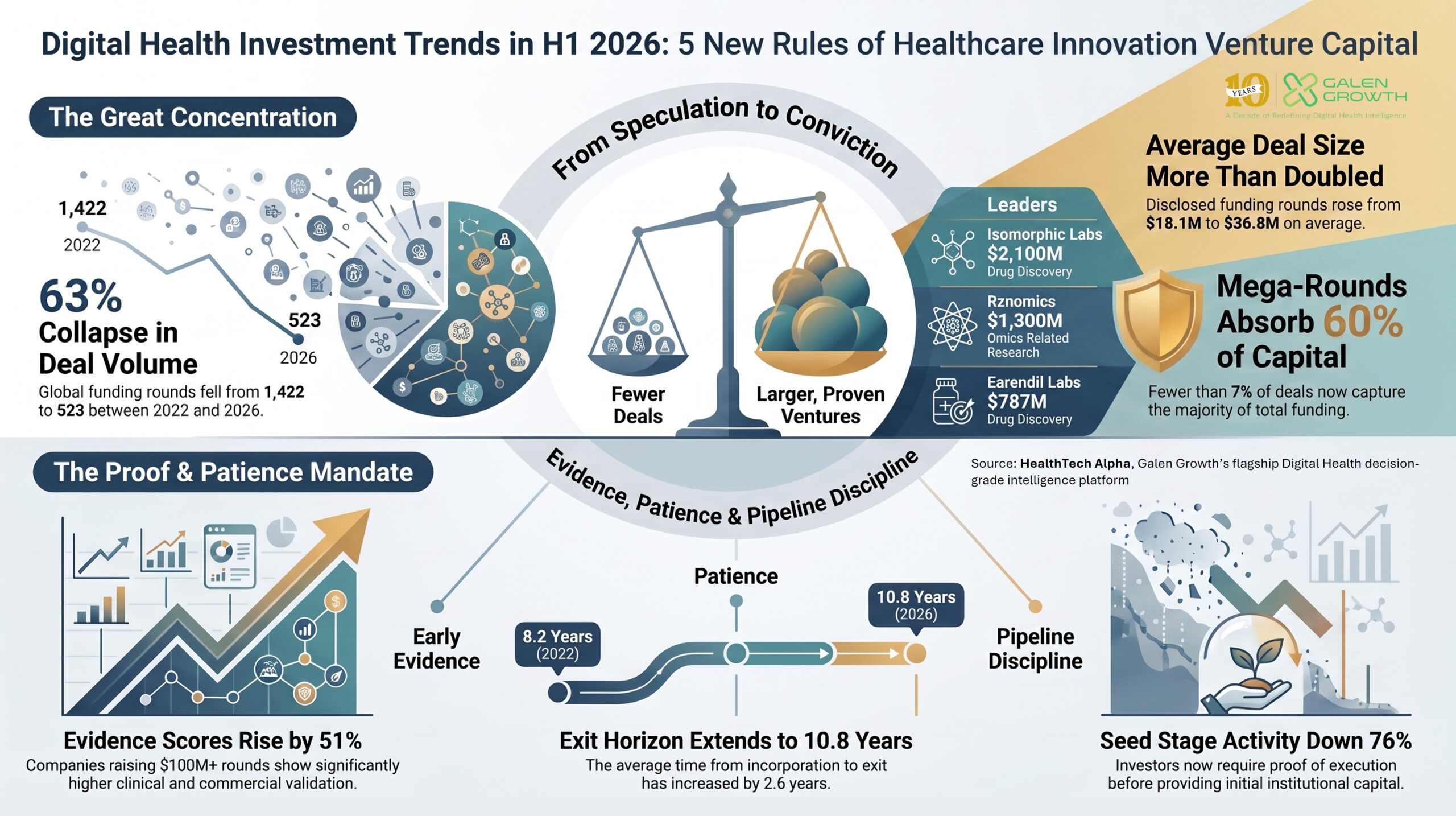
- Digital health funding rounds fell 63%, from 1,422 in H1 2022 to 523 in H1 2026, while total capital recovered to $16.6 billion — capital is concentrating, not disappearing.
- The average disclosed funding round more than doubled, from $18.1 million in H1 2022 to $36.8 million in H1 2026.
- Rounds of $100 million or more absorbed 59.9% of all H1 2026 capital, up from 39.1% in H1 2022, despite accounting for fewer than 7% of transactions.
- Companies raising $100 million+ rounds recorded an average Evidence Score 51% higher, and Money Score 93% higher, than ventures raising smaller rounds.
- Seed and angel deal volume declined 76% between H1 2022 and H1 2026, a steeper contraction than the broader market.
- Average time from incorporation to exit rose from 8.2 years in H1 2022 to 10.8 years in H1 2026.
The H1 2026 data point to five emerging investment principles that now define how capital is being deployed:
- Rule #1: Back fewer companies—but back them with greater conviction.
- Rule #2: Don’t pay for potential. Pay for proof.
- Rule #3: Raise proof earlier than ever before.
- Rule #4: Invest as if liquidity is a decade away.
- Rule #5: Don’t let today’s discipline become tomorrow’s funding gap.
None of these rules appeared overnight. Together, however, they describe a market that has matured. Investors are placing less value on ambitious narratives and more value on demonstrable execution. Clinical validation, enterprise adoption, regulatory progress and sustainable business models have become the primary drivers of investment decisions, while capital is increasingly reserved for companies capable of reducing uncertainty rather than simply promising future growth.
For founders, this changes what it takes to raise institutional capital. For venture investors, it changes how portfolios should be constructed. For pharmaceutical companies and strategic investors, it changes where—and when—the most attractive partnership and acquisition opportunities are likely to emerge.
This is the fifth instalment in Galen Growth’s H1 2026 Key Trends series. Drawing on HealthTech Alpha data covering global digital health financing between January 2022 and June 2026, it argues that the market is no longer experiencing a temporary correction. It is operating under a new investment framework—one that rewards conviction over diversification, proof over promise and patience over speed.
Rule #1: Back Fewer Companies—But Back Them with Greater Conviction
The defining characteristic of digital health investment in H1 2026 is not that less money is being invested. Investors have become dramatically more selective about where that money goes.
During the funding boom of 2021 and early 2022, portfolio construction often prioritised breadth. Capital was deployed across a wide range of opportunities with the expectation that a handful of exceptional performers would ultimately compensate for the rest. In an environment of abundant liquidity and historically low interest rates, diversification itself became a competitive advantage.
That investment playbook is rapidly disappearing.
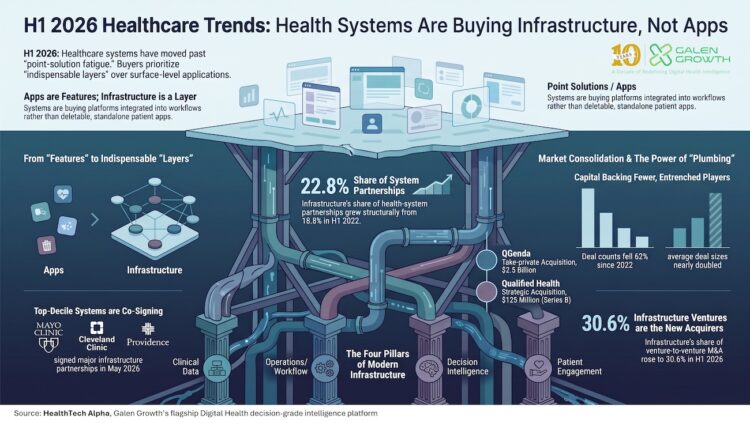
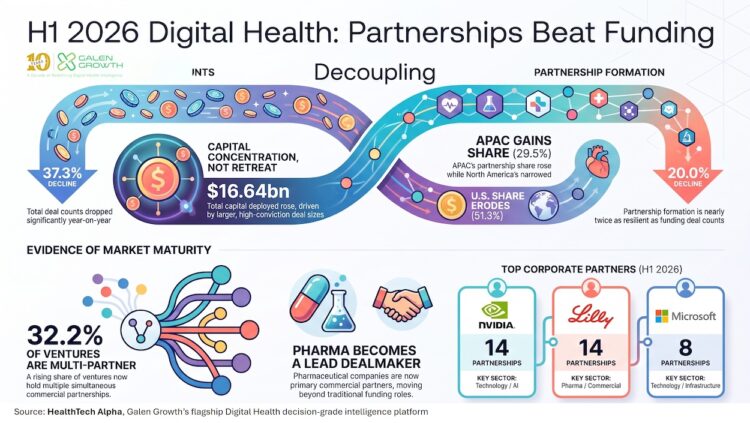
Between H1 2022 and H1 2026, the number of digital health funding rounds fell 63%, from 1,422 to 523. Yet total funding recovered from its 2023 low to reach $16.6 billion, meaning capital is now being deployed across far fewer companies. As a result, the average disclosed funding round has more than doubled, rising from $18.1 million to $36.8 million.
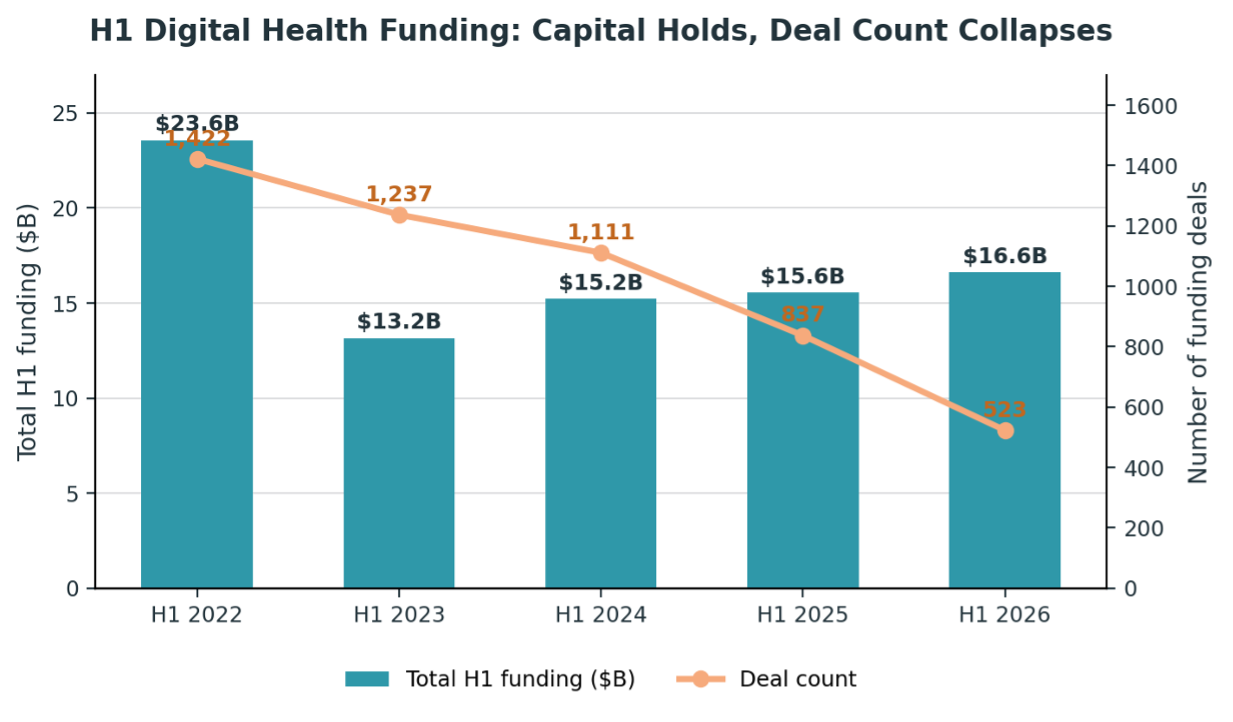
This reflects a fundamental shift in investment strategy. Rather than spreading capital across a broad portfolio of emerging companies, investors are concentrating larger commitments behind businesses that have already demonstrated meaningful progress. Conviction is replacing optionality as the defining characteristic of portfolio construction.
The trend is even more pronounced among the market’s largest financings. Rounds of $100 million or more accounted for 59.9% of all H1 2026 funding, up from 39.1% in H1 2022, despite representing fewer than 7% of total transactions. Capital is becoming increasingly concentrated behind a small group of proven companies.
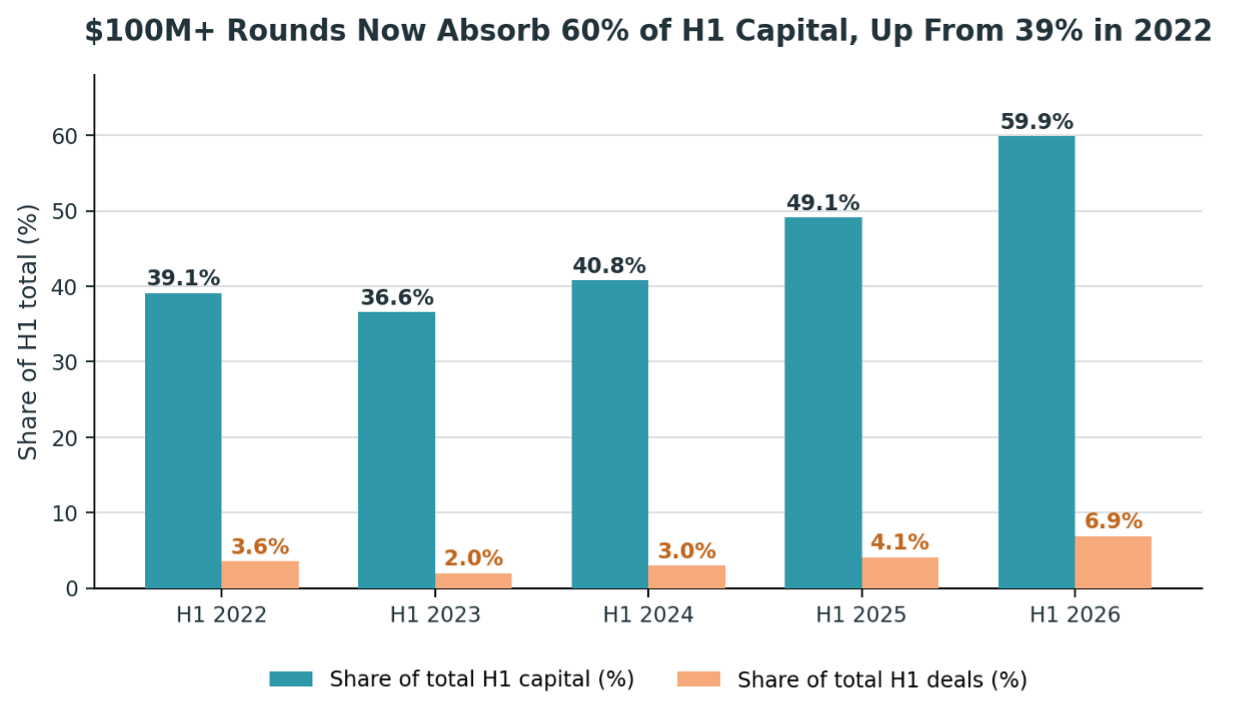
For investors, the implication is clear. Competitive advantage is becoming less about backing the greatest number of companies and more about identifying the few capable of delivering sustained outperformance—and continuing to support them as they scale.
INVESTMENT PRINCIPLE
The competitive advantage in today’s digital health market comes less from backing more companies and more from identifying the few companies worthy of sustained conviction. Capital has become more concentrated because investor confidence has become more selective.
Rule #2: Don’t Pay for Potential. Pay for Proof.
If Rule #1 explains where capital is flowing, Rule #2 explains why.
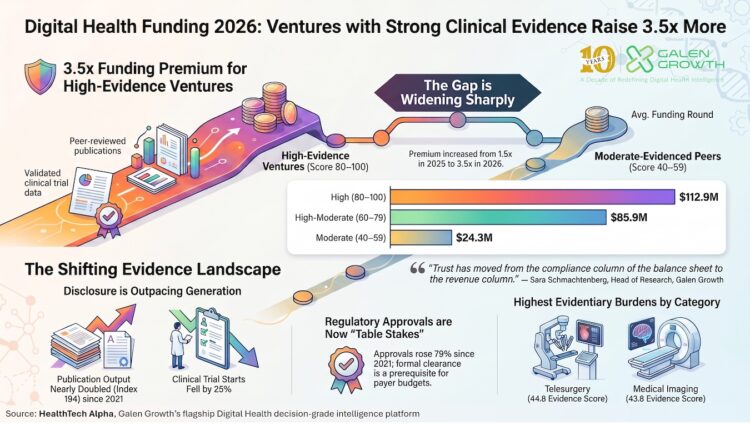
Healthcare has always rewarded evidence, but H1 2026 suggests investors have fundamentally raised the bar. Clinical validation, commercial traction and regulatory progress are no longer milestones that justify a higher valuation later—they are increasingly prerequisites for attracting institutional capital in the first place.
The data reinforce this shift. Companies raising $100 million or more in H1 2026 recorded an average Evidence Score that was 51% higher than ventures raising smaller rounds. Their Money Score, reflecting commercial strength and financial performance, was 93% higher, and their Maturity and Market scores showed the same pattern.
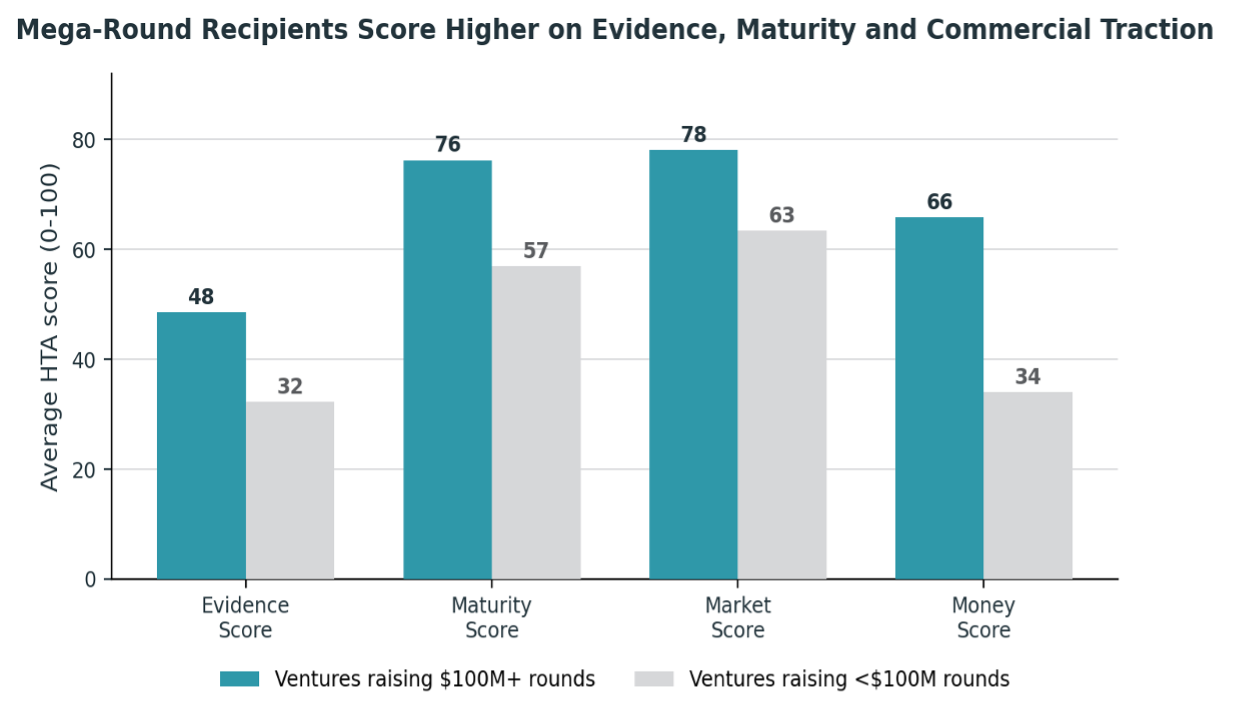
The implication is clear: investors are no longer paying a premium for compelling narratives alone. They are paying for businesses that have already reduced uncertainty through clinical validation, enterprise adoption, regulatory progress or repeatable commercial execution.
The largest funding rounds of H1 2026 illustrate this well. Although they span diverse sectors—from AI-enabled drug discovery to health insurance and clinical infrastructure—they share one defining characteristic: each company entered fundraising with meaningful proof that its model could succeed in real-world healthcare.
Largest Disclosed Digital Health Funding Rounds, H1 2026
| Venture | Stage | Amount (H1 2026) | Category | Country |
| Isomorphic Labs | Series B | $2,100M | Drug Discovery | United Kingdom |
| Rznomics | Strategic | $1,300M | Omics Related Research | South Korea |
| Earendil Labs | Strategic | $787M | Drug Discovery | United States |
| WHOOP | Series G | $575M | Wearables | United States |
| Alan | Series G1 | $455.9M | Health Insurance | France |
| Devoted Health | Series F | $366M | Health Insurance | United States |
| Verily | Series E | $300M | Clinical Data Infrastructure | United States |
| OpenEvidence | Series D | $250M | Health Information Platform | United States |
| Oviva | Series D | $235M | Disease Management | Switzerland |
| Science Corporation | Series C | $230M | Digital Therapeutics | United States |
For founders, this changes the fundraising playbook. Vision remains important, but it is increasingly evidence that unlocks capital. For investors, competitive advantage lies not in backing the boldest story, but in identifying the companies that are systematically removing risk ahead of the market.
INVESTMENT PRINCIPLE
In today’s digital health market, investors are increasingly paying for uncertainty removed—not potential imagined.
Rule #3: Raise Proof Earlier Than Ever Before
If evidence has become the price of admission, it follows that founders must begin generating it much earlier.
The impact is most visible at the earliest stages of the funding ecosystem. Between H1 2022 and H1 2026, seed and angel deal volume declined by 76%, a considerably steeper contraction than the broader market. Early-stage capital has not disappeared, but investors are applying a much higher bar before writing a first institutional cheque.
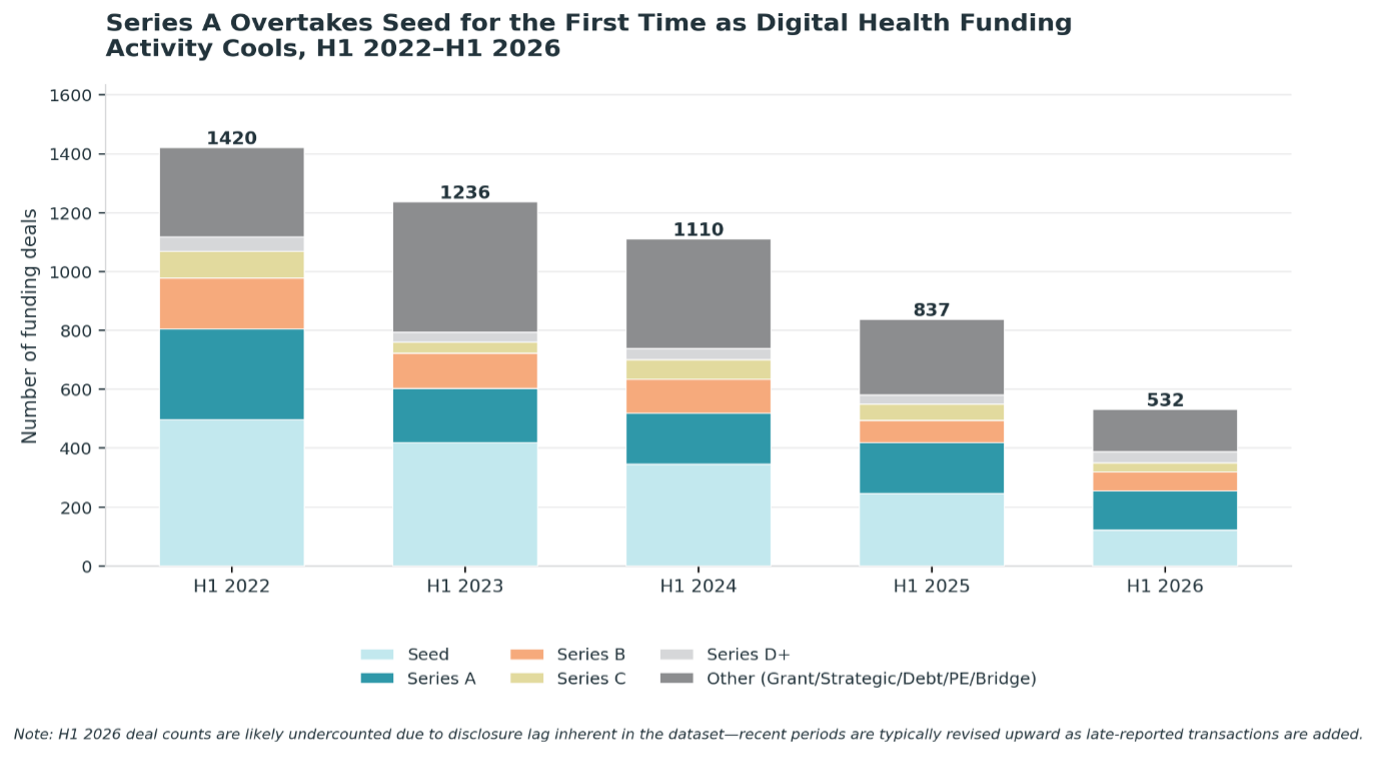
For founders, this changes the sequencing of company building. Regulatory progress, pilot programmes, clinical validation and initial enterprise customers are increasingly becoming prerequisites for fundraising rather than outcomes of it. Investors are asking companies to demonstrate that they can execute before providing the capital to scale that execution.
This undoubtedly raises the challenge of building a company. But it also reflects a healthier long-term market, where institutional capital is increasingly allocated to businesses that have demonstrated both technological promise and commercial credibility.
INVESTMENT PRINCIPLE
Evidence is no longer something founders raise money to create. It is increasingly what allows them to raise money in the first place.
Rule #4: Invest as if Liquidity Is a Decade Away
The previous investment cycle encouraged expectations of relatively rapid exits. H1 2026 suggests those expectations need to be recalibrated.
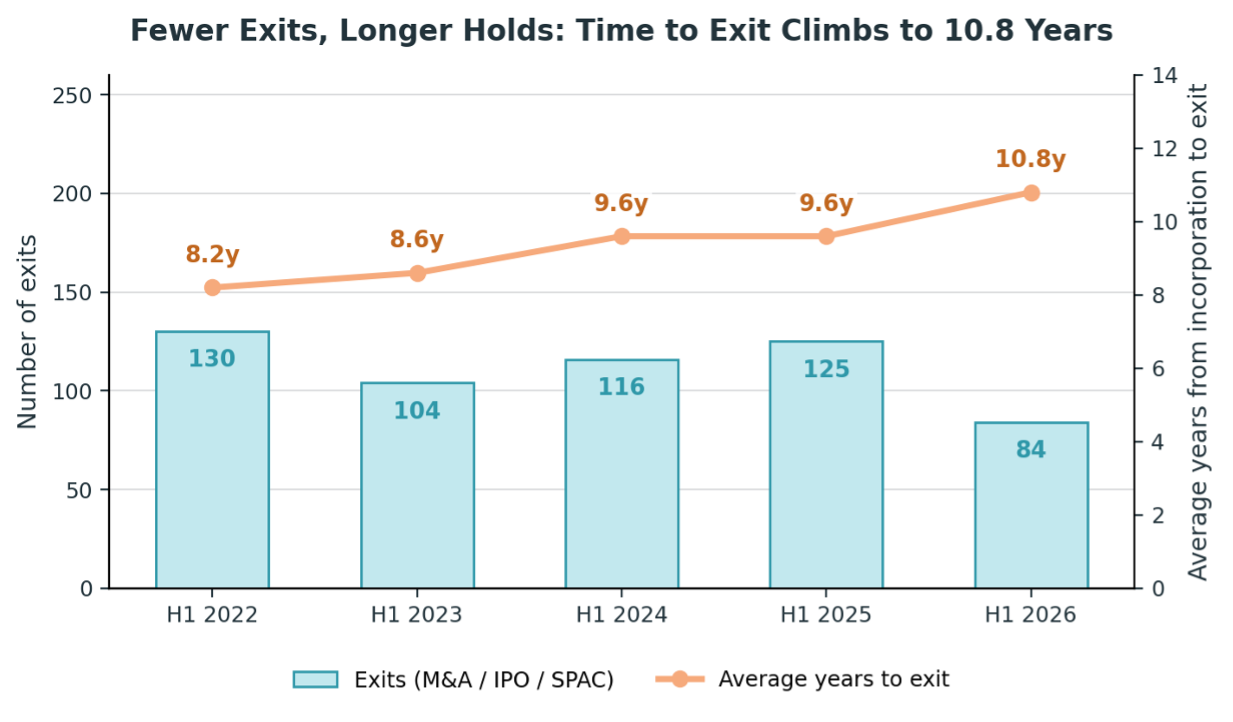
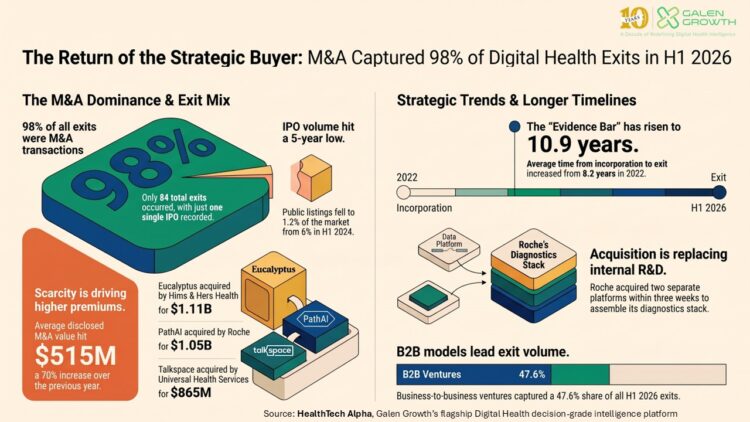
Average time from incorporation to exit has increased from 8.2 years in H1 2022 to 10.8 years in H1 2026. Exit activity has also slowed, while each successive funding stage is taking longer to reach than it did only a few years ago.
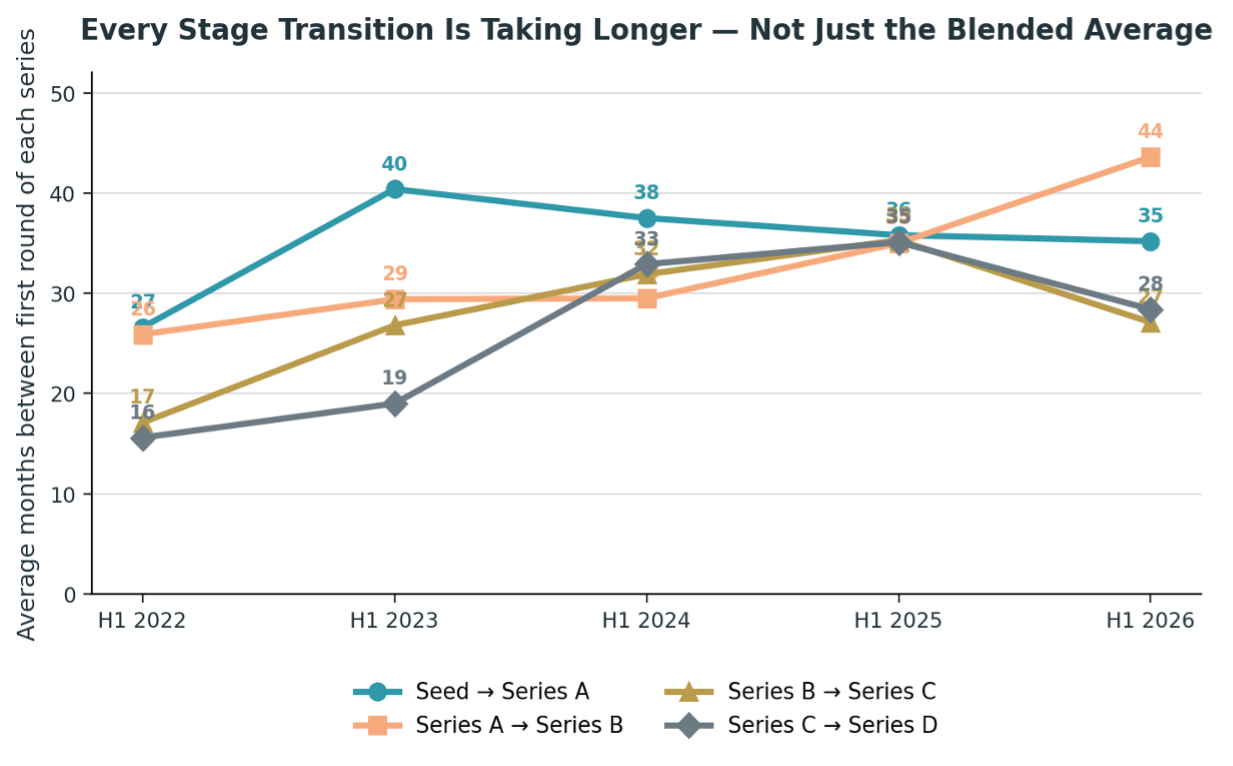
Longer development cycles, more demanding due diligence, and a subdued IPO market all point to the same conclusion: successful investing increasingly requires patience. Fund structures, reserve strategies and LP expectations should reflect longer holding periods and fewer assumptions of near-term liquidity.
Rather than viewing this as a temporary slowdown, investors should consider it part of a broader maturation of the market. Healthcare innovation has always required time to generate clinical, regulatory and commercial proof. Capital markets are increasingly recognising—and pricing—that reality.
INVESTMENT PRINCIPLE
Build portfolios for long-term value creation, not short-term liquidity.
Rule #5: Don’t Let Today’s Discipline Become Tomorrow’s Funding Gap
Every investment strategy creates trade-offs.
The increased discipline evident in H1 2026 is largely positive. Capital is being deployed more selectively, companies are expected to demonstrate stronger commercial and clinical fundamentals, and investors are backing fewer businesses with greater conviction. Compared with the growth-at-all-costs mentality of previous years, the market is healthier and more sustainable.
But discipline also creates a long-term risk.
While investors are concentrating behind proven companies, seed and angel financings have fallen by more than three-quarters since H1 2022. Higher standards may be improving quality, but they are also reducing the number of companies entering the pipeline that will become tomorrow’s growth-stage opportunities.
Digital health innovation takes years to mature. The companies raising late-stage rounds today were founded many years ago, while the category leaders of 2029 and 2030 are being funded now. If early-stage investment remains constrained, growth investors, corporate VCs and pharmaceutical companies may eventually compete for a much smaller pool of mature, investment-ready businesses.
This is not an argument for returning to indiscriminate investing. Instead, it reinforces the importance of identifying exceptional companies earlier while maintaining today’s evidence-driven investment discipline. That balance may become the industry’s next competitive advantage.
INVESTMENT PRINCIPLE
The best investors won’t relax their standards—they’ll become better at identifying future category leaders before the broader market does.
What Is the New Playbook for Digital Health Investors?
Taken together, the five rules outlined in this analysis are not simply a response to tougher market conditions. They point to a structural evolution in the financing of digital health innovation.
Capital remains available, but the threshold for earning it has fundamentally changed. Over the past four years, investors have shifted from funding possibility to funding probability. Evidence has become the new currency of confidence, commercial execution has overtaken narrative as the primary driver of valuation, and capital is increasingly concentrated behind companies that have demonstrated their ability to create lasting value.
The challenge now is to preserve this discipline without starving the next generation of breakthrough companies. Markets that consistently reward evidence produce stronger businesses. Markets that stop funding the creation of evidence risk weakening tomorrow’s innovation pipeline.
The firms that outperform will not simply identify the best companies. They will adapt their investment strategy to the new rules that now govern capital allocation: conviction over diversification, proof over promise, patience over speed, and disciplined risk-taking over indiscriminate growth.
The question is no longer whether the market has changed. It is whether investors are prepared to change with it.
What this means
For investors: Successful investors are likely to back fewer companies, but support them more decisively. They will place greater emphasis on clinical, regulatory and commercial validation when assessing risk, build portfolios expecting longer holding periods and fewer—but larger—follow-on rounds, and treat conviction as a more valuable competitive advantage than diversification alone.
For digital health ventures: Building a great technology is no longer enough. Institutional investors increasingly expect companies to demonstrate measurable progress before capital is deployed, whether through clinical evidence, enterprise adoption, regulatory milestones or sustainable commercial performance. The fundraising journey is becoming less about telling a compelling story and more about proving that the story is already becoming reality.
For pharma and corporate partners: As venture capital concentrates around a smaller pool of validated companies, competition for strategic partnerships, minority investments and acquisition targets is likely to intensify. Waiting for businesses to mature before engaging may increasingly mean competing for a limited number of premium assets at premium valuations.
FAQ
What are the “new rules” of digital health investment in H1 2026?
The H1 2026 data suggest that digital health investors are operating under a fundamentally different investment framework than they were just a few years ago. Capital is increasingly concentrated among fewer companies; valuation is driven by evidence rather than potential; founders are expected to demonstrate commercial and clinical progress earlier; investment horizons are lengthening; and investors must balance greater discipline today with maintaining a healthy pipeline of future innovation.
Has digital health investment declined?
Not in the way many headlines suggest. While digital health deal volume fell by more than 60% between H1 2022 and H1 2026, total funding remained comparatively resilient at approximately $16.6 billion in H1 2026. Rather than leaving the sector, investors are concentrating capital into a smaller number of companies capable of demonstrating stronger evidence and commercial traction.
Why are fewer companies raising venture capital?
Investors have become more selective about the risks they are willing to finance. Today’s funding environment places greater emphasis on clinical validation, regulatory progress, enterprise adoption, and sustainable business models than it did during the post-pandemic funding boom. Companies are increasingly expected to demonstrate meaningful progress before attracting institutional investment, particularly at later funding stages.
What does “proof over potential” mean in practice?
It means investors are increasingly rewarding companies that have reduced uncertainty. Rather than valuing businesses primarily on future market opportunity or technology vision, investors are placing greater weight on demonstrated outcomes, including clinical evidence, customer adoption, regulatory milestones and commercial performance. H1 2026 data show that companies raising the largest funding rounds consistently score higher across multiple indicators of business quality and maturity.
Is early-stage digital health funding disappearing?
No—but it is becoming significantly more competitive. Seed and angel investment activity has declined sharply since H1 2022, indicating that investors are applying a higher bar before making first institutional investments. Early-stage capital remains available, but founders are increasingly expected to demonstrate evidence that would previously have been generated after fundraising.
Why are investors concentrating capital into fewer companies?
Concentrating capital allows investors to increase conviction while reducing portfolio uncertainty. As fundraising conditions have become more selective and exit timelines have lengthened, investors are reserving larger allocations for businesses that have already demonstrated an ability to execute. This results in fewer overall investments but larger funding rounds for companies with validated business models.
How long does it now take a digital health company to reach an exit?
The average time from incorporation to exit increased from 8.2 years in H1 2022 to 10.8 years in H1 2026. Longer development cycles, extended fundraising timelines and a subdued IPO market all contribute to a market in which investors should increasingly plan for longer holding periods and more patient capital deployment.
Does this mean digital health has become a lower-growth investment sector?
No. The data suggest the sector is becoming more disciplined rather than less innovative. Digital health continues to produce significant scientific and technological advances, particularly in areas such as AI, drug discovery, diagnostics and care delivery. What has changed is how investors evaluate risk. Capital is flowing toward companies that can demonstrate measurable progress rather than relying solely on future growth expectations.
What does this mean for founders seeking investment?
Founders should expect investors to scrutinise evidence earlier in the company lifecycle. Clinical validation, regulatory milestones, enterprise customers and repeatable commercial performance are becoming increasingly important fundraising milestones. Companies that reduce execution risk before approaching institutional investors are likely to be better positioned to raise capital in today’s market.
What is the biggest strategic risk for investors over the next few years?
The greatest long-term risk may not be excessive caution—it may be underinvesting in the next generation of category leaders. While today’s evidence-driven investment discipline is strengthening the quality of funded companies, a prolonged contraction in early-stage investment could reduce the pipeline of high-quality growth-stage businesses later this decade. The most successful investors are therefore likely to combine disciplined underwriting with selective early-stage conviction.
Data source and methodology
Data source: HealthTech Alpha by Galen Growth, Q2 2026 (covering global digital health financing between January 2022 and June 2026). Excludes M&A, IPO, SPAC and post-IPO equity transactions; figures are in USD; some figures may be understated due to undisclosed deal terms. This analysis is provided solely for informational purposes and was prepared in good faith on the basis of public information available at the time of publication without independent verification. Numbers will be updated from to time to reflect information identified after the event. Galen Growth does not guarantee or warrant the reliability or completeness of the data nor its usefulness in achieving any particular purposes. Galen Growth shall not be liable for any loss, damage, cost or expense incurred by any reason because of any person’s use or reliance on this report.
Related Galen Growth analysis
- The Maturity Era: Digital Health Funding, H1 2026
- 95% of Digital Health Exits Are Now M&A: 2026 Liquidity Shift
How to cite this analysis
About Galen Growth
Galen Growth is the digital health intelligence firm behind HealthTech Alpha, the leading ontology-driven platform tracking the global digital health ecosystem. With operating entities in the US, Europe and Asia, we combine large-scale labelled data, auditable GenAI research and explainable analytics to advise pharma, medical device, insurance, health system, investor and startup clients.