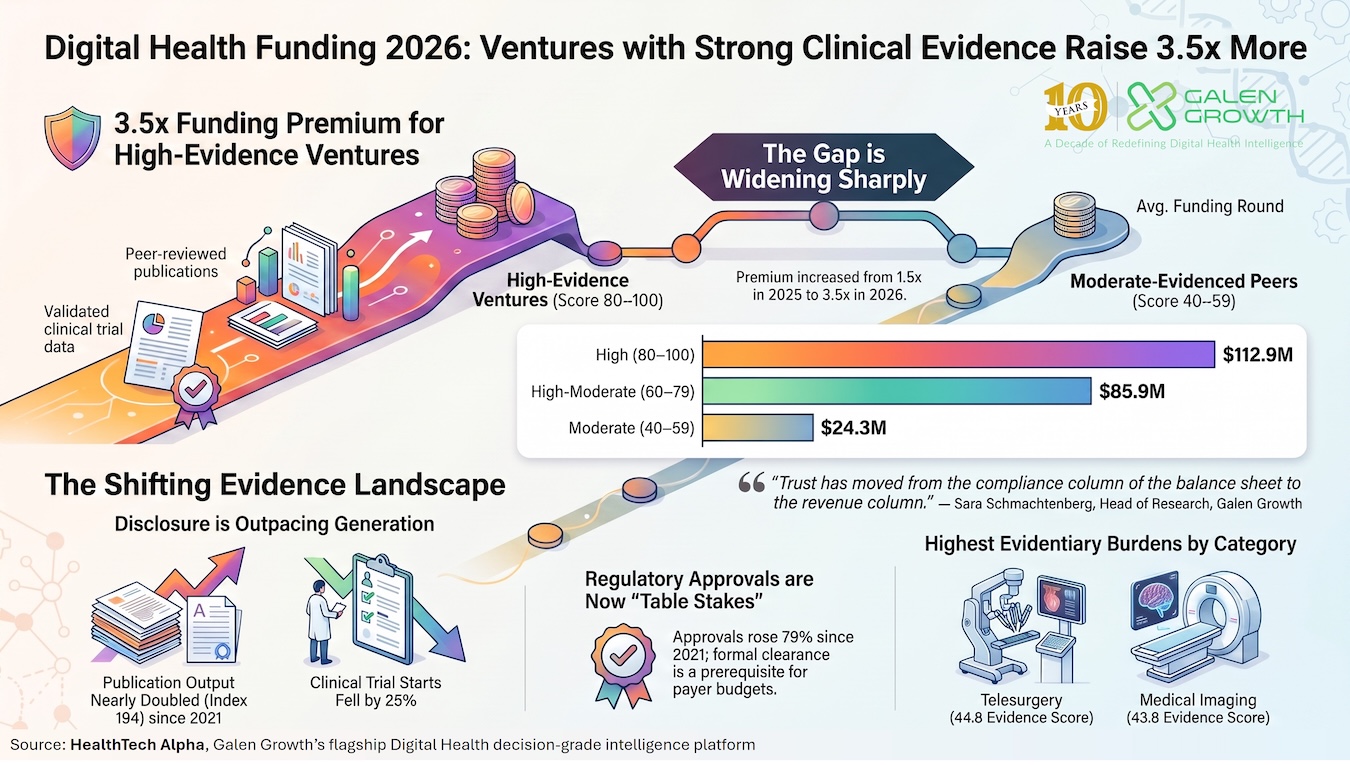
Proof has become the new product: as digital health matures, the market is no longer rewarding the best story — it is rewarding the ones that can prove that their story makes a difference, and ventures with strong clinical evidence are now raising 3.5x more than thinly-evidenced peers.
KEY TAKEAWAYS
- Ventures in the top Evidence Score band (80–100) raised an average of $113M per round in 2026 YTD, versus $24M for moderately-evidenced ventures (40–59) — a premium that has roughly doubled since 2025.
- Peer-reviewed publication output from digital health ventures has nearly doubled since 2021 (index 194 vs. 100), even as new clinical trial starts have fallen by roughly a quarter over the same period — evidence disclosure is outpacing evidence generation.
- Regulatory approval volume hit a record 2,888 in 2025, more than 35% above the 2021 count of 1,611, as devices and software increasingly need documented clearance to compete for enterprise and payer budgets.
- Categories with structurally higher evidentiary burdens — Telesurgery (44.8), Medical Imaging (43.8), and Omics-Related Diagnosis (42.8) — post the highest average Evidence Scores in the market, well above the cross-category norm in the low 30s.
- The gap between well-evidenced and thinly-evidenced ventures is widening, not narrowing — a signal that capital allocators are treating clinical proof as a scarce, price-setting asset rather than a compliance checkbox.
For most of the last decade, digital health capital chased velocity: user growth, download counts, engagement metrics. Evidence — a completed trial, a peer-reviewed outcome, a formal regulatory clearance — was treated as a lagging indicator, something ventures backfilled once they had already won market share. That sequencing is inverting.
The market has started pricing proof, not promise
The data shows a clear and widening funding premium tied to Evidence Score, a composite measure of a venture’s clinical trial activity, regulatory approvals, and peer-reviewed publication record. In 2026 year-to-date, ventures scoring 80–100 on Evidence Score raised an average of $112.9M per round. Ventures in the 60–79 band raised $85.9M. Below that line, the picture changes sharply: the 40–59 band averaged just $24.3M, and the 20–39 band $26.1M. The premium for strong evidence over moderate evidence has gone from roughly 1.5x in 2025 to more than 3.5x in 2026 YTD.
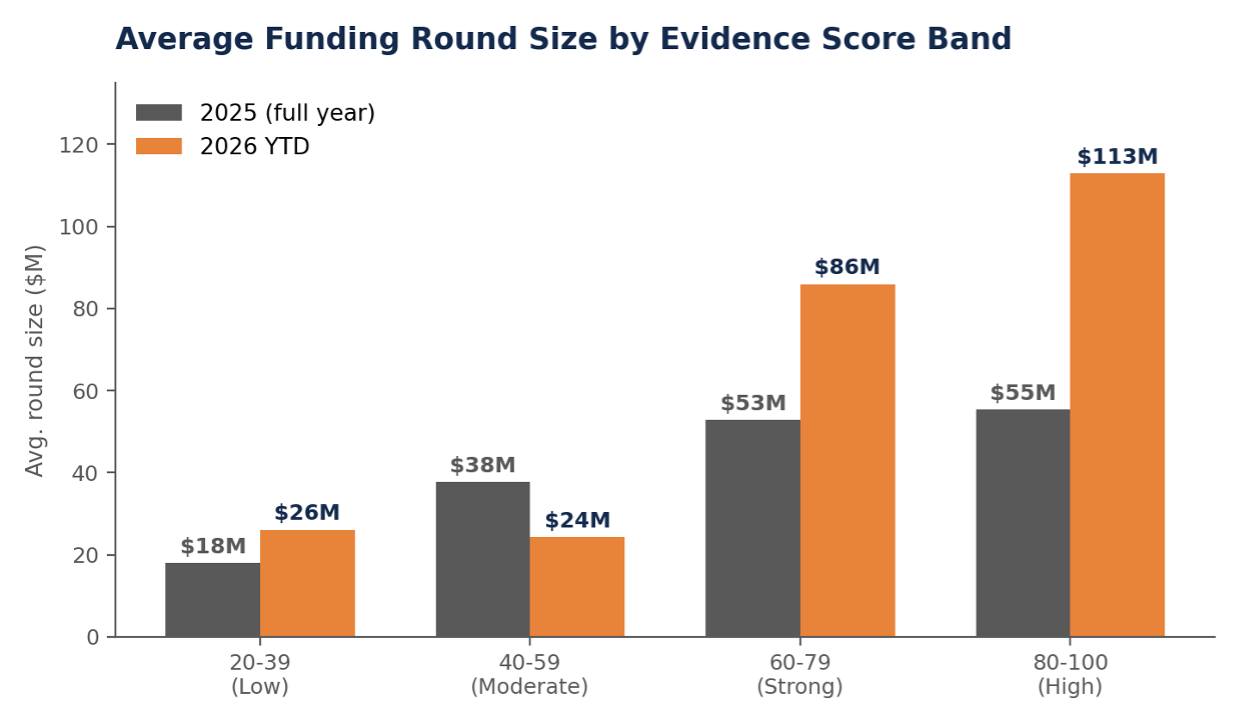
This is not a story about more capital chasing evidence — deal volume in every band except the top two has softened. It is a story about capital concentrating into a smaller number of ventures that can substantiate their claims. In a market where switching costs for buyers are high and procurement cycles are long, an unsubstantiated product claim is no longer just a marketing weakness. It is underwriting risk that investors are now visibly pricing.
Trials are getting harder to start — and easier to justify skipping. That should worry the market
Look past the funding data and a more structural shift appears in the evidence base itself. Since 2021, the number of new clinical trials initiated by digital health ventures has fallen from 720 to 477 in 2025, and is on pace for roughly 530 in 2026 — an index of 74 against a 2021 baseline of 100. Over the same window, peer-reviewed publication output has moved in the opposite direction: from 12,284 papers in 2021 to 22,863 in 2025, and on pace for close to 23,800 in 2026 — an index of 194.
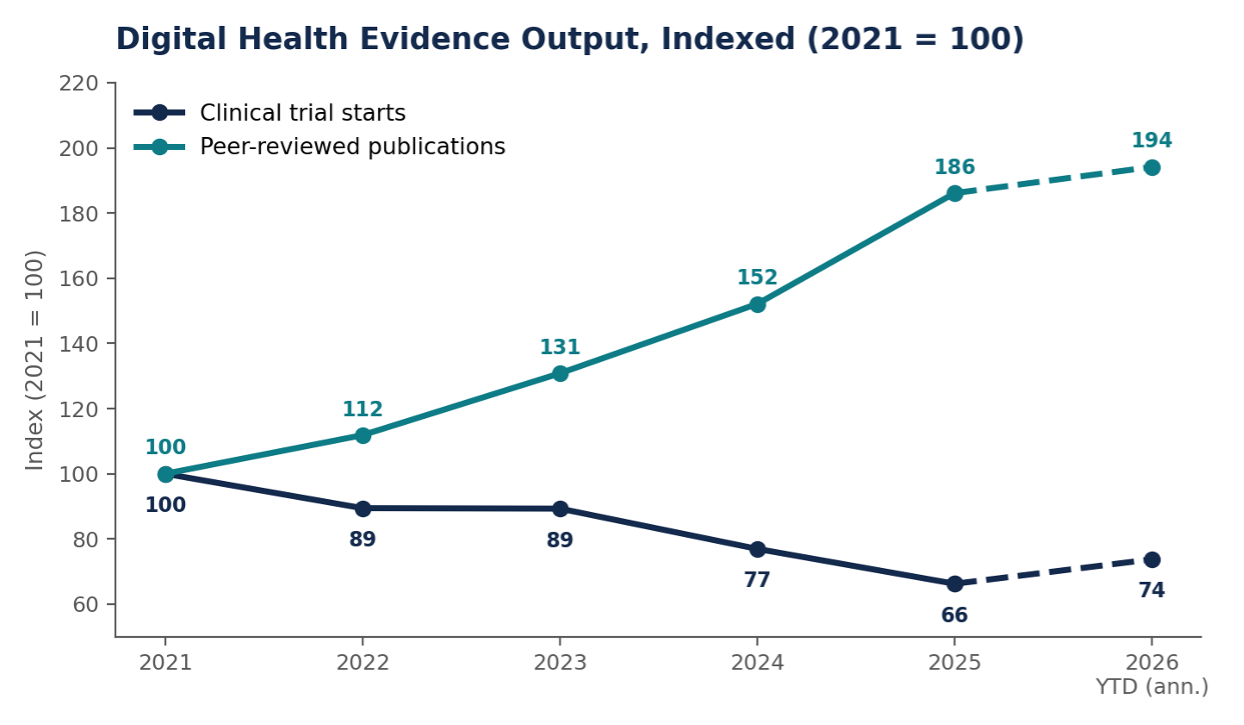
The divergence is worth sitting with. It suggests the industry is not generating dramatically more primary clinical evidence — it is publishing, disclosing, and formalizing the evidence it already has more aggressively than before. That is partly healthy: real-world evidence studies, retrospective analyses, and secondary publications on existing trial data are cheaper and faster than new randomized trials, and they extend the useful life of a single dataset. But it also means the newest cohort of digital health ventures is entering the market with a thinner primary evidence base than their predecessors had at the same stage, even as buyers and investors are demanding more documentation than ever. Ventures that can still originate new trial data — rather than only repackage old data into new publications — are becoming disproportionately valuable precisely because that capability is getting rarer.
Regulatory approval activity tells a compatible story on the compliance side. Approvals issued to digital health ventures rose from 1,611 in 2021 to a record 2,888 in 2025 — a 79% increase — as products that once competed as consumer software increasingly needed formal clearance (FDA 510(k), CE marking via the European medical device databank, or national equivalents) to be procurable by hospitals, health systems and payers at all. Regulatory status has quietly become table stakes rather than differentiation for large swaths of the market — which is precisely why the ventures able to clear a higher evidentiary bar, not just the minimum one, are pulling away on valuation and funding terms.
Not all evidence is created equal — some categories simply have to prove more
Evidence intensity is not evenly distributed across digital health. Categories built around physical intervention, diagnosis, and high-stakes clinical decisions carry structurally higher Evidence Scores than software-first, consumer-adjacent categories. Telesurgery ventures average an Evidence Score of 44.8, Medical Imaging 43.8, and Omics-Related Diagnosis 42.8 — all comfortably above the cross-category average, which sits in the low-to-mid 30s for categories like Drug Discovery (33.4), Bioinformatics (32.7), Remote Diagnostic Devices (32.7) and general Diagnosis Tools (32.1).
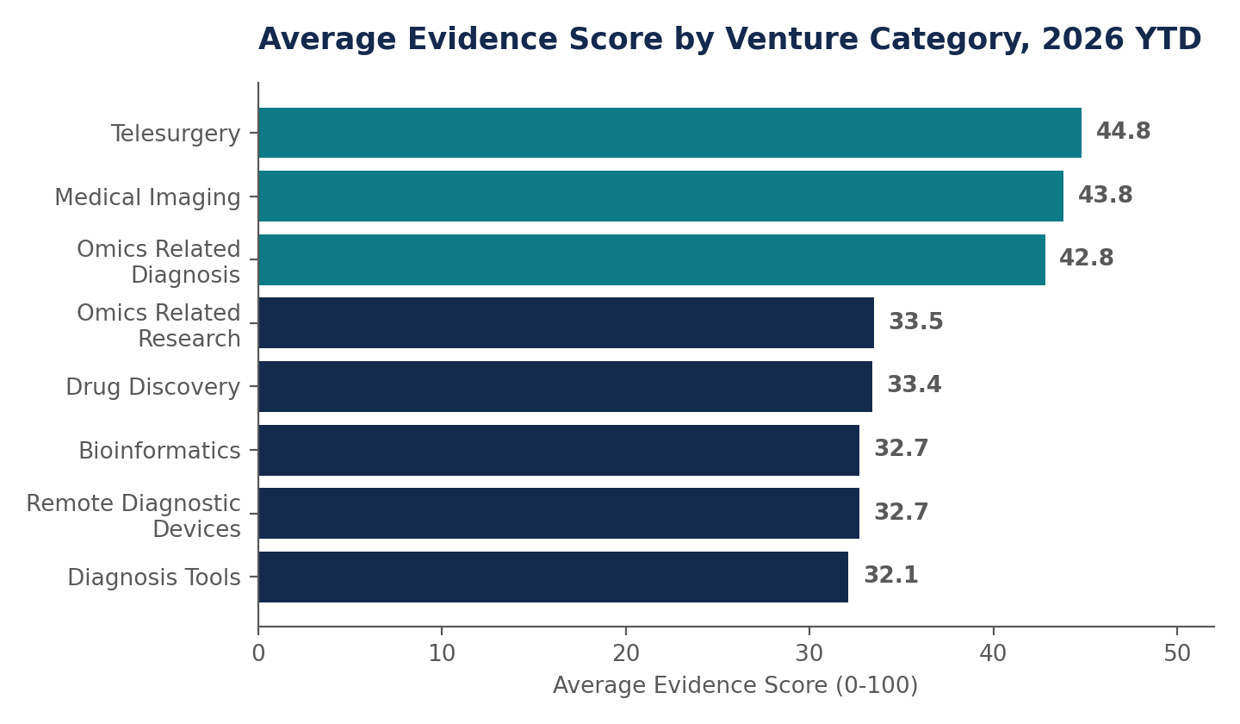
This is not a ranking of which categories are “better” — it reflects where regulators, clinicians and payers have historically demanded the most rigor before allowing a product near a patient or a diagnosis. But it does mean the competitive bar within a category matters more than the bar across categories. A Telesurgery venture with a below-average Evidence Score for its category is at a much sharper disadvantage than a Bioinformatics venture with the same absolute score, because its buyers already expect more.
The leaderboard: what evidence leadership actually looks like among independent ventures
Pulling these threads together into named examples clarifies what “proof as product” looks like in practice — specifically among ventures that remain privately held and independent, rather than public companies with decades of accumulated disclosure behind them. The private, independent ventures with the deepest, broadest evidence bases combine volume across all three pillars — trials, regulatory approvals, and publications — rather than leaning on just one.
| Venture | Category | Country | Evidence Score | Trials | Approvals | Publications |
| Brainomix | Medical Imaging | United Kingdom | 98.1 | 3 | 27 | 381 |
| GAIA | Digital Therapeutics | Germany | 100 | 28 | 274 | 94 |
| Cognito Therapeutics | Digital Therapeutics | United States | 93.0 | 4 | 1 | 368 |
| Iterative Health | Medical Imaging | United States | 93.8 | 1 | 6 | 347 |
| Empatica | Remote Monitoring Devices | United States | 100 | 8 | 24 | 293 |
| AliveCor | Remote Monitoring Devices | United States | 98.1 | 3 | 45 | 273 |
| Anumana | Diagnosis Tools | United States | 96.1 | 3 | 7 | 299 |
What stands out is the diversity of paths to evidence leadership among independent ventures. GAIA has built its position primarily through regulatory breadth — 274 approvals across markets, reflecting a multi-country device/software clearance strategy. Brainomix and Cognito Therapeutics lean instead on publication depth — 381 and 368 papers respectively — the currency clinicians and regulators trust most in categories like consumer wellness scoring, imaging, and neurostimulation. AliveCor and Empatica combine solid trial programs with substantial regulatory records, the classic medtech playbook applied to consumer-facing monitoring devices. There is no single template — but there is a common thread: durable evidence leadership requires depth in at least two of the three pillars, not just one, and none of these ventures is winning on volume alone.
The counter-argument: evidence accumulation is not free, and it is not evenly accessible
None of this means every venture should chase maximum evidence indiscriminately. Building the kind of record shown above takes years and capital that early-stage and resource-constrained ventures — particularly outside the U.S., Western Europe, and a handful of Asian markets with mature clinical trial and regulatory infrastructure — often do not have. There is a real risk that “proof as product” becomes a moat that entrenches well-capitalized incumbents and geographically privileged ventures, rather than a genuinely open competitive signal.
There is also a sequencing problem. Trials and publications take years; funding decisions get made in months. A venture with a genuinely superior product but a two-year-old founding date will structurally lag an inferior product from a venture founded five years earlier, purely on evidence volume. Investors and partners need to distinguish evidence velocity — is this venture generating proof faster than its evidence-stage peers? — from raw evidence stock, or they will systematically overweight incumbency and underweight genuine innovation. And evidence itself can be gamed: a large volume of low-quality, non-peer-reviewed publications or approvals in low-scrutiny jurisdictions should not score the same as a smaller number of high-quality randomized trials and FDA Pre-Market Approvals. Evidence Score attempts to weight for this, but any single composite metric invites some degree of optimization toward the metric rather than the underlying substance.
Why trust has become a line item, not a footnote
The AI layer now being built into digital health products raises the stakes further. An AI-enabled triage tool, diagnostic aid, or clinical decision support system is making judgment calls that used to require a licensed human — which means the evidentiary bar buyers apply to it is closer to the bar for a clinician than the bar for a consumer app. Health systems, payers and regulators evaluating AI-driven products are asking not just “does this work” but “can you prove it works, on evidence I can audit, in a form a regulator will accept” — and increasingly, “can you prove it keeps working as the underlying model changes.”
That shift changes what trust actually buys a venture. Historically, trust functioned mainly as a risk-reduction input to compliance and legal review — a prerequisite to get in the door. Today it is functioning as a demand driver in its own right: health systems are willing to pay more, commit longer procurement cycles, and grant deeper data access to vendors with a documented, auditable evidence trail, specifically because that trail reduces the buyer’s own downstream liability.
The unresolved question: how much proof is enough, and who decides?
The data makes clear that evidence intensity is now a priced input to valuation, funding, and market access in digital health. What it does not yet resolve is where the evidentiary bar should plateau. Regulators, payers, health systems and investors are each independently raising their own thresholds, largely uncoordinated with one another, which risks a compounding evidentiary burden that only the best-capitalized ventures can clear — precisely the ventures that arguably need the discipline least. The ventures, investors and policymakers who work out a shared, proportionate standard for “enough proof” will likely shape who wins the next phase of digital health more than any single product innovation will.
What this means
For investors: Evidence Score and its underlying components (trial activity, regulatory breadth, publication depth) are now materially predictive of round size and should be underwritten as explicitly as growth metrics, not treated as a secondary compliance check during diligence.
For pharma and corporate partners: Partnership and licensing terms should increasingly reflect a venture’s evidence velocity, not just its current evidence stock — a fast-improving, thinly-evidenced venture may be a better bet than a stagnant, heavily-evidenced incumbent.
For health systems and policymakers: The lack of coordination across regulatory, reimbursement and procurement evidentiary standards is a real market inefficiency; harmonizing thresholds would lower costs for credible ventures without lowering the bar for accountability.
For digital health ventures: A single strong pillar — trials, approvals, or publications — is no longer sufficient to lead a category; the ventures pulling ahead are building evidence across at least two of the three pillars, deliberately and early, rather than backfilling it after commercial traction.
FAQ
What is Evidence Score, and how is it different from a valuation or momentum score?
Evidence Score is a composite measure of a venture’s demonstrated clinical substantiation — its clinical trial activity, regulatory approvals, and peer-reviewed publication record. Unlike momentum or market scores, which capture commercial traction, Evidence Score isolates how well a venture’s claims are independently verified, which is the specific signal this analysis links to funding outcomes.
Is the funding premium for high-evidence ventures new, or has it always existed?
It has existed directionally for years, but it has widened sharply. The gap between top-band (80–100) and moderate-band (40–59) average round sizes went from roughly 1.5x in 2025 to more than 3.5x in 2026 year-to-date, based on the underlying funding records.
Why are clinical trial starts declining while publications are rising?
The data cannot fully explain causality, but the most likely drivers are cost and time: new trials are expensive and slow, while secondary analyses, real-world evidence studies and follow-up publications on existing datasets are faster and cheaper to produce, allowing ventures to extend the commercial and evidentiary life of data they already hold.
Does a high Evidence Score guarantee commercial success?
No. Evidence Score reflects the strength of a venture’s documented proof, not its go-to-market execution, pricing, or product-market fit. It is one input among several — but the data shows it is an increasingly weighted one in funding decisions specifically.
Which digital health categories face the highest evidentiary bar, and why?
Categories with direct clinical or diagnostic risk — Telesurgery, Medical Imaging, and Omics-Related Diagnosis — carry the highest average Evidence Scores, reflecting the greater regulatory and clinical scrutiny historically applied to products that make diagnostic or interventional claims, as opposed to software-adjacent categories like general wellness or care coordination tools.
Data source and methodology
Data source: HealthTech Alpha by Galen Growth, accessed August 2026 (covering venture Evidence Scores, clinical trial records, regulatory approvals, peer-reviewed publications, and funding transactions through 1 August 2026). 2026 trial and publication counts are annualized (multiplied by 12/7) for indexed comparison to prior full years and should be interpreted directionally rather than as final-year totals; funding amounts reflect disclosed round sizes in USD; evidence bands group ventures by their current, not historical, Evidence Score; the evidence leaderboard is restricted to ventures with a “Private / Independent” legal status.
This analysis is provided solely for informational purposes and was prepared in good faith on the basis of public information available at the time of publication without independent verification. Numbers will be updated from to time to reflect information identified after the event. Galen Growth does not guarantee or warrant the reliability or completeness of the data nor its usefulness in achieving any particular purposes. Galen Growth shall not be liable for any loss, damage, cost or expense incurred by any reason because of any person’s use or reliance on this report.
Related Galen Growth analysis
- The Maturity Era: Digital Health Funding, H1 2026 — Galen Growth
- Infrastructure, Not Apps: Digital Health H1 2026 — Galen Growth
- Global Digital Health Funding & Trends 2025 — Galen Growth
How to cite this analysis
About Galen Growth
Galen Growth is the digital health intelligence firm behind HealthTech Alpha, the leading ontology-driven platform tracking the global digital health ecosystem. With operating entities in the US, Europe and Asia, we combine large-scale labelled data, auditable GenAI research and explainable analytics to advise pharma, medical device, insurance, health system, investor and startup clients.