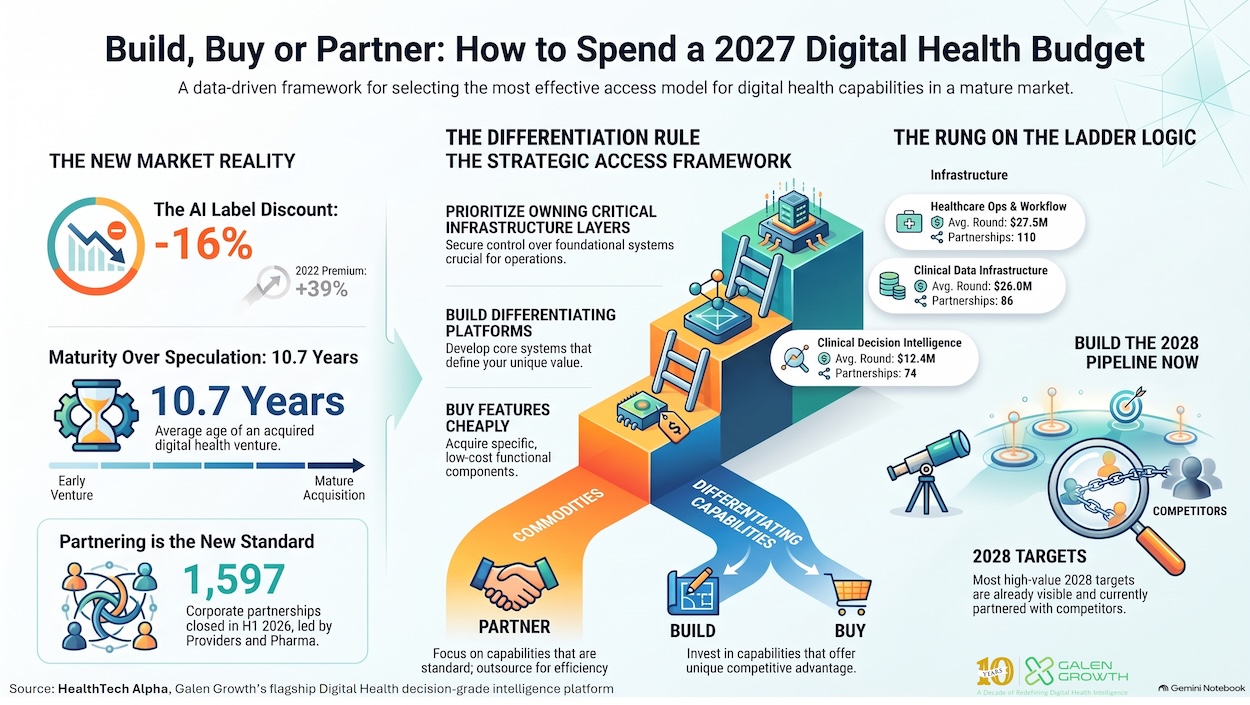
The AI label has gone from a 39% funding premium to a 16% discount, the average acquired venture is now 10.7 years old, and 1,597 corporate partnerships closed in a single half-year. Access model, not category, is the decision that will define your 2027 allocation.
This is the second of three articles published across the Q4 2026 planning window. Part one established the market you are budgeting into and where to play. This instalment covers how to access capability. Part three, intended for 29 September, covers what to stop and how to measure what remains.
KEY TAKEAWAYS
- Stop paying for the AI label. Ventures that market themselves as AI companies took 58.1% of H1 2026 rounds but only 54.0% of capital, and their average disclosed round of $30.9 million now sits below the $36.7 million average for every other venture — against a 39% premium in H1 2022.
- Budget by rung on the ladder, not by technology. Health Management Solutions ventures signed 280 corporate partnerships and were acquired 22 times in H1 2026 on an average round of just $21.5 million — the signature of a category being absorbed into healthcare’s operating fabric rather than sold to it.
- Partnering at volume is now normal corporate behaviour. H1 2026 recorded 1,597 disclosed venture–corporate partnerships, with healthcare providers (270), pharmaceutical companies (166) and technology corporates (143) the largest counterparty types. Nvidia and Eli Lilly and Company have each closed 15 disclosed venture partnerships in 2026 to date.
- Acquisition is a market for mature capabilities, not speculative technology. H1 2026 recorded 83 M&A transactions worth a disclosed $5.15 billion against a single IPO, and the average acquired venture had existed for 10.7 years, up from 8.2 years in H1 2022.
- Build the 2028 pipeline in this budget round. Eight of the ten largest acquisitions of 2026 to date involved companies at least seven years old and half involved companies over a decade old. The assets worth buying in two years are already visible and already partnered with someone.
Part one of this series settled where to play. This instalment settles the harder question, which is how to get hold of the capability once you have chosen the category.
Most innovation teams answer it by default rather than by decision. They partner when procurement is easy, build when engineering has spare capacity, and buy when a banker calls. The H1 2026 data supports something more disciplined, and it starts with a finding that is awkward for anyone whose 2027 budget contains a line item labelled simply “AI”.
The analysis in this series is drawn from Galen Growth’s 2027 budget planning guide. The Digital Health Budget Planner brings it together in one place: an interactive tool for working through the four decisions against your own allocation, and the full planning manual behind the three articles.
What should you actually spend the AI budget on?
Read the tag carefully before reading the numbers, because it records positioning rather than engineering. HealthTech Alpha classifies a venture as AI when the venture presents itself that way. By 2026 almost everything in the dataset is running machine learning somewhere in the product, whether or not it says so in the deck. What the comparison below measures is therefore not the value of using AI. It is the value of advertising it.
Ventures carrying the tag took 349 of the 601 rounds closed in H1 2026 — 58.1% of all transactions, up from 45.4% in H1 2022 — but only $9.43 billion, or 54.0% of the capital. Their average disclosed round was $30.9 million, against $36.7 million for everyone else. In H1 2022 the same comparison ran $22.1 million against $15.9 million, a 39% premium for saying it out loud.
Average Disclosed Round Size: Ventures That Market Themselves as AI vs All Others
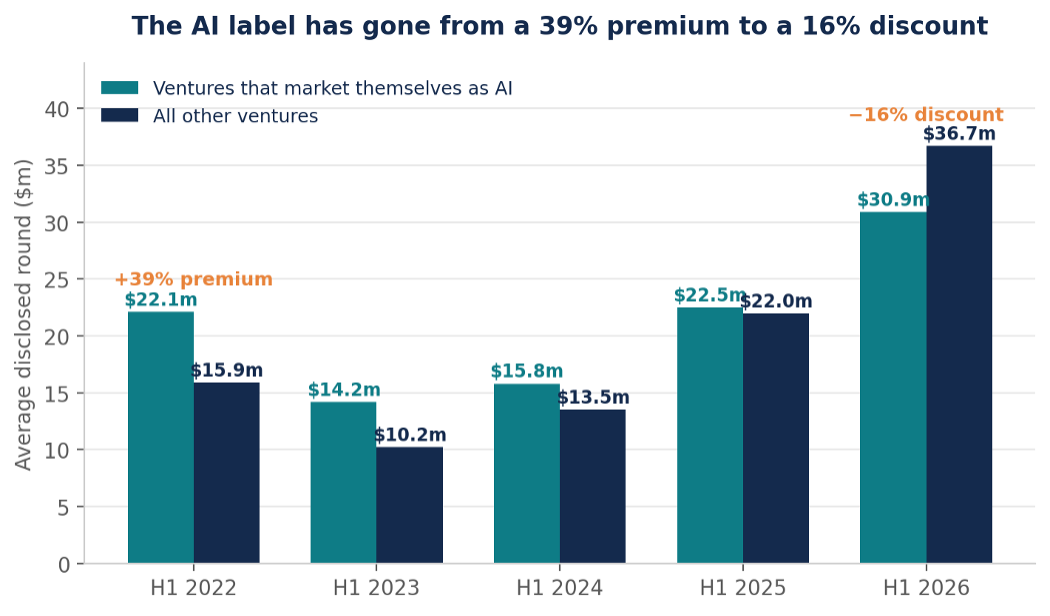
The premium has gone, and the plain reading is uncomfortable for anyone still building a pitch or a budget around the acronym: the claim no longer separates anyone from anyone. Rewarding a marketing department for putting AI on the front page has stopped being a strategy.
The budgeting implication is precise. Because the label carries no premium, you cannot use “it is an AI company” as either a valuation justification or a strategic rationale. What still carries a premium is what the AI is embedded in. The ventures raising the largest rounds of H1 2026 were AI-enabled drug discovery platforms selling into pharmaceutical R&D budgets, clinical data infrastructure selling to health systems, and diagnostic platforms selling into reimbursed pathways — not AI capabilities sold as capabilities.
A workable split for 2027 divides AI spending into three pools rather than one. The first is automation of processes you already run and already measure, where the return is a cost line you can name and implementation risk is low. The second is augmentation and decision support embedded in clinical or operational workflow, where the return is real but the evidence and governance burden is heavy enough to need its own budget. The third is infrastructure — data quality, interoperability, model governance and monitoring — which produces no visible product, is invariably underfunded, and determines whether the first two pools deliver anything at all. If your 2027 AI budget has no third pool, it is a pilot budget wearing a strategy label.
The ladder that should decide your roadmap: feature, product, platform, infrastructure
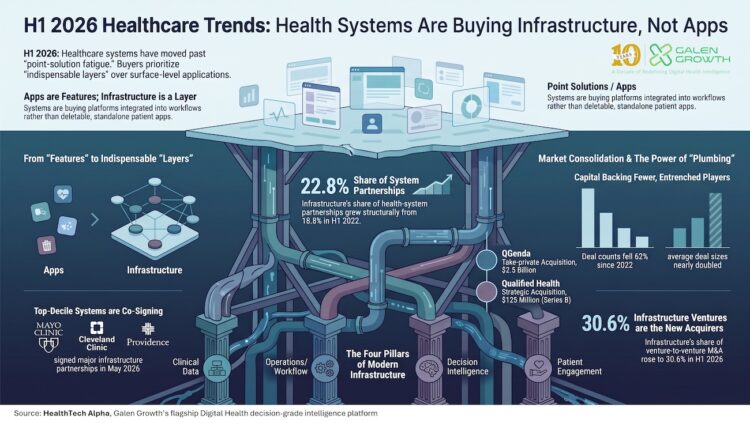
Health systems stopped shopping for features some time ago. What they are buying now is a layer — something that sits underneath documentation, scheduling, claims or care coordination and becomes structurally difficult to remove. That shift has a direct budgeting consequence, because the four rungs of the ladder have completely different economics.
The evidence sits in the partnership and M&A data rather than the funding data. Health Management Solutions ventures signed 280 corporate partnerships in H1 2026, more than any other cluster, and were acquired 22 times — more than a quarter of all digital health M&A in the half — while raising an average round of just $21.5 million. That is the signature of a category being absorbed into the operating fabric of healthcare rather than sold to it.
Within the cluster, the sub-category detail is where a roadmap decision actually gets made. Healthcare Operations and Workflow carries both the deepest partnership activity and the largest capital pool. Clinical Decision Intelligence generates 74 partnerships on an average round of $12.4 million — a category being adopted well ahead of being funded. Patient Engagement, the most feature-like of the four, generates almost no partnership activity at all.
Inside the Infrastructure Cluster: Capital vs Adoption by Category, H1 2026
| Category | H1 2026 funding | Rounds | Average round | Corporate partnerships | Rung on the ladder |
|---|---|---|---|---|---|
| Healthcare Operations & Workflow | $908 million | 36 | $27.5 million | 110 | Infrastructure |
| Clinical Data Infrastructure | $494 million | 24 | $26.0 million | 86 | Infrastructure |
| Clinical Decision Intelligence | $273 million | 24 | $12.4 million | 74 | Platform |
| Patient Engagement | $67 million | 7 | $9.6 million | 10 | Feature |
Contrast that with a category selling a feature. A feature competes on attention and price, renews annually, and is replaced the moment a platform ships an equivalent capability. A platform competes on integration depth and switching cost, and is bought when a larger player needs the position rather than the product. In H1 2026 that difference was worth the gap between a $21.5 million average round and the $650 million paid for Weave in August.
For a 2027 roadmap, the question is not whether your portfolio contains AI, or wearables, or ambient documentation. It is which rung each asset sits on, and whether there is a credible path to the next one. Features should be bought cheaply or partnered for, never built. Platform positions are the only ones worth building internally, and only where the capability is genuinely differentiating. Infrastructure — the layer everyone else’s products depend on — is now the most expensive thing to acquire and the most valuable thing to own.
The decision rule: differentiation first, assets second
Start with differentiation. If the capability is not strategically differentiating for your organisation, partner for it. Nothing in the 2026 data suggests you will win by building a commodity capability internally, and the partnership market is deep enough to make partnering the default rather than the exception.
H1 2026 recorded 1,597 disclosed venture–corporate partnerships. Healthcare providers were the largest counterparty type at 270, followed by pharmaceutical companies at 166 and technology corporates at 143 — a buyer base that is clinical and life-sciences led rather than technology led, which is not what a decade of digital health commentary would have predicted.
H1 2026 Venture–Corporate Partnerships by Counterparty Type
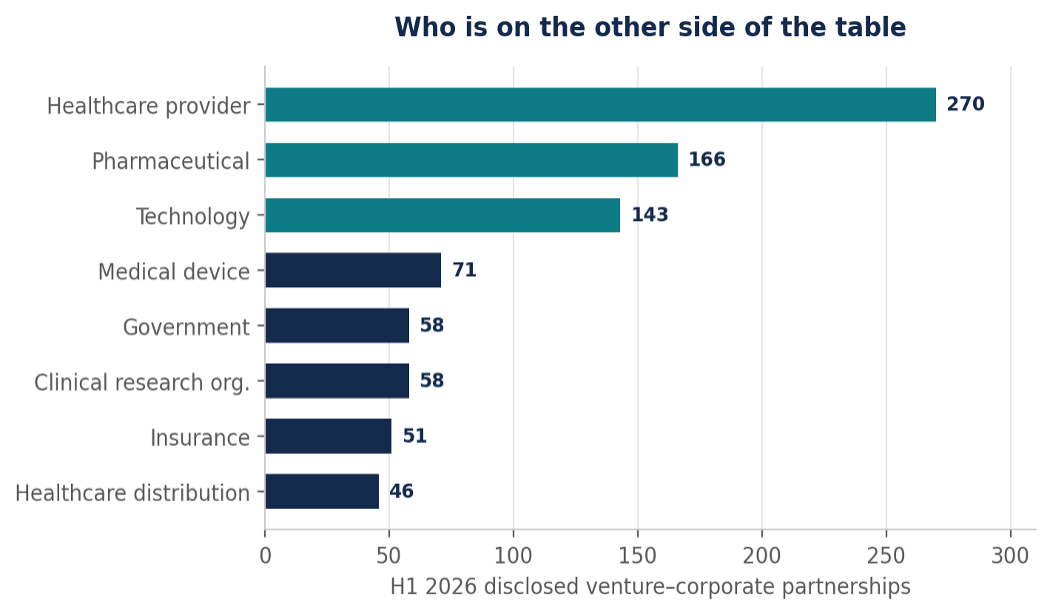
The named-entity data confirms that partnering at volume is normal corporate behaviour rather than an experiment. Nvidia and Eli Lilly and Company have each closed 15 disclosed venture partnerships in 2026 to date, ahead of Microsoft at eight and Novo Nordisk and Daiichi Sankyo at seven each. The presence of four pharmaceutical companies in the top eight makes the point that partnership is now pharma’s preferred mechanism for commercial-stage engagement, not a research side project.
Most Active Corporate Partners, 2026 Year to Date
| Corporate partner | Sector | Disclosed venture partnerships |
|---|---|---|
| Nvidia | Technology | 15 |
| Eli Lilly and Company | Pharmaceutical | 15 |
| Microsoft | Technology | 8 |
| Novo Nordisk | Pharmaceutical | 7 |
| Daiichi Sankyo | Pharmaceutical | 7 |
| Athenahealth | Technology | 6 |
| Pfizer | Pharmaceutical | 6 |
| Walmart | Retail | 6 |
| AstraZeneca | Pharmaceutical | 5 |
| Mayo Clinic | Healthcare provider | 5 |
If the capability is differentiating, ask whether you already hold the underlying assets — data, distribution, clinical governance, engineering. If you do, build. If you do not, ask whether you could assemble them faster than the market will move. In most categories the honest answer for 2027 is no, which points to acquisition.
Acquisition in this market has a specific shape — and it is not the one most corporate development plans assume
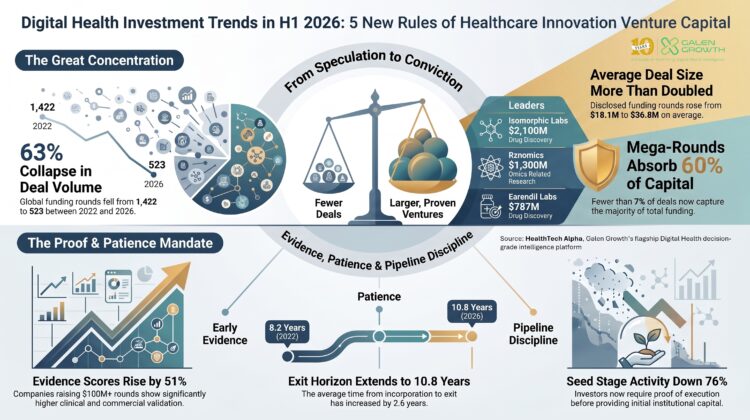
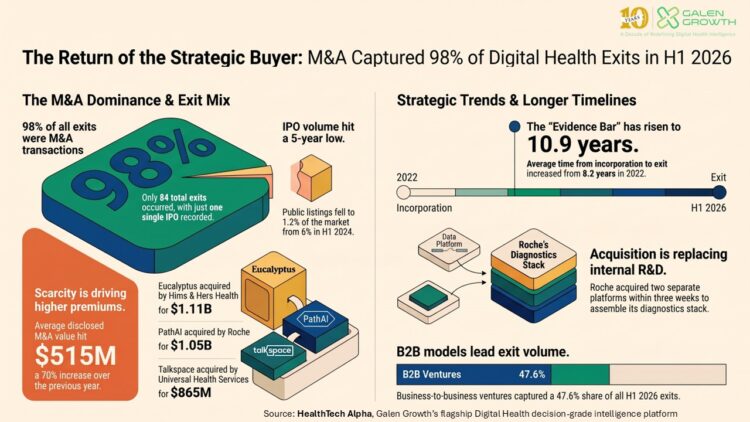
H1 2026 recorded 83 M&A transactions worth a disclosed $5.15 billion against a single IPO: the narrowest exit route mix in the five-year window. Fewer deals, larger cheques, and much older targets. The average venture acquired in H1 2026 had been in existence for 10.7 years, against 8.2 years in H1 2022.
M&A Volume and Average Age at Acquisition, H1 2022–2026
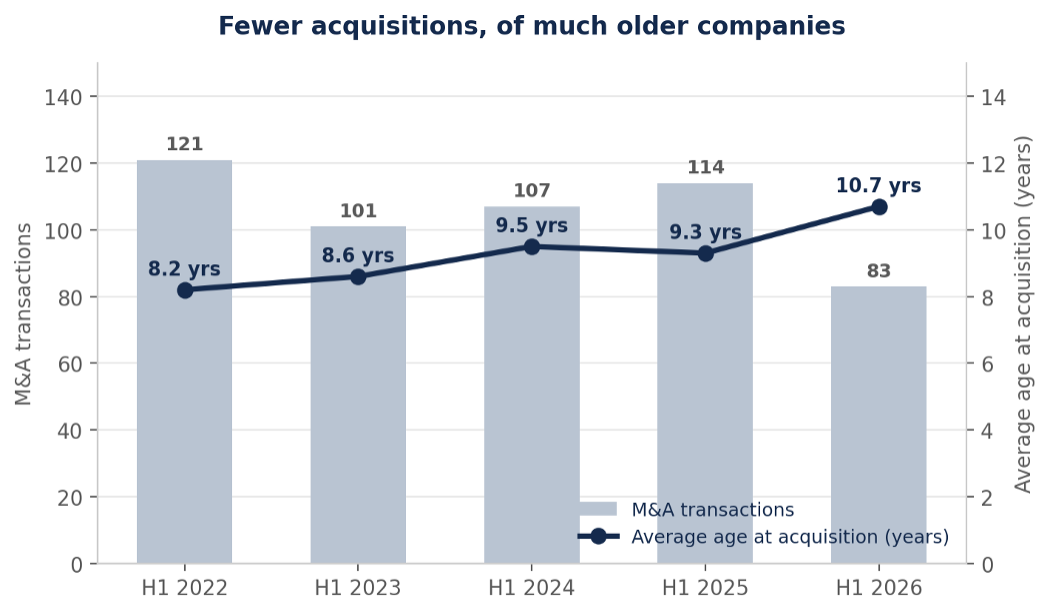
The largest transactions of the year confirm the pattern rather than qualifying it. Eight of the ten largest acquisitions of 2026 to date involved companies at least seven years old, and half involved companies more than a decade old. Weave, acquired for $650 million in August, had been in existence for over eighteen years. Care.com, at $320 million, for more than nineteen.
Largest Disclosed Digital Health Acquisitions, 2026 Year to Date
| Venture | Cluster | Country | Disclosed value | Age at exit |
|---|---|---|---|---|
| Personalis | Medical Diagnostics | United States | $1.50 billion | 15.4 yrs |
| Eucalyptus | Telemedicine | Australia | $1.11 billion | 7.0 yrs |
| PathAI | Medical Diagnostics | United States | $1.05 billion | 10.2 yrs |
| Talkspace | Telemedicine | United States | $865 million | 13.7 yrs |
| Weave | Health Management Solutions | United States | $650 million | 18.4 yrs |
| SAGA Diagnostics | Medical Diagnostics | Sweden | $595 million | 10.2 yrs |
| Noctrix Health | Patient Solutions | United States | $340 million | 7.5 yrs |
| Care.com | Population Health Management | United States | $320 million | 19.3 yrs |
| VitalConnect | Remote Devices | United States | $288 million | 15.6 yrs |
| Kaia Health | Patient Solutions | Germany | $285 million | 9.2 yrs |
Three planning consequences follow. Your acquisition pipeline should be built now for capabilities you will need in 2028 and 2029, because the assets worth buying are already visible and already partnered with someone. Your reserve and capital planning should assume a decade-long path from formation to liquidity for anything you back early. And your competitive scanning should extend beyond your own industry: technology-native and adjacent-sector entrants are buying healthcare capability rather than building it, on cycles measured in weeks.
Where this decision rule breaks down
The rule above is a default, not a law, and it fails in three identifiable situations that are worth naming before a planning committee finds them for you.
The first is when the differentiating capability and the commodity capability are the same system. Ambient documentation is commodity in isolation and differentiating when it is the mechanism by which your clinical data becomes structured. Splitting the two cleanly is often impossible, and partnering for the commodity half can quietly transfer the differentiating half to your partner. The question to ask is not what the capability does but what data it accumulates and who ends up holding it.
The second is acquirer risk. With 83 acquisitions in a single half-year and Health Management Solutions accounting for more than a quarter of them, a partner being bought by a competitor mid-deployment is a foreseeable event rather than a freak one. Evaluating a venture without mapping its likely acquirers is an incomplete diligence process in this market. Ask who buys this company, and what happens to you if they do.
The third is the limit of the partnership data itself. A partnership announcement records that a relationship exists. It does not record its contract value, deployment scope or renewal likelihood, and the 1,597 figure for H1 2026 is preliminary and will revise upward. Partnership volume is evidence of enterprise demand in aggregate; it is not evidence that any individual relationship is deep. That distinction is the subject of part three.
What this means
For investors: The AI tag has stopped functioning as a valuation input, so any thesis that still prices it as one needs revisiting before the 2027 deployment model is set. Underwrite the workflow the technology is embedded in and the buyer budget it reaches, not the technology category. On exits, reset reserve assumptions to a decade-long path to liquidity before the LP conversation rather than after it: 10.7 years is the H1 2026 average, and it has risen in four of the last five periods.
For pharma and corporate partners: Make the build, buy or partner call explicitly for each priority capability during this planning round rather than defaulting to whichever route procurement finds easiest in March. Partnering is now the standard access model for non-differentiating capability and the most active corporates run it at volume — Nvidia and Eli Lilly and Company have each disclosed 15 venture partnerships in 2026 to date. The strategic-buyer map for your priority categories is a Q4 exercise, not a 2027 one.
For health systems and payors: Treat a Health Management Solutions or diagnostics partner as an infrastructure decision from day one. These are the categories with both the deepest partnership activity and the highest acquisition rates, which makes switching costs and ownership changes foreseeable rather than surprising. Spend your increased leverage on integration terms, evidence obligations and data rights rather than on pricing alone.
For digital health ventures: Which rung you occupy now determines your access to both capital and acquirers, and the ladder is visible in the data. Ventures embedded in operations and clinical documentation raised modest rounds and were acquired twenty-two times in a single half-year; feature-level categories generated almost no partnership activity at all. Position for embeddedness rather than user counts, and plan runway against a decade-long path to exit as the base case rather than a pessimistic scenario.
FREQUENTLY ASKED QUESTIONS
Should our 2027 innovation budget have an AI line item?
Not as a standalone category. Ventures that describe themselves as AI companies took 58.1% of H1 2026 rounds but only 54.0% of capital, and their average disclosed round of $30.9 million sits below the $36.7 million average for everything else. The claim no longer carries a premium, largely because almost every venture now uses AI in some form. Budget AI inside the workflows it changes, and fund the data, interoperability and model governance layer explicitly, because it is the layer that determines whether anything else works.
How should we decide between building, buying and partnering a capability?
Partner where the capability is not strategically differentiating. Build only where it is differentiating and you already hold the underlying data, distribution and governance assets. Buy where it is differentiating and you cannot assemble those assets fast enough. The 2026 M&A data supports the last route for mature capabilities in particular: 83 transactions worth a disclosed $5.15 billion, with an average target age of 10.7 years.
How long should we assume it takes a venture to reach an exit?
Plan for a decade. The average time from incorporation to acquisition rose from 8.2 years in H1 2022 to 10.7 years in H1 2026, and eight of the ten largest acquisitions of 2026 to date involved companies at least seven years old. Reserve planning, partnership horizons and acquisition pipelines should all be built on that timeline rather than a seven-year assumption.
Is the IPO route worth planning around at all?
Only for a small number of category leaders with substantial revenue scale. H1 2026 recorded a single IPO against 83 acquisitions, the narrowest exit route mix in the five-year window covered here. For portfolio construction and corporate development purposes, strategic acquisition is the base case and a public listing is the outlier.
Does a high partnership count mean a venture is commercially proven?
Not on its own. A partnership announcement records that a relationship exists; it does not record contract value, deployment scope or renewal. Partnership volume is a strong signal of enterprise demand across a category, and depth — second and third partnerships, renewals, expanded scope — is the signal at the level of an individual venture. H1 2026 counts are also preliminary and will revise upward as later-reported deals are backfilled.
Data source and methodology
Data source: HealthTech Alpha by Galen Growth, accessed September 2026, covering venture financing, venture–corporate partnership activity, M&A and exit transactions, venture profiles and technology tagging across the global digital health ecosystem. Funding analysis covers H1 (1 January–30 June) periods from 2022 to 2026 and excludes M&A, IPO, SPAC, post-IPO equity, pre-IPO, delisted and secondaries transactions unless exit activity is being analysed directly. The acquisition and corporate partner tables cover 1 January–31 August 2026. Figures are in US dollars.
AI classification reflects HealthTech Alpha’s technology tagging of the venture as a whole, not of the individual round, and captures how a venture describes and positions its technology rather than an independent audit of the models in its product. Age at exit is measured from recorded incorporation date to recorded M&A transaction date for ventures with a disclosed incorporation date. Average round sizes are calculated on disclosed amounts only. H1 2026 funding and partnership counts are preliminary and are expected to revise upward as later-reported transactions are disclosed and classified.
Galen Growth is the Healthcare Innovation Intelligence company behind HealthTech Alpha. Built on proprietary data, AI-enabled workflows and expert insights, HealthTech Alpha delivers decision-grade intelligence that helps healthcare leaders identify opportunities, evaluate companies and make better strategic decisions.
Related Galen Growth analysis
- Digital Health Budget Planner — Galen Growth interactive tool and full 2027 planning manual
- The Ten-Week Window: A Q4 Planning Guide for Your 2027 Digital Health Budget (part one of this series)
- The Return of the Strategic Buyer: Digital Health M&A, H1 2026
- Healthcare Is Buying Infrastructure, Not Apps
- H1 2026 Digital Health Trends: Why Partnerships Matter More Than Funding
Disclaimer
This analysis is provided solely for informational purposes and was prepared in good faith on the basis of public information available at the time of publication without independent verification. Numbers will be updated from time to time to reflect information identified after the event. Galen Growth does not guarantee or warrant the reliability or completeness of the data nor its usefulness in achieving any particular purposes. Galen Growth shall not be liable for any loss, damage, cost or expense incurred by any reason because of any person’s use or reliance on this report.