
Key takeaways
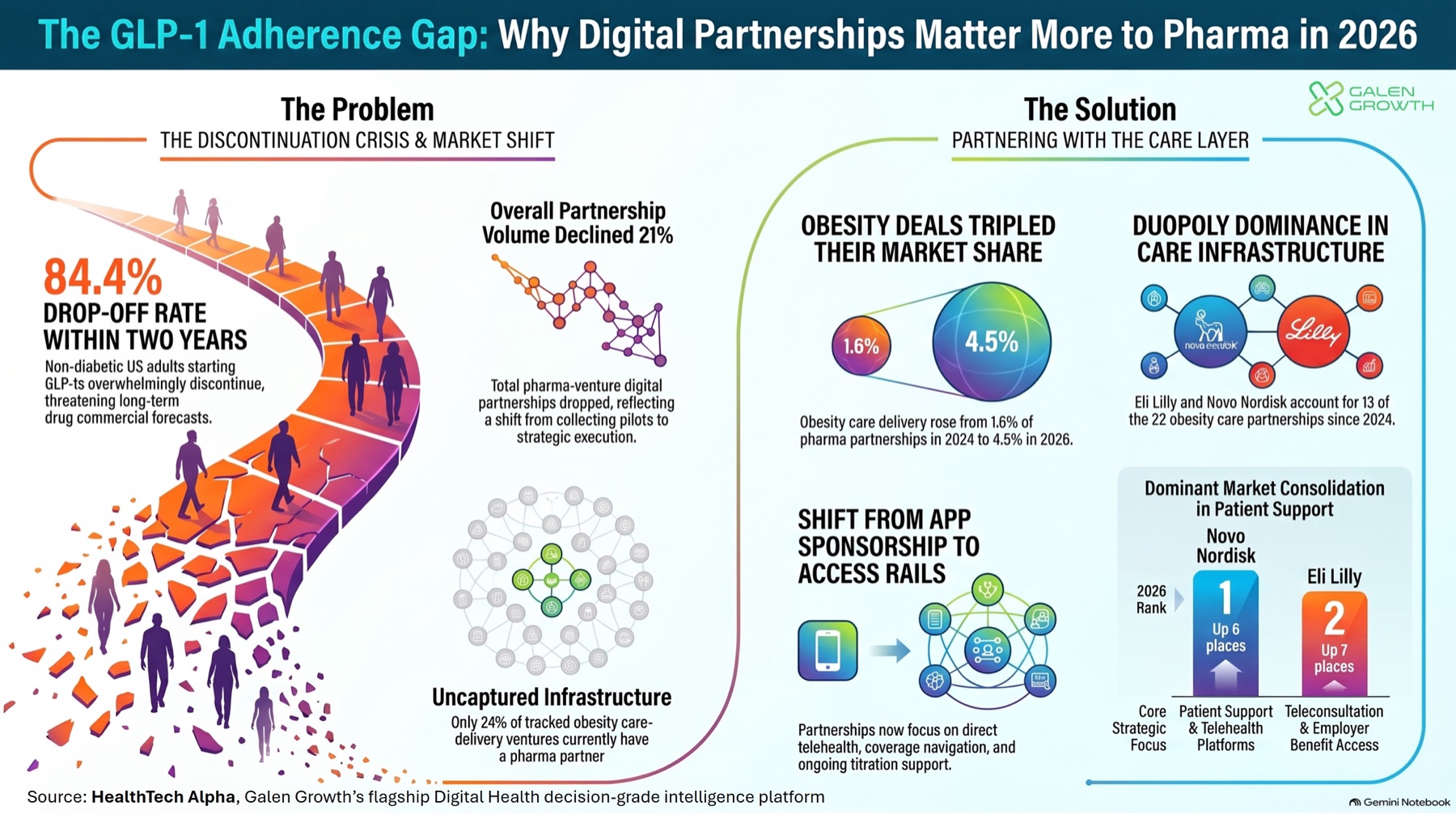
- Partnership volume across the largest pharma portfolios fell from 149 in 2023 to 115 in 2025, according to the 2026 Pharma Innovation Index, and HealthTech Alpha shows the decline continuing: 200 pharma–venture partnerships in January–September 2026, down 21% year on year.
- Over the same nine months, pharma signed nine partnerships with obesity-focused care-delivery ventures, more than in any full year since at least 2019, lifting their share of all pharma partnerships from 1.6% in 2024 to 4.5%.
- Novo Nordisk and Eli Lilly top the 2026 Index’s Patient Support Programme ranking, up from seventh and ninth in 2025, and together account for 13 of the 22 obesity care-delivery partnerships signed since January 2024.
- The driver is adherence: in a US cohort of 125,474 adults, 84.4% of patients without type 2 diabetes had stopped GLP-1 therapy within two years.
- Only 32 of the 134 obesity-focused care-delivery ventures tracked by HealthTech Alpha (24%) have any pharma partner, so most of the infrastructure pharma now depends on still sits outside its partnership networks.
By the most basic measure, pharma’s appetite for digital health is waning. Galen Growth’s 2026 Pharma Innovation Index, the sixth edition, benchmarks 24 pharmaceutical companies and finds partnership volume across the largest portfolios down from 149 in 2023 to 115 in 2025. Only six companies now sit in the Index’s Proactive quadrant, above the median on both strategy and portfolio strength, against eight a year earlier.
The wider market tells the same story. HealthTech Alpha recorded 200 partnerships between pharmaceutical companies and digital health ventures in the first nine months of 2026. That is 21% fewer than in the same period of 2025, and 36% fewer than the 313 signed in January–September 2024, the high point of the cycle. The number of pharma companies signing any venture partnership has also shrunk, from 223 in 2024 to 183 in 2025.
Why is the partnership count the wrong number to watch?
The easy reading is retreat. The Index reads it differently, calling the fall “a filter, not a retreat”: companies are moving from collecting partnerships to converting them. An aggregate deal count flattens very different behaviour into a single line. A company that stops funding a dozen exploratory app pilots and instead signs three contracts it intends to run for years looks, in the count, like a company losing interest. It is doing the opposite.
Obesity is where that distinction is sharpest. GLP-1 medicines are the largest commercial story in the industry, and their commercial performance now depends on something a molecule cannot supply on its own: patients who start therapy and stay on it.
While the total falls, partnerships between pharma and obesity-focused care-delivery ventures (telehealth providers, chronic care and disease management platforms, wellness and employer-benefit services) have moved the other way. Pharma signed nine in January–September 2026, up from seven in the same period of 2025 and five in each of the three years before that. Nine is already more than in any full year since at least 2019.
The absolute numbers are small and should be read as directional. The share is what has moved. Obesity care-delivery deals accounted for roughly 1.6–1.7% of pharma’s venture partnerships in each of 2021 to 2024. So far in 2026 they account for 4.5%, nearly three times the historic level.
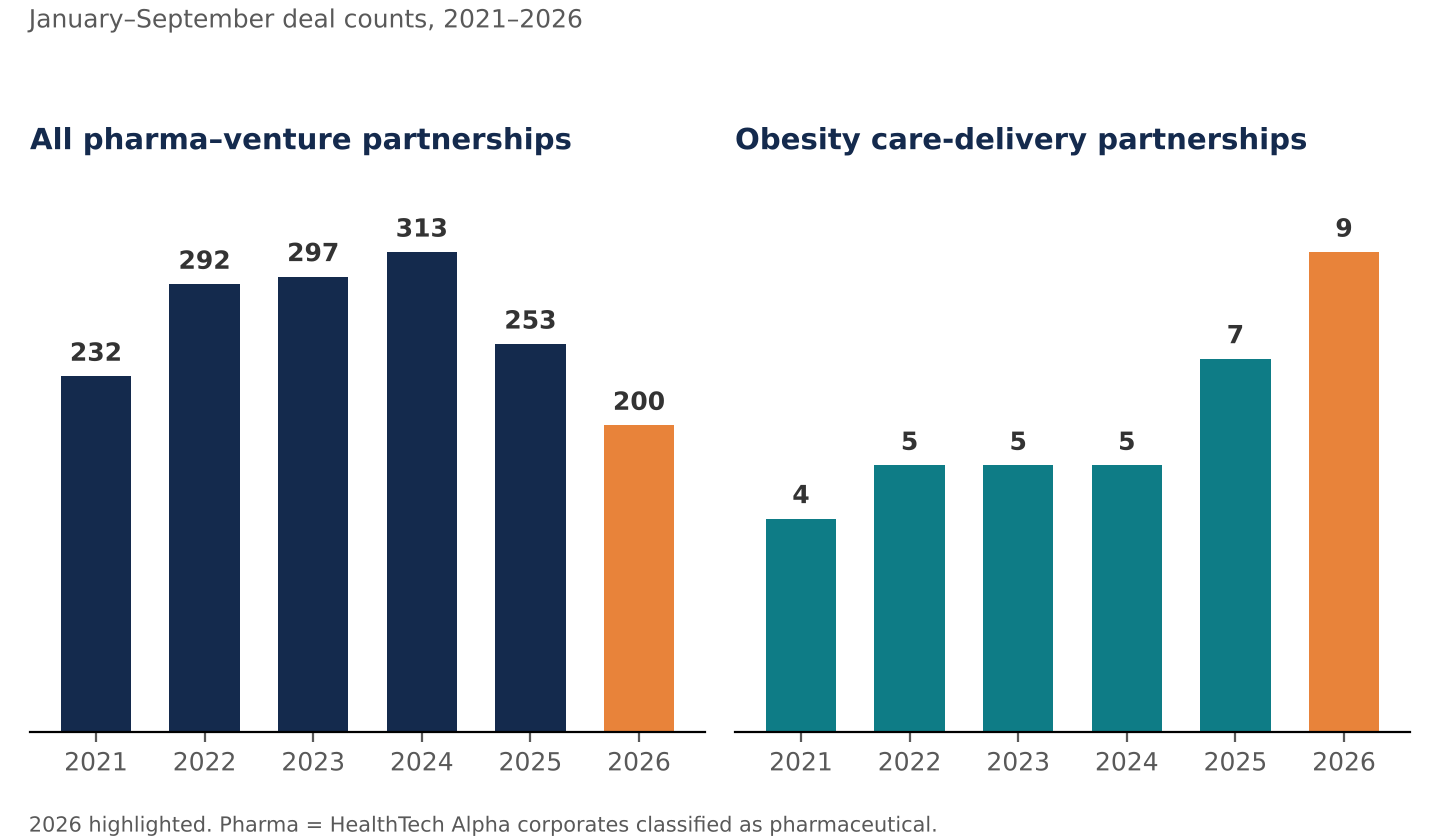
Source: HealthTech Alpha by Galen Growth, October 2026. Total pharma partnering has fallen by more than a third from its 2024 peak, while obesity care-delivery deals reached a record.
The 2026 Pharma Innovation Index points the same way. This year the Index shifted its patient lens from engagement to support, to reflect where pharma is now building capability after the prescription. On that measure, Novo Nordisk climbed six places to first and Eli Lilly seven places to second in the ranking of patient support programme portfolios. Over the past three years Lilly has partnered with 23 patient support ventures and Novo with 15, many of them in obesity and cardiometabolic care, including weight-management and telehealth platforms such as Ro, knownwell and Form Health.
Top Patient Support Programme portfolios, Pharma Innovation Index 2026
| 2026 rank | Company | 2025 rank | Movement |
|---|---|---|---|
| 1 | Novo Nordisk | 7 | ▲ 6 |
| 2 | Eli Lilly | 9 | ▲ 7 |
| 3 | Daiichi Sankyo | 2 | ▼ 1 |
| 4 | Biogen | 10 | ▲ 6 |
| 5 | Eisai | 3 | ▼ 2 |
Source: Pharma Innovation Index 2026, Galen Growth, using HealthTech Alpha partnerships announced 30 September 2023 to 29 September 2026. The two GLP-1 leaders now hold the strongest patient support portfolios in the Index; 2025 ranks refer to the narrower Patient Engagement list.
The adherence problem is the business problem
The reason sits in the persistence data. A JAMA Network Open study of 125,474 US adults with overweight or obesity who started a GLP-1 between 2018 and 2023 found that 84.4% of those without type 2 diabetes had discontinued within two years; among those with diabetes the figure was 64.1%. Gastrointestinal side effects and smaller early weight loss were both associated with stopping. Many patients come back after regaining weight, but only around a third of non-diabetic patients restarted within a year.
of GLP-1 patients without type 2 diabetes had stopped therapy within two years (JAMA Network Open, 125,474 US adults)
For a chronic therapy priced and forecast as long-term treatment, these are not clinical footnotes. They are the revenue model. A patient who stops at month five generates a fraction of the lifetime value assumed in the forecast, and the stop-start cycle that follows (regain, restart, titrate again) is expensive for payers and hard on patients. It also weakens the outcomes case manufacturers need to win broader coverage.
Nothing in the molecule solves this. Managing dose escalation and side effects, nutrition and muscle preservation, coaching, cost and coverage friction: these are care-delivery problems, and they sit with whoever owns the patient relationship between prescriptions. For most of the GLP-1 boom, that was not the manufacturer.
How are Eli Lilly and Novo Nordisk partnering with the obesity care layer?
The partnership data shows who moved first. Since January 2024, Eli Lilly and Novo Nordisk account for 13 of the 22 obesity care-delivery partnerships recorded in HealthTech Alpha. Neither company’s activity resembles the app-sponsorship model of the late 2010s. In the 2026 Index, Lilly has the largest recent portfolio of any company assessed, 57 ventures partnered in the past three years, and is the only company in the top two for both R&D and patient support. Novo Nordisk ranks third on Portfolio Strength, with the highest average venture maturity of any company in the Index.
Lilly’s first moves, with Form Health and 9amHealth in January 2024, coincided with the launch of LillyDirect, which connects patients with independent telehealth services. It added Noom and knownwell in 2025. In March 2026 it launched Lilly Employer Connect, which links employers with independent benefit administrators and a pharmacy network to give US workers access to Zepbound, with the KwikPen priced at $449 per dose at network pharmacies. The launch roster of administrators included 9amHealth, Form Health, Transcarent, eMed and FlyteHealth alongside Teladoc Health and GoodRx. HealthTech Alpha records new Lilly partnerships with Transcarent, FlyteHealth, eMed and Ilant Health that month.
Novo Nordisk has followed a similar path. It partnered with 9amHealth and Form Health in August 2025 and with knownwell in January 2026. In March 2026 it struck a deal with Hims & Hers that ended its lawsuit against the telehealth company and put branded Ozempic and Wegovy on a platform that had marketed compounded semaglutide; Hims & Hers agreed to stop advertising its compounded version. In June 2026 Novo extended the pattern to Asia with Singapore-based Novi Health.
The common thread is that these ventures are access and continuity infrastructure. They are where patients are prescribed, paid for, coached and refilled.
“Pharma is partnering with the rails, not decorating the brand.”
Eli Lilly and Novo Nordisk partnerships with obesity care-delivery ventures, 2024–2026
| Date | Pharma partner | Venture | Venture category |
|---|---|---|---|
| Jan 2024 | Eli Lilly | Form Health | Teleconsultation |
| Jan 2024 | Eli Lilly | 9amHealth | Disease management |
| Mar 2025 | Eli Lilly | Noom | Digital therapeutics |
| Apr 2025 | Eli Lilly | knownwell | Teleconsultation |
| Aug 2025 | Novo Nordisk | 9amHealth | Disease management |
| Aug 2025 | Novo Nordisk | Form Health | Teleconsultation |
| Jan 2026 | Novo Nordisk | knownwell | Teleconsultation |
| Mar 2026 | Eli Lilly | Transcarent | Medical concierge |
| Mar 2026 | Eli Lilly | FlyteHealth | Disease management |
| Mar 2026 | Eli Lilly | Ilant Health | Integrated population health |
| Mar 2026 | Eli Lilly | eMed | Disease management |
| Mar 2026 | Novo Nordisk | Hims & Hers | Teleconsultation |
| Jun 2026 | Novo Nordisk | Novi Health | Wellness app |
Source: HealthTech Alpha by Galen Growth, October 2026. Three ventures (9amHealth, Form Health and knownwell) now partner with both companies, which suggests the access layer is shared rather than locked up.
A shrinking count and a growing commitment are the same story
Read together, the two trends describe a market that is concentrating rather than contracting. What has been cut is exploratory activity: one-off pilots, innovation-challenge winners, brand-sponsored apps with no route to scale. What survives are partnerships tied to a commercial outcome a pharma company can measure: a patient retained on therapy, a covered life added through an employer, a prescription filled through a channel the company can see.
Obesity makes that trade-off unusually explicit because pricing and policy have pushed manufacturers towards direct relationships with patients. Lilly and Novo both run cash-pay channels, and the TrumpRx pricing agreement of November 2025 set a $245 monthly price for their GLP-1s through that route. Once a manufacturer is selling to the patient rather than through a pharmacy benefit manager, keeping that patient on therapy becomes the manufacturer’s problem, and a digital partner is usually how it gets solved.
The 2026 Index’s outlook makes the broader case. Under the heading “build the system around the medicine”, it argues that value is increasingly realised after the prescription. Patient support ventures have raised $5.9bn across 281 companies, and in 2025 their venture funding rounds fell to 29 while their pharma partnerships rose to 55. Pharma partnerships in this layer now outnumber venture funding rounds almost two to one.
Investors are not absent from obesity, though. Rock Health counted $7.4bn of US digital health funding in the first half of 2026, with weight management and obesity the second most-funded clinical area behind mental health. Capital and pharma are converging on the same conclusion: in obesity, the value is in continuity of care.
What could go wrong, and who owns the patient between prescriptions?
There are good reasons for caution. The first is concentration. Of the nine obesity care-delivery partnerships signed in 2026, seven belong to Lilly or Novo. The other two, Daiichi Sankyo and Otsuka with South Korea’s Geninus, sit at the genomics-and-wellness edge rather than in care delivery. Amgen and Boehringer Ingelheim, both with late-stage obesity candidates, do not appear in this layer of the data since 2024. For now this is two companies’ channel strategy, not an industry pattern.
The second is conflict of interest. When a manufacturer contracts the platform that prescribes its drug, questions about steering follow, and commentators have already flagged the risk of manufacturers controlling the prescribing pathway in direct-to-consumer models. Platforms that work with both Lilly and Novo offer some neutrality, but that neutrality is fragile. The 2026 Index warns that when a widely partnered vendor is acquired by one pharma company its neutrality disappears overnight, and three platforms now serve both Lilly and Novo.
The third is evidence. Few of these partnerships publicly commit to persistence or outcome targets. If adherence is the rationale, they will eventually be judged on whether patients stay on therapy longer, and do better, than they would through a standard pharmacy route. That evidence is mostly not yet in the public domain.
Finally, the white space cuts both ways. Only 32 of the 134 obesity-focused care-delivery ventures in HealthTech Alpha (24%) have any pharma partner. That is an opportunity for the companies arriving late to obesity, and a reminder that most of the care infrastructure around these drugs was built without pharma.
The overall decline in pharma–venture partnerships is real, and the 2026 Pharma Innovation Index records it. But a falling count is not falling importance. The Index’s own conclusion is that the era of collecting partnerships has ended and the era of converting them has begun. In the therapy area that now defines the industry’s growth, the partnerships that matter have become fewer, more commercial and more strategic.
The open question is whether pharma treats these care-delivery partners as distribution vendors, to be swapped when terms improve, or as the clinical infrastructure that decides whether its medicines deliver what they promise. The persistence data suggests only one of those positions is sustainable. As oral formulations and next-generation agents widen the market, the companies that own, or reliably partner into, the space between prescriptions will set the terms of the obesity market.
What this means
For pharma and corporate partners: Judge digital partnerships by what they are for, not how many there are. In obesity and other chronic therapies, adherence and access partners belong in the commercial plan rather than the innovation budget, with persistence targets written into the contract.
For investors: Obesity care-delivery ventures with manufacturer contracts have a distribution and revenue model that wellness apps never had. Diligence should test how many manufacturers a venture works with and the quality of its persistence data, because dependence on one company’s channel strategy is a concentration risk.
For payers, employers and policymakers: Manufacturer-linked care platforms can widen access and improve continuity, but they blur the line between care and promotion. Transparent reporting on prescribing patterns and patient outcomes would make these models easier to trust and to reimburse.
For digital health and healthtech ventures: The opening is in owning the stretch of care between prescriptions: titration support, side-effect management, nutrition, coverage navigation. Ventures that can show persistence gains across more than one manufacturer’s products will hold the strongest negotiating position.
Frequently asked questions
Are pharma partnerships with digital health ventures declining?
Yes, in aggregate. HealthTech Alpha recorded 200 pharma–venture partnerships in January–September 2026, 21% fewer than in the same period of 2025 and 36% fewer than in 2024. The decline is concentrated in exploratory activity, while partnerships with obesity care-delivery ventures rose over the same period.
Why does GLP-1 adherence matter so much to pharma?
GLP-1 obesity drugs are priced and forecast as long-term chronic therapies, but most patients stop. A JAMA Network Open study of 125,474 US adults found that 84.4% of patients without type 2 diabetes had discontinued within two years. Every early discontinuation reduces revenue and weakens the outcomes case manufacturers make to payers.
Which pharma companies are partnering with obesity digital health ventures?
Eli Lilly and Novo Nordisk account for 13 of the 22 obesity care-delivery partnerships HealthTech Alpha has recorded since January 2024. Lilly’s partners include Form Health, 9amHealth, Noom, knownwell, Transcarent, FlyteHealth, Ilant Health and eMed; Novo’s include 9amHealth, Form Health, knownwell, Hims & Hers and Novi Health.
What kinds of digital health ventures are pharma companies partnering with in obesity?
Mostly telehealth providers, chronic disease management platforms and employer-benefit services rather than standalone consumer apps. These ventures handle prescribing, coverage navigation, coaching and refills, which are the points where patients are most likely to drop off therapy.
What does the 2026 Pharma Innovation Index say about patient support and obesity?
Galen Growth’s 2026 Pharma Innovation Index ranks Novo Nordisk first and Eli Lilly second for patient support programme portfolios, based on partnerships announced between September 2023 and September 2026. It notes that many of their partners are in obesity and cardiometabolic care, and it frames the overall fall in partnership volume as a filter rather than a retreat.
Data source and methodology
Data source: HealthTech Alpha by Galen Growth, Q3 2026 (covering partnerships dated January 2019 to 30 September 2026). Partnership counts cover digital health ventures and corporates classified as pharmaceutical in HealthTech Alpha; year-on-year comparisons use the same January–September window. “Obesity care-delivery ventures” are ventures with obesity as a therapeutic focus, or tagged for obesity, weight management or GLP-1 support, whose primary cluster is Patient Solutions, Telemedicine, Wellness, Health Services Search, Population Health Management, Online Marketplace or Remote Devices; the venture-universe figures (134 ventures, 32 with a pharma partner) use obesity as a therapeutic focus only. Counts in this segment are small and should be read as directional. Partnerships without a recorded date are excluded. This analysis is provided solely for informational purposes and was prepared in good faith on the basis of public information available at the time of publication without independent verification. Numbers will be updated from time to time to reflect information identified after the event. Galen Growth does not guarantee or warrant the reliability or completeness of the data nor its usefulness in achieving any particular purposes. Galen Growth shall not be liable for any loss, damage, cost or expense incurred by any reason because of any person’s use or reliance on this report.
Company rankings, portfolio sizes and outlook figures are from the Pharma Digital Health Innovation Index 2026 by Galen Growth, which covers 24 pharmaceutical companies and partnerships announced from 30 September 2023 to 29 September 2026. Adherence figures are from Rodriguez et al., JAMA Network Open (2025), as reported by Healio and Truveta. Details of Lilly Employer Connect are from PharmExec (5 March 2026); the Novo Nordisk–Hims & Hers agreement from HLTH (10 March 2026); GLP-1 pricing from HLTH (April 2026); and US funding figures from Rock Health’s H1 2026 report, as reported by MarketScale.
Related Galen Growth analysis
- Pharma Digital Health Innovation Index 2026
- The Medicine Is No Longer Enough — PSPs 2026
- Pharma Digital Health Partnerships: The Asset Investors Miss