
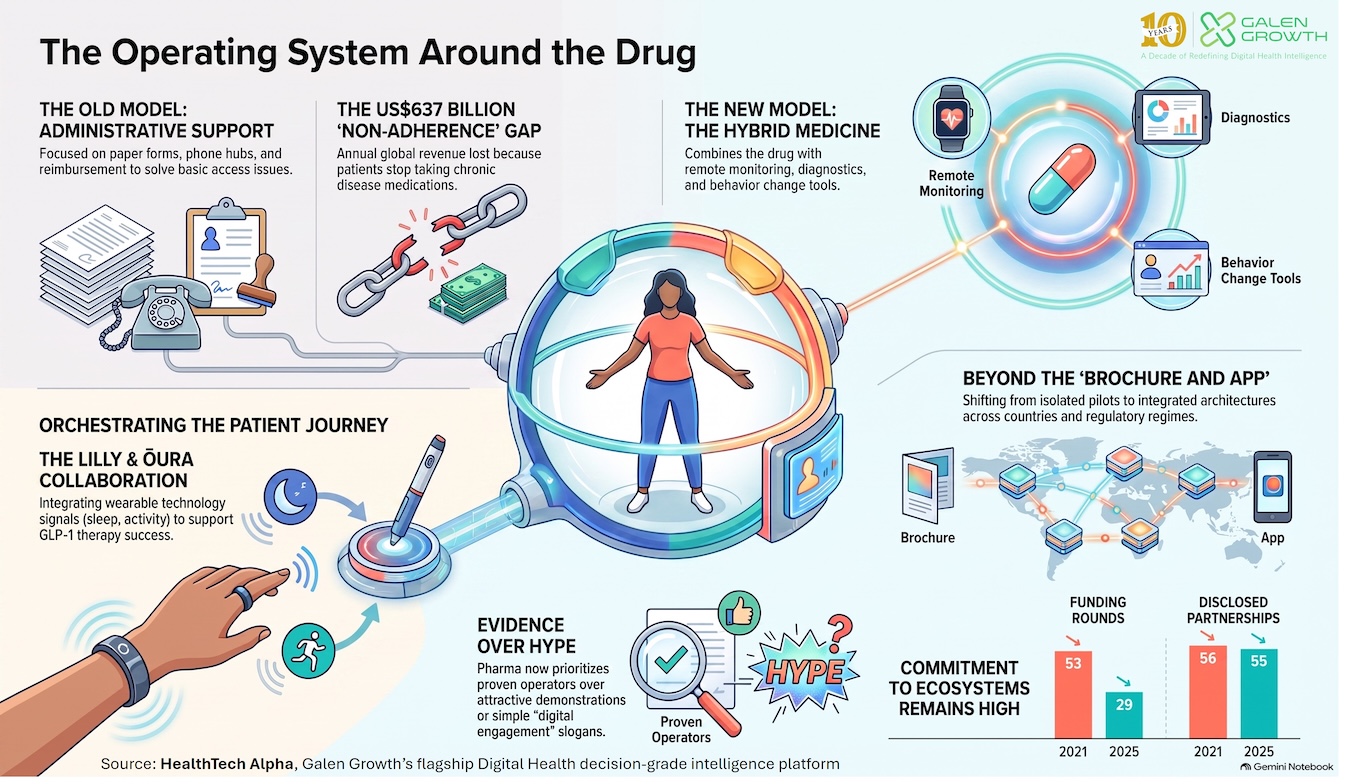
Patient support programmes are evolving from back-office cost centres into the infrastructure that determines whether a treatment works in ordinary life — provided the industry remembers that a patient is not a data-extraction opportunity.
KEY TAKEAWAYS
- Pharma's next competitive battle will not be fought solely through better medicines, but through the ecosystems surrounding them.
- PSPs are evolving from back-office cost centres into connected platforms that shape access, adherence, outcomes and ultimately the value of the therapy itself.
- Investors are becoming more selective, while pharmaceutical companies are becoming more committed: a shift from experimentation to operational deployment.
- The greatest opportunity is to improve patient care. The greatest risk is building highly connected systems that optimise data collection without improving the patient experience.
Patient support programmes were once the unglamorous plumbing of the pharmaceutical industry. They helped patients enrol, navigate reimbursement, obtain copay assistance and, with luck, remember to take their medicine. Necessary, expensive and usually discussed with the enthusiasm reserved for warehouse management.
That is changing.
Digital Health is turning the patient support programme, or PSP, from a collection of services around a prescription into something closer to an operating system around the medicine: identification, onboarding, nursing support, monitoring, persistence, real-world data and an alert when a care team should intervene.
This is not another story about replacing a call centre with an app. The bigger change is that the digital layer is becoming part of how treatment works in everyday life.
The medicine is no longer enough.
Why pharma cares about what happens after the prescription
Pharmaceutical companies are very good at getting medicines approved. What happens after approval is messier.
A doctor may prescribe a product the patient never collects, or stops taking when side effects appear, symptoms ease, the copay becomes painful, or ordinary life gets in the way. A specialty medicine may also require diagnostics, prior authorisation, cold-chain delivery and repeated contact with several parts of the health system. Each handover is another chance to disappear.
The industry calls this non-adherence — a phrase both technically accurate and emotionally sterile. It can describe an elderly person confused by several prescriptions, a cancer patient frightened by adverse effects, or someone choosing between medicine and rent.
A HealthPrize and Capgemini analysis put global pharmaceutical revenue forgone to non-adherence in chronic disease at US$637bn in 2015. Pharma has long known that a medicine cannot create value while sitting unopened in a kitchen cupboard — and newer therapies, expensive and operationally demanding, raise the stakes.
The question is no longer "How do we remind the patient to take the pill?" but "How do we prevent the treatment journey from breaking?" That is a far more serious question, and a much larger market.
The patient support programme is becoming the front door
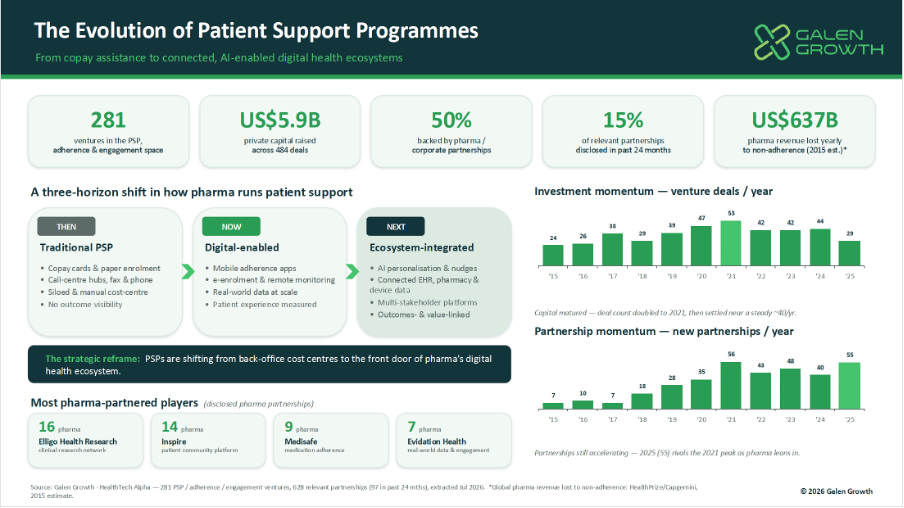
The old PSP was largely administrative: paper forms, telephone hubs, reimbursement support, copay cards and nurse helplines. Data were limited, outcomes hard to see, and the whole arrangement was designed around the pharmaceutical company rather than the patient's daily life.
The first wave of digitisation improved the machinery. Enrolment became electronic. Apps delivered reminders. Dashboards gave programme managers some idea of what happened after the prescription left the pharmacy. Useful, certainly. Transformative, not always.
The next generation connects diagnosis, onboarding, access, education, adherence, monitoring and evidence generation across health records, pharmacy data and connected devices. That is a move from vendor selection to ecosystem strategy: the question is not which Digital Health company to hire, but whether the architecture fits the next generation of medicines.
An app can be procured. An ecosystem must be designed — decided capability by capability, then made to work across countries, brands and regulatory regimes without collapsing into a splendidly expensive collection of pilots.
Pharma is not famous for throwing away a pilot. It's better at adding another one.
The rise of the hybrid medicine
The phrase "beyond the pill" has been around long enough to qualify for a pension, yet it has often meant little more than placing a digital service next to a medicine and hoping the two become acquainted.
A hybrid medicine is more demanding. It combines the pharmacological product with the capabilities that make it work in practice: diagnostic support, education, remote monitoring, behaviour change and real-world evidence. The digital element is not a promotional accessory. It becomes part of the treatment model.
Lilly's investment in ŌURA offers a glimpse. In June 2026, ŌURA and LillyDirect announced a collaboration supporting people on prescribed GLP-1 therapies, framed around access and behavioural support rather than selling a wearable, and stating that no data would be shared. Weeks later, Eli Lilly took an equity stake on undisclosed terms.
The sequence is more revealing than the investment. ŌURA sits in daily life, letting members log medication, dosage and side effects alongside signals on sleep, activity and recovery; more than 100,000 had done so by July 2026. No smart ring has been added to a drug label, and ŌURA says its ring is not intended to diagnose, treat, cure, monitor, or prevent medical conditions. The point is that Lilly is investing in the infrastructure around treatment. The drug addresses the biology; the surrounding system tries to make success more likely in ordinary life.
None of this turns software into medicine by rhetorical decree, but two products with similar clinical profiles may perform differently if one arrives with a well-designed patient ecosystem and the other with a brochure and yet another password-protected app.
Follow the partnerships, not the slogans
Better evidence lies in what companies fund and who they work with.
HealthTech Alpha's July 2026 analysis identified 281 specialist ventures in PSP, adherence and patient engagement. They had raised US$5.9bn across 484 disclosed deals, and the market had recorded 628 relevant partnerships, 97 of them in the previous 24 months.
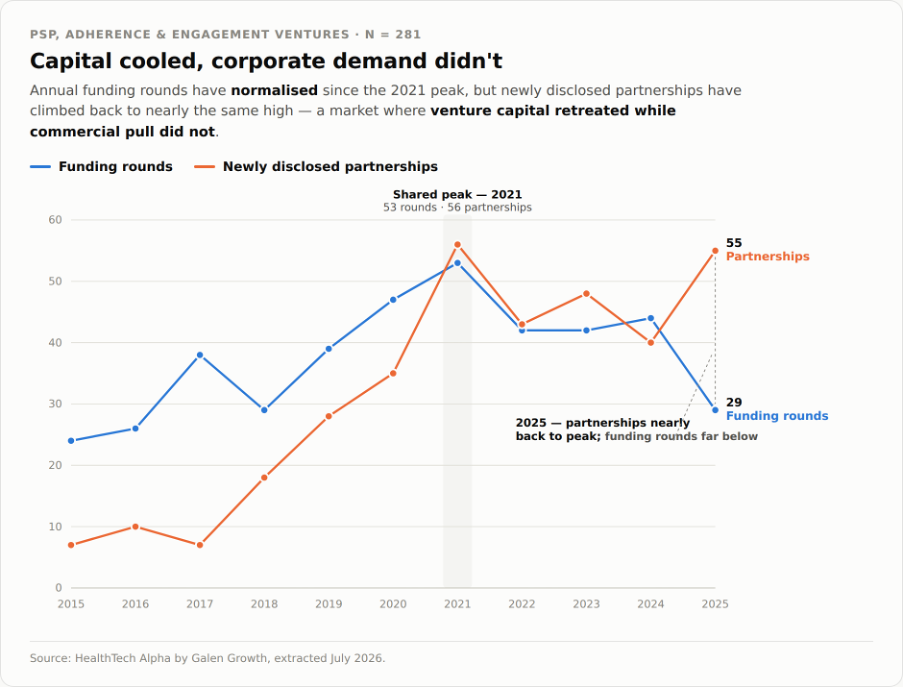
Funding rounds rose from 24 in 2015 to 53 in 2021, then settled: 42 in 2022 and 2023, 44 in 2024, 29 in 2025. Partnerships climbed from seven in 2015 to 56 in 2021 and reached 55 in 2025.
Investors became more selective. Pharma kept partnering.
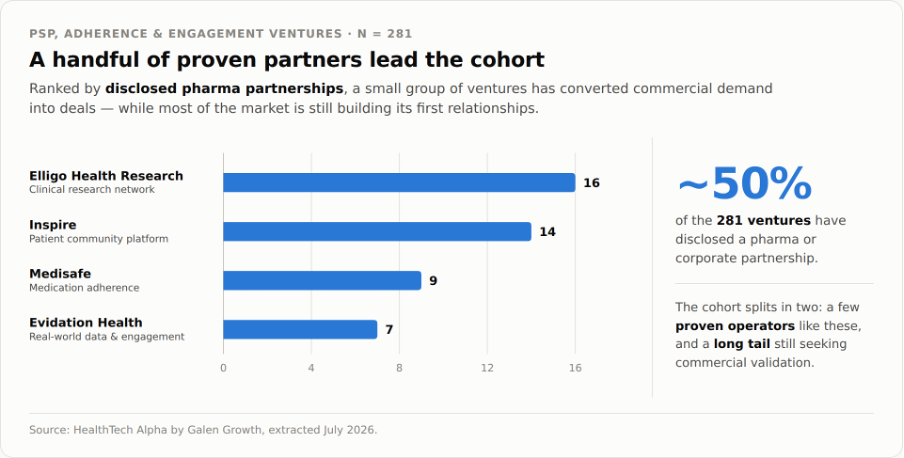
The market no longer rewards an attractive demonstration, but survival through procurement, clinical validation, and international rollout. HealthTech Alpha records 16 disclosed pharma partnerships for Elligo Health Research, 14 for Inspire, 9 for Medisafe and 7 for Evidation Health.
Partnership announcements are not outcome studies, no matter how cheerfully the press release is written. But repeated partnerships signal lasting value.
What pharma is really trying to buy
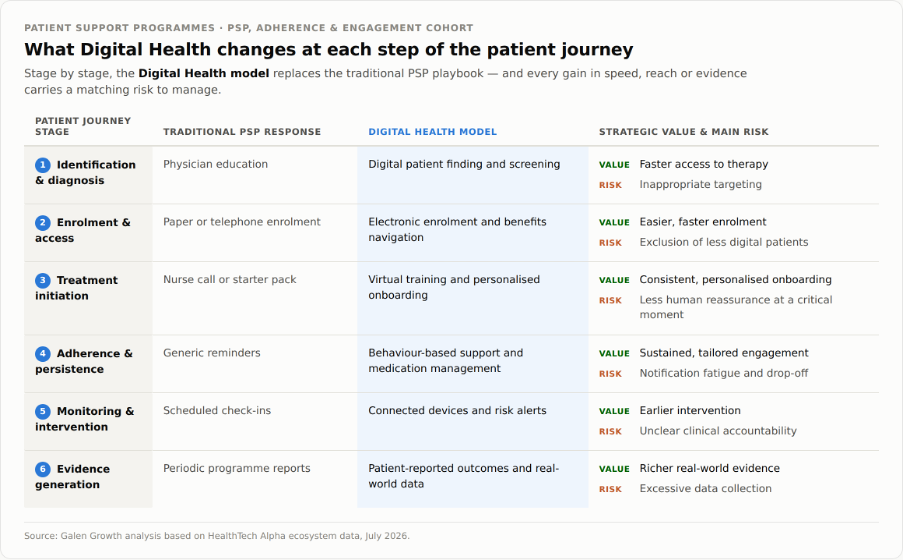
Pharma is not, in any meaningful sense, shopping for apps. It is buying solutions to specific failures: patients diagnosed late or never matched to an eligible therapy; enrolment and reimbursement that remain bewilderingly difficult; the gap between prescription and first dose.
Then persistence. Reminders are the bluntest instrument; better systems ask why a patient is struggling. Is the treatment unpleasant? Did the pharmacy fail to deliver? An alert without a route to help is merely a digital nag. What pharma wants is continuity between clinical intervention and daily life — and there is commercial value in that. Pharma is not a charitable order with a regulatory department. Patients' and manufacturers' interests can align. They are not identical.
The case is strong — and not quite as simple as advertised
A well-designed digital PSP can reduce paperwork, offer support outside clinic hours, spot warning signs earlier and spare patients repeating themselves to five organisations. Healthcare is delivered in appointments; illness is lived between them.
Yet digital access is not universal. Some patients lack devices, connectivity, confidence or trust; others are exhausted by portals, passwords and alerts. The assumption that every patient eagerly waits to engage with a pharmaceutical app is one of the industry's more charming delusions.
A PSP can also fragment care rather than connect it: one tool from the hospital, another from the pharmacy, a third from the manufacturer. Each claims to place the patient at the centre — of three incompatible login screens.
Governance will matter as these relationships mature. Who sees the data? Can support quietly become promotion? Will patients receive equally good care if they do not own the device? These are not objections to connected care. They are the conditions under which it deserves trust.
There is also the risk of surveillance masquerading as support. A system built to encourage adherence can quietly become one for judging it, and patients who do not follow a plan may have rational reasons. Technology should uncover those reasons, not reduce them to a red warning icon.
The best digital PSPs will combine automation with human judgement. The worst will scale irritation.
What this means
For patients, the promise is not "digital engagement"; few people wake up hoping to be more engaged with a pharmaceutical company. The promise is less friction. But consent must be understandable, and human support must be available. A patient should be able to decline an app without being treated as a defective unit in the adherence funnel.
For innovators, the market is more attractive and less forgiving. The age of the isolated patient-engagement app is fading: buyers need integration, evidence, security and multi-market deployment. The customer may be pharma, but the users are patients, clinicians and nurses — the buyer can sign a contract; it cannot force a health system to adopt a clumsy workflow. Ventures must also resist becoming custom-development shops: a dozen bespoke pilots may create revenue and destroy the product.
For investors, commercial demand and venture financing are no longer moving in lockstep: 29 funding rounds in 2025 against 55 newly disclosed partnerships. Distinguish partnership logos from repeatable, expanding programmes; ten pilots with ten pharmaceutical companies can indicate that nobody has bought the full product.
For pharma, strategy cannot remain divided brand by brand, country by country and vendor by vendor. Some capabilities are shared infrastructure — identity, consent, enrolment, data exchange, measurement — while others remain therapy-specific. Integration matters more than novelty, and a flag of non-adherence must be distinguishable from financial pressure, clinical intolerance or considered choice. Selection should also weigh what happens if a partner is acquired or runs out of money: a fragile vendor can become a rather durable corporate problem. And the more closely a service is tied to treatment, the harder it is to dismiss failures as the vendor's problem: greater value, greater duty.
The next advantage will come from architecture, not another app
HealthTech Alpha's 281-venture cohort is not a shopping list. It is evidence of a capability market forming around medicine. Capital built the field. Pharma is now deciding which parts belong inside routine operations.
The Lilly–ŌURA relationship remains early, and no evidence has shown it improves clinical outcomes. Read it as a strategic signal, not a proven care model: leading companies are looking beyond the medicine, and beyond the conventional PSP vendor, towards platforms that stay alongside patients between appointments.
This is where market intelligence matters. Neither a corporate database nor a search engine explains whether a venture has the evidence, the pharmaceutical relationships or a realistic role in the wider patient ecosystem. Galen Growth uses HealthTech Alpha to test market activity against a company's own assumptions, map missing capabilities and assess partners in context.
The industry has spent decades perfecting what happens before approval. Its next contest will be over what happens afterwards — won not by the company with the loudest patient-engagement slogan, but by the one that makes treatment easier to start, safer to continue and more effective in ordinary life.
Patients will not call that a digital ecosystem.
They may simply call it care.
FREQUENTLY ASKED QUESTIONS
How many digital health ventures work on patient support and medication adherence?
HealthTech Alpha by Galen Growth identified 281 specialist ventures in patient support, adherence and patient engagement in its July 2026 analysis. Together they had raised US$5.9bn across 484 disclosed funding deals.
Is investment in patient support programme startups still growing?
No. Funding rounds peaked at 53 in 2021 and fell to 29 in 2025, having settled at 42 in 2022 and 2023 and 44 in 2024. Partnerships moved the other way, reaching 55 in 2025 — investors became more selective while pharma kept partnering.
Which patient support ventures have the most pharma partnerships?
HealthTech Alpha records 16 disclosed pharmaceutical partnerships for Elligo Health Research, 14 for Inspire, 9 for Medisafe and 7 for Evidation Health. Repeated partnerships are a better signal of lasting value than any single announcement.
Why did Eli Lilly invest in ŌURA?
In June 2026, ŌURA and LillyDirect announced a collaboration supporting people on prescribed GLP-1 therapies, framed around access and behavioural support and stating that no data would be shared; weeks later Eli Lilly took an equity stake on undisclosed terms. It should be read as a strategic signal about investing in the infrastructure around treatment, not as a proven care model — no evidence has shown it improves clinical outcomes.
How much revenue does medication non-adherence cost the pharmaceutical industry?
A HealthPrize and Capgemini analysis put global pharmaceutical revenue forgone to non-adherence in chronic disease at US$637bn in 2015. That figure is historical context rather than a current calculation.
About the author
Julien de Salaberry is Founder & CEO of Galen Growth. He writes regularly on digital health innovation, healthcare investment, pharmaceutical strategy and the evolution of healthcare technology markets.
Data source and methodology
The market figures in this article come from HealthTech Alpha by Galen Growth and its defined global cohort of 281 Digital Health ventures operating across patient support, medication adherence, and patient engagement. The dataset includes 484 disclosed funding deals representing US$5.9bn in private capital and 628 relevant corporate partnerships, including 97 disclosed during the 24 months preceding extraction in July 2026. Partnership figures reflect publicly disclosed relationships and may understate private commercial activity. Funding values are in US dollars.
The US$637bn non-adherence figure is a 2015 HealthPrize/Capgemini estimate, presented as historical context rather than a current calculation.
References to ŌURA and Eli Lilly cover the LillyDirect–ŌURA collaboration announced in June 2026 and Eli Lilly's subsequent equity investment in ŌURA, announced in July 2026. Investment terms were not disclosed; the LillyDirect collaboration states that it does not involve data sharing, and ŌURA states that its ring is not intended to diagnose, treat, cure, monitor or prevent medical conditions.
This analysis is provided solely for informational purposes and was prepared in good faith on the basis of public information available at the time of publication without independent verification. Numbers will be updated from to time to reflect information identified after the event. Galen Growth does not guarantee or warrant the reliability or completeness of the data nor its usefulness in achieving any particular purposes. Galen Growth shall not be liable for any loss, damage, cost or expense incurred by any reason because of any person's use or reliance on this report.
Related Galen Growth analysis
- The Maturity Era: Digital Health Funding, H1 2026 — Galen Growth
- H1 2026 Digital Health: Partnerships Beat Funding — Galen Growth
How to cite this analysis
About Galen Growth
Galen Growth is the global digital health intelligence and strategy firm behind HealthTech Alpha, the market intelligence platform that tracks more than 17,000 digital health ventures, their funding, partnerships, evidence, regulatory activity and commercial maturity. We help pharmaceutical companies, healthcare providers, investors, and governments understand how digital health markets are evolving, identify strategic partners, benchmark innovation ecosystems, and make better-informed decisions.