
KEY TAKEAWAYS
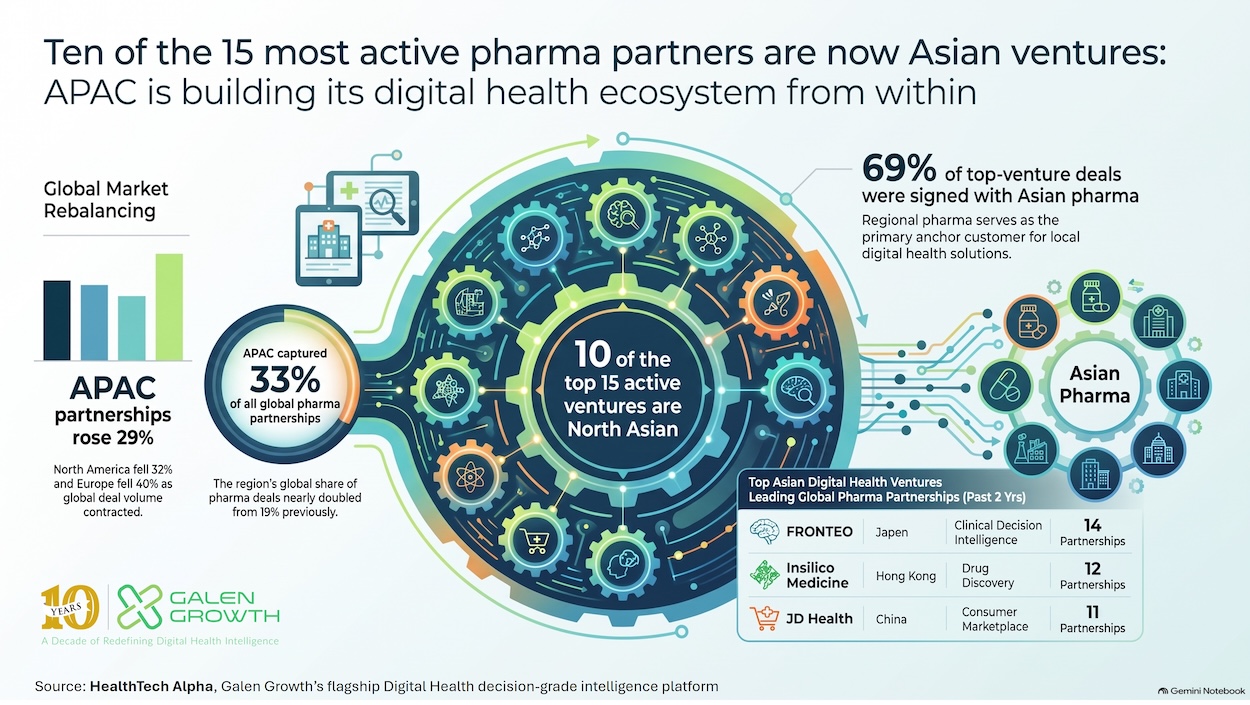
- Ten of the 15 ventures that announced the most pharma partnerships between October 2024 and September 2026 are based in Japan, South Korea, China or Hong Kong, led by FRONTEO (14), Insilico Medicine (12) and JD Health (11).
- Pharma partnerships with ventures in those four markets rose 29%, from 160 to 206, compared with the previous two years, while partnerships with North American and European ventures fell 32% and 40% respectively.
- The four markets’ share of all pharma–venture partnerships rose from 19% to 33%. In calendar 2025, APAC ventures signed 123 pharma partnerships, close to North America’s 130 and well ahead of Europe’s 71.
- The growth is regional: 51 of the 74 pharma partnerships (69%) signed by the ten APAC leaders were with pharma companies headquartered in Asia, from Astellas, Daiichi Sankyo and Chugai to Celltrion, Qilu and Innovent.
- Capital is following the demand. Venture funding in the four markets rose 39% to $3.8bn across 37% fewer rounds, setting up a 2027 ecosystem built around fewer, better-funded ventures anchored by domestic pharma customers.
For most of the past decade, the answer to “which digital health ventures does pharma partner with most?” has been a list of North American platforms. Galen Growth’s analysis for the Pharma Innovation Index 2026 shows that list has changed. When ventures are ranked by the number of pharma partnerships announced over the past two years, ten of the top 15 are based in Japan, South Korea, China or Hong Kong.
The leaders are not newcomers riding a single headline deal. FRONTEO, a Japanese clinical decision intelligence company founded in 2003, announced 14 pharma partnerships in the period, 14 of the 16 it has ever signed. Insilico Medicine added 12 to an already deep portfolio, bringing its all-time total to 33, the highest of any venture in HealthTech Alpha. JD Health signed 11, Galux signed all six of its pharma partnerships in the window, and XtalPi and Gencurix added seven each.
A shrinking market with one region growing
The five non-Asian ventures in the top 15 tell the opposite story. X-Chem and Benchling, two US platforms with 30 and 24 pharma partners over their lifetimes, added only four each in the past two years. They remain embedded in pharma R&D, but they are maintaining established relationships rather than adding new ones. The momentum, measured by new pharma relationships, has moved east.
The ranking matters because it sits against a sharp overall contraction. Pharma companies announced 633 partnerships with digital health ventures between October 2024 and September 2026, down 24% from 831 in the previous two years. The pullback was concentrated in the West: partnerships with North American ventures fell from 399 to 271, and with European ventures from 204 to 123.
APAC was the only major region to grow, from 209 to 225 partnerships. In calendar 2025 the gap with North America almost closed, at 123 against 130. In 2023, North America signed more than twice as many.
Pharma partnerships by venture region, 2019–2025
Source: HealthTech Alpha by Galen Growth, October 2026. North American and European pharma partnering peaked in 2023; APAC is the only region still rising, and is now within a handful of deals of North America.
This is not simply APAC holding steady while others fall. It reflects a change in where pharma is choosing to spend its partnering effort. In a market where every company has become more selective, the region has captured a larger share of a smaller pie: APAC ventures accounted for 25% of pharma partnerships in the prior two years and 36% in the most recent two.
Data for 2026 is not yet complete, but the first three quarters point the same way. APAC ventures have signed 76 of the 200 pharma partnerships announced to the end of September, 38% of the global total, so the region has retained more than a third of partnerships after its 2025 jump. Europe’s share has fallen over the same period, from 22% in 2025 to 14%. North America has partly recovered, to 46% of partnerships, so the 2026 shift is mainly from Europe to APAC rather than from North America.
Japan is the engine; the momentum is North Asian, not pan-APAC
Breaking the region down shows where the acceleration is coming from. Pharma partnerships with Japanese ventures nearly doubled, from 37 to 71, the largest increase of any market in the dataset. South Korea held steady at a high level, with 84 partnerships, and remains the region’s largest single market. China grew modestly from 34 to 37, while Hong Kong jumped from 3 to 14, largely on the strength of Insilico Medicine.
Pharma partnerships with APAC ventures, by market
Source: HealthTech Alpha by Galen Growth, October 2026. Growth is concentrated in North Asia; pharma partnering with ventures in Singapore, India, Australia and Southeast Asia fell by more than half.
The rest of APAC moved the other way. Partnerships with ventures in Singapore, India, Australia and Southeast Asia fell from 49 to 19. The APAC story is therefore a North Asian one: four markets with large domestic pharma industries, mature reimbursement systems and deep pools of clinical and real-world data.
Partnering is also more concentrated per venture. The 206 partnerships in Japan, South Korea, China and Hong Kong were spread across 101 ventures, about two per venture, compared with 1.3 per venture in North America. Pharma in North Asia is not scattering pilots across hundreds of start-ups; it is returning to the same partners and widening the relationship.
Regional pharma is the anchor customer
The most important feature of the APAC surge is who sits on the other side of the table. Of the 74 pharma partnerships signed by the ten APAC leaders in the past two years, 51, or 69%, were with pharma companies headquartered in Asia. These are largely domestic and regional pharma companies rather than the global top 25.
APAC ventures in the top 15, by pharma partnerships in the past two years
| Venture | Market | Primary category | Pharma partnerships, past 2 yrs | Of which with APAC-headquartered pharma |
|---|---|---|---|---|
| FRONTEO | Japan | Clinical decision intelligence | 14 | 14 (100%) |
| Insilico Medicine | Hong Kong | Drug discovery | 12 | 9 (75%) |
| JD Health | China | Consumer marketplace | 11 | 5 (45%) |
| XtalPi | China | Drug discovery | 7 | 4 (57%) |
| Gencurix | South Korea | Omics-related diagnosis | 7 | 4 (57%) |
| Galux | South Korea | Drug discovery | 6 | 4 (67%) |
| Medii | Japan | Teleconsultation | 5 | 3 (60%) |
| Ali Health | China | Integrated population health | 4 | 1 (25%) |
| Pharos iBio | South Korea | Bioinformatics | 4 | 3 (75%) |
| Elix | Japan | Drug discovery | 4 | 4 (100%) |
| Total | 74 | 51 (69%) |
FRONTEO’s partner list reads like a directory of Japanese pharma: Astellas, Chugai, Eisai, Daiichi Sankyo, Shionogi, Nippon Shinyaku, Maruho and others. Galux, a Seoul-based AI protein design company, partnered with Celltrion, GC Biopharma, OliX and ISU Abxis. Insilico Medicine’s new partners include Takeda, SK Biopharmaceuticals, Qilu, Harbour BioMed and Taiwan’s Bora and TaiGen alongside Servier and Eli Lilly. Elix worked only with Japanese partners, including Eisai and Kyorin.
The logic is practical. Mid-sized Asian pharma companies face the same productivity pressure as their global peers but with smaller R&D budgets, so they need discovery and decision tools that compress cost and time. They also share regulators, languages, data sources and clinical networks with ventures in their home markets. A Japanese AI company trained on Japanese medical literature and patient data is easier to deploy at a Japanese pharma company than a US platform that must first be localised.
The work is also weighted towards the core of the value chain. Research Solutions ventures accounted for 30% of pharma partnerships in the four markets, Medical Diagnostics for 19% and Health Management Solutions for 16%. Global pharma still participates, but often in a different role: JD Health and Ali Health partnered with Novartis, Bayer, Boehringer Ingelheim, Eli Lilly and Novo Nordisk, using China’s consumer health platforms as a channel to patients rather than as an R&D resource.
Capital is starting to follow the partnerships
Partnership activity is a leading indicator; capital is the confirmation. Ventures in Japan, South Korea, China and Hong Kong raised $3.8bn in private funding over the past two years, up 39% from $2.7bn, even as the number of rounds fell 37% from 356 to 224. Average round size roughly doubled. North American venture funding, by contrast, was broadly flat, down 4%.
Europe is the useful comparison. European ventures also raised substantially more capital in the period, but their pharma partnerships fell 40%. In North Asia, capital and pharma demand rose together. That combination, investors backing fewer companies with larger cheques while domestic pharma companies commit as customers, is what turns a regional cluster into a self-sustaining ecosystem.
The risks: concentration, a thin trial layer and a narrow map
The data does not describe a frictionless boom. Activity is concentrated: FRONTEO, Insilico Medicine and JD Health alone account for 37 of the 206 partnerships in the four markets, and the ten leaders account for 36%. If two or three of these companies stumble, the regional figures will look very different.
The region is also underweight where pharma’s bottleneck is most acute. Clinical Trials ventures accounted for just six of the 206 partnerships, 3%, compared with 5% in North America. Clinical execution is where pharma loses the most time, yet the APAC partnering surge is concentrated in discovery and diagnostics. And the geography is narrow: the collapse in partnering with Southeast Asian, Indian and Australian ventures suggests that much of APAC is not sharing in the momentum.
Finally, a partnership announcement is not a deployment. Many of the new relationships are early-stage collaborations, and the test in 2027 will be whether they convert into renewals, multi-year contracts and evidence. Regional focus is an advantage in winning first customers, but it can also become a ceiling for ventures that need global pharma to scale.
Why should 2027 be a breakout year for North Asian digital health?
Taken together, the evidence points to a regional flywheel. Domestic pharma companies are committing to local ventures, those ventures are using the revenue and validation to raise larger rounds, and the capital is funding the next generation of capability. Because the partners are regional, the relationships are less exposed to shifts in Western pharma budgets and more closely tied to the region’s own regulatory and data infrastructure.
Several signals will show whether the flywheel holds in 2027. Watch whether Japanese and Korean pharma companies convert their 2025–2026 pilots into multi-year deployments; whether APAC leaders add global top-25 partners on the back of regional evidence; whether capital flows into the clinical trials layer the region has so far neglected; and whether Singapore, India and Australia re-engage.
The larger question is about direction. For a decade, Asian pharma looked west for digital innovation. The data now suggests that North Asia is building its own. The unresolved question for 2027 is whether global pharma will come to these regional champions, or whether the region will keep them for itself.
What this means
For investors: Pharma partnership velocity is a leading indicator of revenue and exit potential, and on that measure North Asia is outperforming. The strongest opportunities are ventures with repeat domestic pharma customers and evidence that can travel, but concentration risk is high, so diligence should test how dependent a venture is on a handful of partners.
For global pharma: The region’s most active ventures are being locked in by regional competitors. Companies with significant APAC exposure should build scouting and partnering capacity in Tokyo, Seoul and Shanghai rather than waiting for these ventures to arrive in Boston or Basel.
For APAC pharma: Domestic partnering is producing a portfolio of capabilities tuned to local data and regulation. The next step is to move from announcements to measured deployments, and to extend partnering into clinical trial execution, where the regional pipeline is thinnest.
For policymakers: The flywheel depends on access to high-quality domestic health data and predictable regulatory pathways. Governments that make data infrastructure and digital approval pathways work for pharma–venture collaborations will capture a disproportionate share of the 2027 growth.
For digital health ventures: Regional pharma is now a credible first customer, not a fallback. Ventures should use domestic partnerships to build evidence and revenue, while designing data, regulatory and commercial models that can be carried to global partners.
FREQUENTLY ASKED QUESTIONS
Which ventures signed the most pharma partnerships over the past two years?
Based on HealthTech Alpha data, FRONTEO (Japan) led with 14 pharma partnerships between October 2024 and September 2026, followed by Insilico Medicine (Hong Kong) with 12 and JD Health (China) with 11. Ten of the top 15 ventures are based in Japan, South Korea, China or Hong Kong.
Is pharma partnering with digital health ventures growing or shrinking?
Shrinking overall. Pharma–venture partnerships fell 24%, from 831 to 633, comparing the two years to September 2026 with the previous two years. APAC was the only region to grow, from 209 to 225, while North America fell 32% and Europe 40%.
Are APAC ventures partnering mainly with global pharma or regional pharma?
Mainly regional. Of the 74 pharma partnerships signed by the ten APAC ventures in the top 15, 69% were with pharma companies headquartered in Asia, such as Astellas, Daiichi Sankyo, Chugai, Celltrion and Qilu. Global pharma is present, but more often uses Chinese consumer health platforms as a channel to patients.
Which APAC markets are driving the growth?
Japan is the main driver, with pharma partnerships nearly doubling from 37 to 71. South Korea remains the largest market at 84, China grew modestly and Hong Kong rose from 3 to 14. Partnerships with ventures elsewhere in APAC, including Singapore, India and Australia, fell from 49 to 19.
What could slow APAC’s digital health momentum in 2027?
Three risks stand out: heavy concentration in a few ventures, a thin pipeline of clinical trial partnerships, and limited participation beyond North Asia. Whether early collaborations convert into multi-year deployments with measurable evidence will determine whether the growth is durable.
Methodology and data source
Data source: HealthTech Alpha by Galen Growth, Q3 2026 (covering partnership records from 29 September 2022 to 28 September 2026, with annual trend data from 2019). Pharma partnerships include all corporates classified as Pharmaceutical in HealthTech Alpha; the past two years cover 29 September 2024 to 28 September 2026 and the prior period the two years before. Ventures are assigned to the market of their headquarters, and partner headquarters were classified by Galen Growth. Duplicate corporate records are counted once, and Foundation Medicine, a Roche subsidiary, is excluded from the venture ranking. Funding figures exclude IPOs. Data for 2026 is partial, and recent periods may be revised as announcements are added.
Galen Growth is the Healthcare Innovation Intelligence company behind HealthTech Alpha. Built on proprietary data, AI-enabled workflows and expert insights, HealthTech Alpha delivers decision-grade intelligence that helps healthcare leaders identify opportunities, evaluate companies and make better strategic decisions.
Related Galen Growth analysis
- Pharma Digital Health Innovation Index 2026 | Galen Growth
- Asia Pacific Digital Health Funding Q1 2026: $2.65B Shift
- Pharma Digital Health Partnerships: The Asset Investors Miss
Disclaimer
This analysis is provided solely for informational purposes and was prepared in good faith on the basis of public information available at the time of publication without independent verification. Numbers will be updated from time to time to reflect information identified after the event. Galen Growth does not guarantee or warrant the reliability or completeness of the data nor its usefulness in achieving any particular purposes. Galen Growth shall not be liable for any loss, damage, cost or expense incurred by any reason because of any person’s use or reliance on this report.