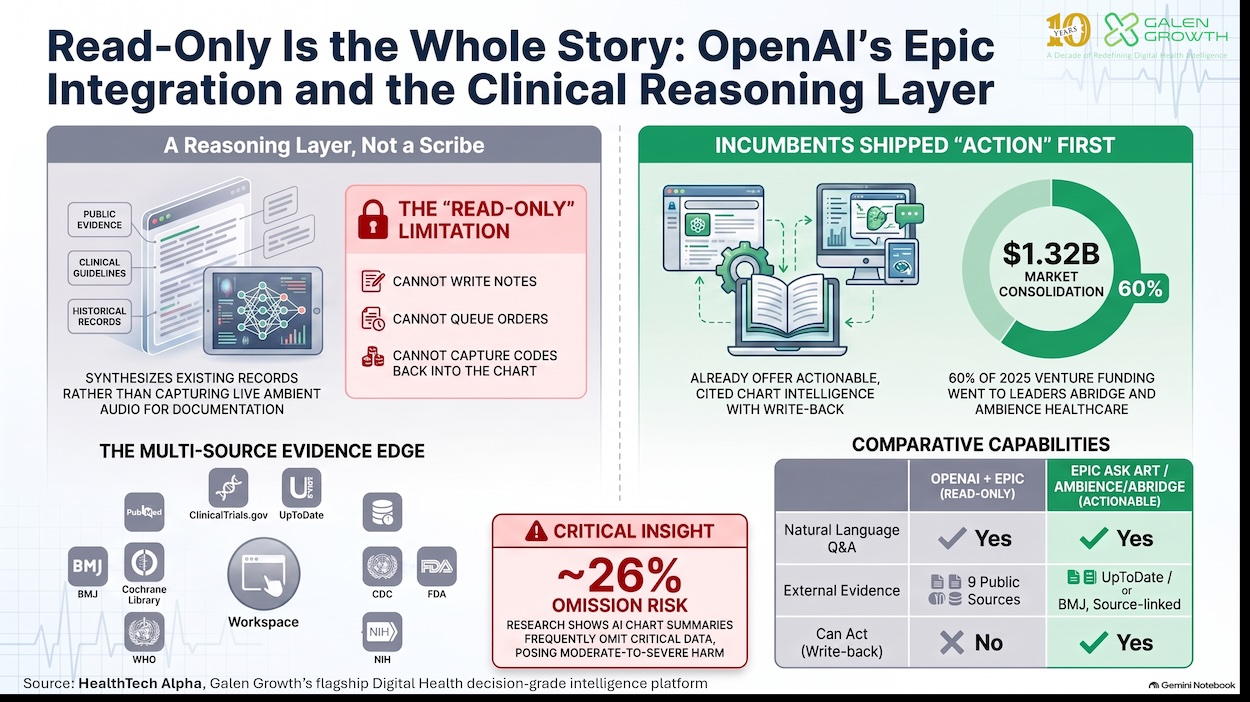
OpenAI has not built a better AI scribe. It has not built a scribe at all — it has shipped a read-only reasoning layer over the Epic chart, arriving third or fourth into a category where $1.32 billion of venture funding went to the incumbents in 2025 alone.
By Dario Heymann, Chief Technology Officer. Published 8 September 2026. Updated 8 September 2026. 15 min read.
KEY TAKEAWAYS
- OpenAI’s Epic integration, shipped 1 September 2026, is read-only. No note is written, no order is queued, no code is captured — nothing goes back into the chart.
- This is not a scribe and should not be judged as one. The like-for-like comparison is against Epic’s Ask Art and Ambience’s Chart Chat, which shipped the same capability in ~2025 and August 2025 respectively — with the ability to act on it.
- Epic reports Art Insights being used more than 16 million times per month as of February 2026, a level of workflow penetration no third party has.
- HealthTech Alpha records $1.32B of disclosed venture funding into ambient documentation ventures in 2025 across 16 deals — 3.8x the $346M raised in 2024. Abridge ($550M) and Ambience Healthcare ($243M) took 60% of it.
- The published evidence on chart summarisation is worse than on scribing: a Mayo Clinic five-platform study found a ~26% mean error rate, roughly three-quarters of them omissions.
- OpenAI’s one genuine differentiator is breadth of external data — nine public sources including PubMed, ClinicalTrials.gov, DailyMed, RxNorm and CMS Coverage in a single workspace.
On 1 September 2026, OpenAI shipped a read-only reasoning layer over the Epic chart. It is useful and well-executed, and it is years behind the incumbents on the thing that actually generates return: turning understanding into action inside the record.
The revolutionary framing describes where this could go, not what shipped. And where it could go, Epic, Microsoft, Abridge and Ambience are already heading. What follows is a reasoning-layer-to-reasoning-layer comparison, the capital that has already been committed to this category, and the published evidence — which runs opposite to the marketing.
Why “AI scribe” is the wrong label
The label matters, because it imports the wrong comparison, the wrong success metric, and the wrong evidence base.
A scribe listens to a live encounter and produces documentation. Its inputs are ambient audio; its output is a note that gets edited and signed; it is judged on documentation time, note quality, and write-back into the record. That is Abridge, Ambience, Dragon Copilot, Suki, Nabla, DeepScribe, and Epic Art’s ambient charting.
OpenAI’s product does something different: it reads an existing chart and answers questions about it. Its input is the stored record plus external data; its output is a synthesis a clinician reads; the right yardstick is chart review and reasoning, not documentation. The correct category name is a clinical reasoning layer — a chart-synthesis copilot, not a scribe.
This reframes the whole assessment. Judged as a scribe, OpenAI looks hopelessly behind, but it is not trying to be one. The honest head-to-head is reasoning layer against reasoning layer: OpenAI’s chart Q&A against Epic’s Ask Art and Ambience‘s Chart Chat, which already do exactly this. The scribe vendors remain the competitive landscape, because they expanded out of documentation into precisely this reasoning-and-action territory — but the like-for-like comparison is between reasoning layers, not between a scribe and a not-scribe.
What did OpenAI actually ship?
The integration has two modes: pull authorised Epic data into ChatGPT, or embed ChatGPT inside the Epic layout so clinicians do not leave the chart. The supported questions are synthesis questions — what changed since last visit, which labs matter, did medications change, what did specialists recommend, what follow-ups are open.
Underneath, it is standard interoperability, not new architecture. Organisations configure an Epic app using a FHIR R4 endpoint, OAuth, and resource-scoped permissions: Patient, Condition, MedicationRequest, Observation, DocumentReference, DiagnosticReport, Encounter and the like. The user authenticates with their own Epic identity, existing Epic authorisation stays authoritative, and ChatGPT gets no permissions the clinician does not already have. It needs the HIPAA-eligible workspace and a BAA.
Three facts about the release matter more than anything in the marketing.
It is read-only. No note is written. No order is queued. No code is captured. Nothing goes back into the chart. In a category where the entire ROI case rests on closing the documentation loop, this is not a detail — it is the ceiling on what the product can do today.
There is almost certainly no special Epic deal. The read-only FHIR scope, the OAuth flow and the workflow described all point to a standard SMART on FHIR launch, the same mechanism any third-party developer can use. As a business associate to an Epic customer, you register an app, pick your APIs, test against the sandbox, list as production-ready, and hospitals choose you. Nobody at Epic had to approve OpenAI specifically. Tellingly, Epic itself has said nothing, and no coverage carries a comment from the company.
It is a feature, not a platform. The most incisive independent read in the field — Brendan Keeler of Health API Guy — calls it at best parity and at worst behind vertical-specific competition. It closes the distance to OpenEvidence. It does not close the distance to Abridge, Ambience, or Epic’s own Art.
Alongside Epic, OpenAI shipped a Healthcare Public Data plugin spanning nine official sources, PubMed, ClinicalTrials.gov, DailyMed, RxNorm and CMS Coverage among them. That lets a clinician move from “what changed in this chart?” to “what does the evidence say?” to “any recruiting trials?” to “what does Medicare cover?” without touching four systems. This aggregation is OpenAI’s strongest genuine differentiator — and it is a clinical-intelligence workspace framing, not a scribe.
Where the incumbents already are
Epic Art is the structural threat, because it is Epic. Art already spans far more than ambient notes: outpatient and inpatient/ED ambient documentation, diagnosis and order extraction, chart and hospital-course summaries, medication insights, referral summaries, diagnosis-code and risk-adjustment coding, care-gap identification, message drafting, nursing and procedure documentation, cancer staging, discharge planning, and Ask Art — natural-language chart questions with concise, cited answers and visualisations.
“AI that reads the Epic chart and answers questions” is precisely what OpenAI is pitching, and Epic has shipped it for over a year. Epic reports Art Insights being used more than 16 million times per month as of February 2026 — Epic-reported, not audited, but indicative of workflow penetration nobody else has. The bigger move is Ergo (November 2026): a clinician interface that flexes to the moment, ingests ambient voice, and pulls Art, Emmie, Penny and Cosmos into a single contextual surface. That is Epic absorbing the whole category into the native licence. That commoditisation, not OpenAI’s arrival, is the defining competitive dynamic of 2026.
Abridge is furthest along on actionability, and the clearest picture of where the category is heading. It spans before, during and after the encounter, and its Contextual Reasoning Engine folds in EHR context, prior encounters, organisational guidelines, clinician preferences, predicted problems, orders, coding and source-linked evidence. It is Epic’s first “Pal” partner — the deepest integration tier — with capture and generated documentation embedded from Haiku through Hyperspace and Hyperdrive, with no separate workflow. It has pushed from medication orders into labs, imaging, referrals, procedures, follow-ups and immunisations, matched against each system’s order catalogue.
Ambience is the closest architectural mirror, and it got there first. It positions explicitly as health-system intelligence rather than a scribe: chart reconciliation, cited chart Q&A, task tracking, specialty documentation, orders, CDI, ICD-10/HCC/MCC/CC/E&M coding, longitudinal context, 200+ specialties across ambulatory, inpatient and ED. The critical detail: Ambience shipped Chart Chat in August 2025 — a copilot embedded in Epic combining patient chart data with BMJ Best Practice evidence for patient-specific insight. That is Epic context plus medical knowledge plus LLM reasoning, a core piece of OpenAI’s “novel” architecture, productised a year earlier.
Behind them sit Microsoft Dragon Copilot, the mature incumbent from the Nuance dictation lineage, with deep Epic integration and specialty-specific structured summaries; Suki, with ambient generation, pre-charting, coding and voice editing, order entry listed as upcoming; DeepScribe, focused on complex specialties with heavy physician-level customisation; and Nabla, inserting structured notes and follow-ups into Epic on a roughly two-to-three-week deployment.
The like-for-like table below is where the “revolutionary” claim runs into trouble. OpenAI is the third or fourth entrant, not the first.
| Reasoning-layer capability | Epic Ask Art | Ambience Chart Chat | Abridge | OpenAI + Epic |
|---|---|---|---|---|
| Natural-language chart Q&A | Yes | Yes | Yes | Yes |
| Cited / source-linked answers | Yes | Yes | Yes | Yes |
| Longitudinal chart synthesis | Yes | Yes | Yes | Yes |
| External evidence in same view | Via UpToDate | Via BMJ Best Practice | Source-linked evidence | Yes — 9 public sources (its edge) |
| Lives natively in the record | Is Epic | Embedded in Epic | Haiku → Hyperspace | Read-only, embeddable |
| Can act on what it finds | Yes | Yes | Yes | No |
| First shipped | ~2025 | Aug 2025 | 2025 → | Sep 2026 |
On the reasoning layer alone, OpenAI’s one genuine differentiator is breadth of external data. Everything else in that table, the incumbents shipped first — and they shipped it able to act.
The scribe products are not the benchmark, but they are the market OpenAI is walking into, because they long ago stopped being scribes. Each now bolts a reasoning layer onto a documentation-and-action engine, which is exactly the combination OpenAI lacks.
| Platform | Reasoning / chart intelligence | Ambient capture | Write-back (notes/orders/codes) | Epic depth |
|---|---|---|---|---|
| Epic Art | Very high (Ask Art) | Yes | Very high | Native — is Epic |
| Abridge | Very high | Yes | Very high | Very high (Pal tier) |
| Ambience | Very high (Chart Chat) | Yes | Very high | Very high |
| Microsoft Dragon Copilot | Moderate | Yes | Moderate–high | Very high |
| Suki | Moderate | Yes | Moderate (orders upcoming) | Very high |
| DeepScribe | High | Yes | Moderate | High |
| Nabla | Moderate–high | Yes | Moderate | High |
| OpenAI + Epic (today) | Very high (potential) | No | None (read-only) | High, less operational |
The asymmetry is in the last two columns. OpenAI is strongest as a reasoning environment and absent as a workflow engine. The incumbents have both, and their version is the one that closes the loop.
The capital has already been committed
Whatever OpenAI’s architectural ambitions, the money in this category was placed before September 2026. HealthTech Alpha records $1.32 billion of disclosed venture funding across 16 deals into ambient documentation ventures in 2025 — 3.8x the $346 million raised across 12 deals in 2024, and more than the previous five years combined.
[INSERT CHART HERE – Chart 1 — Ambient documentation funding, 2019–2026 YTD. Source: HealthTech Alpha by Galen Growth, accessed September 2026. Visual: combination bar-and-line chart across 2019–2026 YTD for the 64-venture ambient documentation cohort — disclosed venture funding in US$M as bars (51, 137, 294, 209, 188, 346, 1,319, 71) with the 2025 bar highlighted and labelled $1.32B and the 2026 bar greyed as year-to-date, against disclosed deal count as an overlaid line (12, 10, 13, 12, 11, 12, 16, 5). Subtitle notes the cohort tags — Ambient AI, Ambient Listening, AI Scribe, AI Clinical Scribe, Clinical Notetaking, Healthcare Transcription — and that M&A and IPO are excluded. Caption to note that 2026 is year-to-date and understated: Abridge’s June 2026 strategic round is recorded with undisclosed terms.]
Concentration is the story inside the total. Abridge raised $550 million across two rounds in 2025 (a $250 million Series D in February and a $300 million Series E in June); Ambience Healthcare raised $243 million in a July Series C. Between them, those two ventures took 60% of the year’s disclosed capital in this cohort. Innovaccer added $275 million, Heidi $75 million and Nabla $70 million.
HealthTech Alpha’s present valuations for the leaders make the point another way: Abridge at $5.71 billion, OpenEvidence at $3.93 billion, Ambience Healthcare at $2.04 billion, Suki at $903 million. These are not early-stage experiments waiting to be displaced by a better base model. They are capitalised, Epic-embedded platforms with several years of workflow engineering behind them — and the write-back that OpenAI does not have.
The evidence asymmetry cuts against the hype
OpenAI’s numbers are vendor-generated and unreplicated. Physicians rated 99.1% of 4,363 responses “safe” across 27 use cases; connector accuracy ran from 93.2% (CMS Coverage) to 98.6% (DailyMed). No methodology is published, no peer review, no independent replication. Roughly 39 ratings fell short — in a workflow where a clinician reads a summary of a chart they never opened. This sets a floor for a sales conversation and nothing more.
The adjacent scribe category, by contrast, has randomised trials, and they set a realistic ceiling. The UCLA study in NEJM AI (Lukac et al., November 2025) covered 238 physicians across 14 specialties and roughly 72,000 encounters: Nabla cut time-in-note by 9.5%, about 41 seconds per note, while DAX showed no significant change. A JAMA multisite study (Rotenstein et al., April 2026) compared 1,800+ scribe users against 6,770 controls and found 13.4 fewer minutes of EHR time and 16.0 fewer minutes of documentation time — but after-hours EHR time did not change significantly, meaning the “pajama time” claim failed to replicate at scale. A Providence evaluation of 1,547 clinicians found statistically significant but modest gains, with the authors explicitly cautioning against overstating them. PHTI’s independent assessment concluded that scribes reduce burnout and cognitive load but have not proven financial ROI.
If a mature, write-back-enabled scribe category produces those numbers, a read-only reasoning layer with no published trials should be assumed no better until shown otherwise. And chart summarisation — what a reasoning layer actually does — has worse published data than scribing.
| Study | Finding |
|---|---|
| Mayo Clinic Digital Health, 5-platform simulated encounters | ~26% mean error rate; ~three-quarters were omissions; some with moderate-to-severe harm potential |
| UCSF ED summaries (GPT-4) | Only 33% entirely error-free; 42% hallucinations; 47% omitted relevant clinical information |
| npj Health Systems (2026), EHR-integrated chart review | Omissions the leading concern; authors conclude omission is a larger threat than hallucination |
| UC Davis pilot, 7,545 notes (JMIR 2026) | Omissions the most frequent error (18%); hallucinations 11.5% |
Omission is invisible to the reader by definition — the summary looks complete. And this integration explicitly encourages relying on the summary instead of opening the chart. A 99.1% vendor safety figure does not touch that risk.
Verdict: a feature today, an architecture bet tomorrow
Is it a revolutionary AI scribe? No — high confidence. The core capabilities are mature and deployed across multiple vendors. Is it a fundamentally new way to query Epic? Not fundamentally — high confidence. Ask Art and Chart Chat already do conversational, cited chart intelligence, and Abridge already folds in longitudinal context.
Could it reshape the competitive architecture of clinical AI? Yes — this is the real hypothesis. Several of these companies build on the frontier models of the company they now compete with: Abridge has reported quality gains from GPT-5.5, and Ambience built Chart Chat using OpenAI reinforcement fine-tuning. With the Epic integration, OpenAI is moving down that stack toward the application layer — the classic platform-eats-its-customers tension seen in cloud, operating systems and enterprise software. The economic threat was never that GPT would suddenly write better notes. It is a health system eventually asking why it should buy a separate clinical-AI platform if ChatGPT already has governed access to Epic, the evidence base and its own data.
The incumbents’ defence is workflow engineering, specialty adaptation, coding, provenance and clinical action — all much harder than giving an LLM chart access. On today’s evidence, the defence holds. OpenAI trails on workflow depth, has no ambient capture at all, lacks the accumulated specialty taxonomies and coding rules a stronger base model does not replicate, and does not treat revenue-cycle integration as first-class the way Ambience and Abridge do.
Where it could genuinely win is horizontal: one governed workspace serving clinicians, utilisation management, research, pharmacy, population health, finance and operations. That is a different purchase from a scribe licence, and it is the real competitive threat — to the CIO’s software budget, not to the scribe. The AdventHealth case makes the point: the flagship example is utilisation management, with physician advisors using ChatGPT to review charts and draft rationales. That is knowledge-work acceleration, closer to prior authorisation than to documentation. The headline “80% reduction in administrative time” is an OpenAI customer case study, not an independent comparison, and the genuinely transferable lesson is the adoption model — messages per user per business day tracked as a KPI, EHR-timestamp measurement over self-report — not the technology.
The next inflection point is write access and agentic action. Once ChatGPT can safely convert chart understanding into controlled Epic actions, the assessment changes materially. Until then, the “revolutionary” claim describes the potential end-state, not the product that exists.
What this means
For investors, the 2025 concentration is the signal — 60% of $1.32B went to two ventures. Late capital is backing write-back and workflow depth, not reasoning quality, because reasoning is the part a frontier model commoditises. Diligence on any ambient or chart-intelligence position should test what the product can put back into the record, not how well it reads.
For pharma and corporate partners, OpenAI’s nine-source public data plugin — PubMed, ClinicalTrials.gov, DailyMed, RxNorm, CMS Coverage — is the most interesting piece for non-documentation use cases. Trial feasibility, coverage analysis and medical affairs benefit more from chart-plus-literature synthesis than routine notes do.
For health systems and providers, treat the ~26% chart-summarisation error rate as the governing number, not the 99.1% vendor safety figure. A read-only layer that encourages reading the summary instead of the chart shifts risk toward omission, which is the failure mode clinicians cannot see. Epic’s Ergo (November 2026) also means a large part of this functionality is heading into the native licence — worth checking before signing a separate contract.
For digital health ventures, the defensible layer is not reasoning. It is order catalogues, coding rules, specialty taxonomies, provenance and integration tier — the things Abridge and Ambience spent years building. Ventures whose value is a good prompt over an EHR API should assume that surface is being absorbed, by Epic from inside and by OpenAI from outside.
FREQUENTLY ASKED QUESTIONS
Is OpenAI’s Epic integration an AI scribe?
No. It is a read-only clinical reasoning layer that reads an existing Epic chart and answers questions about it. It has no ambient capture and writes nothing back — no notes, no orders, no codes.
Can ChatGPT write notes or place orders in Epic?
No. The integration launched on 1 September 2026 is read-only, using a standard SMART on FHIR R4 launch with resource-scoped OAuth permissions. Write access is the next inflection point, and it does not exist today.
Does OpenAI have a special partnership with Epic?
Almost certainly not. The read-only FHIR scope and OAuth flow point to the standard third-party app pathway any developer can use. Epic has issued no comment, and no coverage carries a statement from the company.
Who already offers AI chart Q&A inside Epic?
Epic’s own Ask Art (shipped around 2025, with Art Insights used more than 16 million times per month as of February 2026), Ambience’s Chart Chat (August 2025), and Abridge’s Contextual Reasoning Engine. All three can act on what they find; OpenAI’s cannot.
How much funding has gone into ambient documentation?
HealthTech Alpha records $1.32 billion of disclosed venture funding across 16 deals in 2025, up 3.8x from $346 million across 12 deals in 2024. Abridge ($550M) and Ambience Healthcare ($243M) accounted for 60% of the 2025 total.
How accurate are AI chart summaries?
Less accurate than the marketing suggests. A Mayo Clinic five-platform study found a ~26% mean error rate, roughly three-quarters of them omissions. A UCSF study of GPT-4 emergency-department summaries found only 33% entirely error-free and 47% omitting relevant clinical information.
About the author
Dario Heymann is Chief Technology Officer of Galen Growth and the architect of HealthTech Alpha. He writes on clinical AI, health data infrastructure, digital health market structure and the evidence behind healthcare technology claims.
Data source and methodology
Data source: HealthTech Alpha by Galen Growth, accessed September 2026 (funding covering January 2013 to September 2026). The ambient documentation cohort comprises 64 ventures tagged Ambient AI, Ambient Listening, AI Scribe, AI Clinical Scribe, Clinical Notetaking or Healthcare Transcription in HealthTech Alpha, of which 39 have recorded funding events. Funding figures are disclosed amounts in US dollars and exclude M&A, IPO and post-IPO transactions; 2026 is year-to-date and understated, as several 2026 rounds — including Abridge’s June 2026 strategic round — are recorded with undisclosed terms. Present valuations are HealthTech Alpha estimates.
Product capability claims, usage figures and safety statistics attributed to OpenAI, Epic, Abridge, Ambience Healthcare and other vendors are vendor-reported and have not been independently audited. Clinical study findings are attributed to their published sources.
This analysis is provided solely for informational purposes and was prepared in good faith on the basis of public information available at the time of publication without independent verification. Numbers will be updated from to time to reflect information identified after the event. Galen Growth does not guarantee or warrant the reliability or completeness of the data nor its usefulness in achieving any particular purposes. Galen Growth shall not be liable for any loss, damage, cost or expense incurred by any reason because of any person’s use or reliance on this report.
Related Galen Growth analysis
- The Maturity Era: Digital Health Funding, H1 2026 — Galen Growth
- Big Tech in Healthcare: AI, Cloud and Digital Health Strategy — Galen Growth
- Health Management Solutions at Health Revolution Congress 2026 — Galen Growth
How to cite this analysis
About Galen Growth
Galen Growth is the global digital health intelligence and strategy firm behind HealthTech Alpha, the market intelligence platform that tracks more than 17,000 digital health ventures, their funding, partnerships, evidence, regulatory activity and commercial maturity. We help pharmaceutical companies, healthcare providers, investors, and governments understand how digital health markets are evolving, identify strategic partners, benchmark innovation ecosystems, and make better-informed decisions.