TL;DR
- A Shortcut to the Next Generation: Amidst a maturing market that saw $29.7 billion in global digital health funding in 2025, the 2026 HealthTech 250 serves as an evidence-led shortcut to the highest-potential early-stage digital health startups within the year’s three hottest clusters.
- Cluster 1: Health Management Solutions ($5.5B, 19%): The definitive arena for operational efficiency. The strategic benefit here is clear: 32% of partnerships are with frontline health systems, and 19% are with Big Tech, providing investors and buyers with highly integrated, enterprise-ready infrastructure solutions.
- Cluster 2: Research Solutions ($4.5B, 16%): Moving beyond theoretical AI, these ventures use massive datasets and Real-World Data (RWD) to precisely tune drug discovery tools, capturing the immense upside of the biopharma boom without the binary risk of single-asset failures.
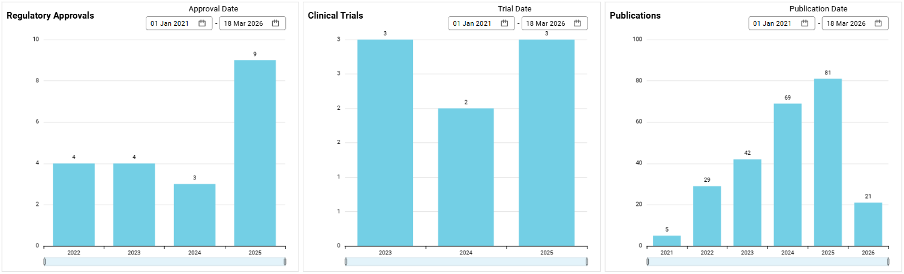
- Cluster 3: Medical Diagnostics ($2.6B, 10%): The pipeline for global, evidence-backed innovation. 56% of these ventures originate outside the US, leveraging rigorous European regulatory environments to accumulate 9 regulatory approvals, 3 active clinical trials, and 81 peer-reviewed publications in 2025 alone.
- The 2026 Selection Criteria: The HealthTech 250 list is a decision-grade shortlist of ventures incorporated since 2021 at Series A or below, prioritising clinical validation, resilience, and infrastructural value over hype cycles.
With global digital health startup funding reaching a monumental $29.7 billion in 2025, Galen Growth’s latest intelligence platform provides a decision-grade roadmap for navigating the sector. For investors, corporate strategists, and health system executives, this analysis of the three top-funded clusters reveals how the next generation of evidence-backed startups offers unprecedented opportunities for de-risked investment and high-yield strategic partnering.
The Institutionalisation of Digital Health Capital and the Value of Curated Intelligence
In 2025, the digital health sector attracted a massive $29.7 billion in total global venture funding. However, navigating this vast influx of capital presents a monumental challenge for industry leaders. How does an investor separate genuine infrastructural innovation from lingering market hype? How does a hospital Chief Information Officer identify software vendors that will survive to see their Series B?
To answer these critical questions, Galen Growth has curated the 2026 HealthTech 250. In particular, the list of the Top Digital Health Startups by Leading Clusters intentionally focuses on the top-funded digital health clusters, looking exclusively at the next generation of ventures. This is a decision-grade shortlist meticulously engineered to benefit the reader by enabling rapid benchmarking, partner scouting, and investment thesis validation.
Drawing on approximately 1.5 billion data points and tracking 1,500 digital health companies, this intelligence layer filters out the noise to identify the most promising early-stage ventures worldwide. By absorbing the analytical heavy lifting, this intelligence allows pharmaceutical executives, institutional allocators, and health systems to dramatically accelerate their due diligence processes and de-risk their strategic decisions.
The Next-Generation Paradigm: Reaping the Rewards of Charted Territory
To truly capitalise on the intelligence provided by the 2026 HealthTech 250, the reader must recognise the evolutionary leap this specific cohort represents. The first wave of digital health innovation was largely exploratory. Early pioneers spent the last decade educating a notoriously stubborn healthcare market, battling legacy procurement cycles, and slowly carving out novel regulatory pathways for digital tools. They absorbed the immense financial friction of charting an unknown wilderness.
The immense benefit of the 2026 HealthTech 250 is that it focuses entirely on the next generation of ventures—specifically those incorporated in 2021 or later. Building on the learnings that more mature ventures have already discovered, these ventures are going one step further to maximise the use of digital tools in uncharted territory to address acute pain points in the market.
Because the foundational groundwork has been laid by their predecessors, these newly minted companies are unburdened by the need to prove that digital health can work. Instead, they are singularly focused on proving that their specific infrastructural layers work better, faster, and more cost-effectively than the status quo.
They are operating in a landscape where health systems already possess mature electronic health records (EHRs), where pharmaceutical companies already recognise the absolute necessity of computational biology, and where digital diagnostic frameworks are firmly established. By entering charted territory, these start-ups are achieving commercial traction at an unprecedented velocity.
For the investor or corporate partner reading this analysis, the benefit is profound: you gain exposure to rapidly scaling entities that have completely bypassed the existential, capital-draining market-education phase that consumed the previous decade.
A $29.7 Billion Ecosystem and Your Roadmap to Value
The $29.7 billion in global venture capital deployed in 2025 was neither evenly distributed nor speculative. It aggregated heavily within three specific clusters, which were selected for the HealthTech 250 spotlight precisely because they secured the highest volumes of global venture funding. Together, these clusters provide the reader with a definitive roadmap for where the world’s most sophisticated capital is being allocated.
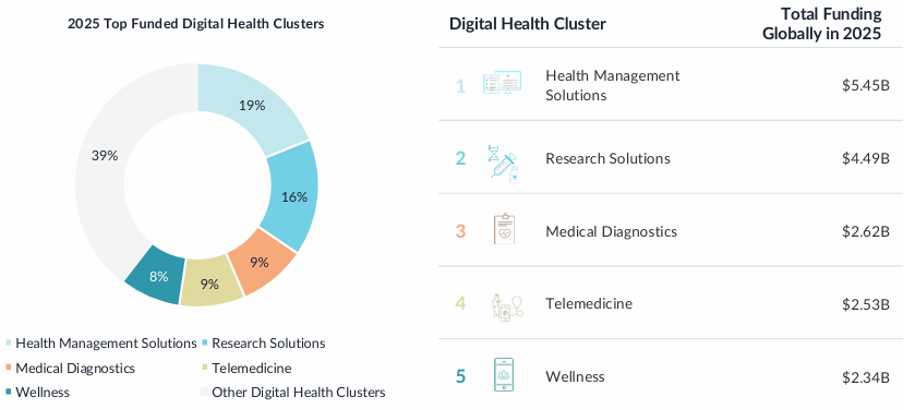
According to Galen Growth’s global digital health funding trends report, these clusters dominate capital concentration.
Cluster 1: Health Management Solutions – Securing Operational Efficiency ($5.5 Billion)
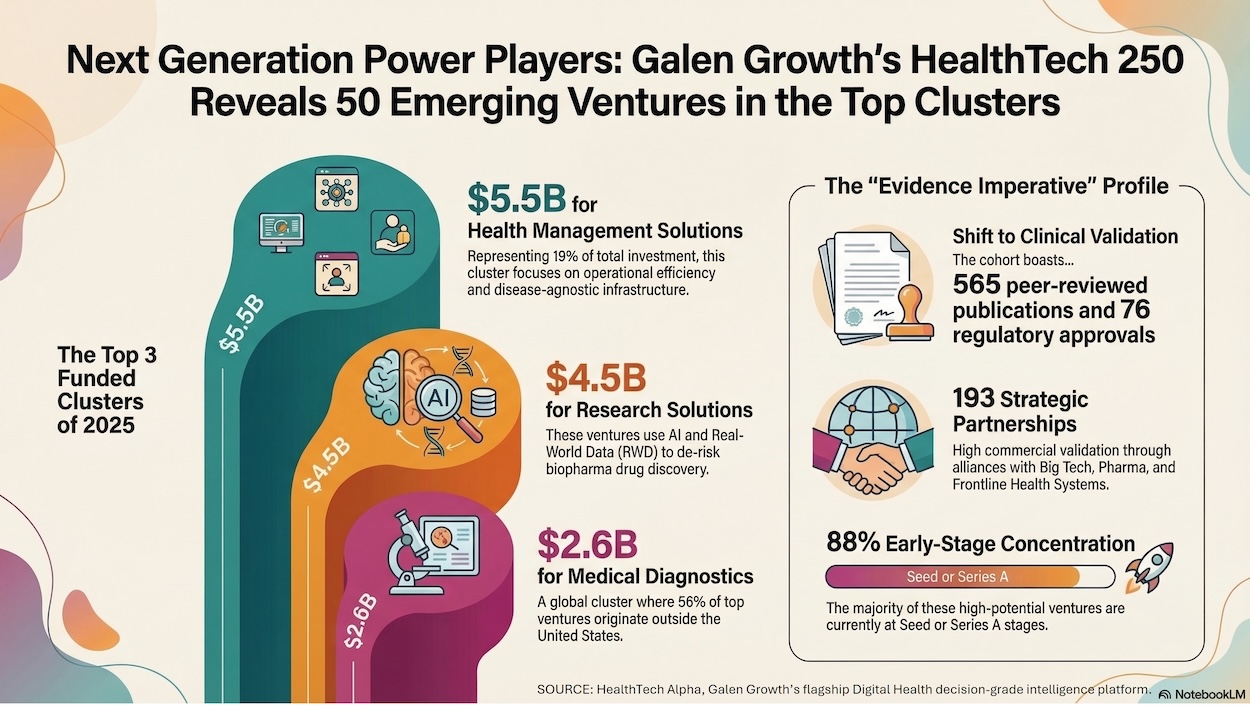
Leading the global digital health funding table is Health Management Solutions, which commanded an impressive $5.5 billion, representing 19% of total investment in 2025.
This cluster constitutes the largest infrastructure segment within the HealthTech 250, heavily populated by disease-agnostic platforms built to alleviate systemic administrative burdens.
Global health systems are buckling under administrative strain and staffing shortages. These solutions automate friction across operational workflows.
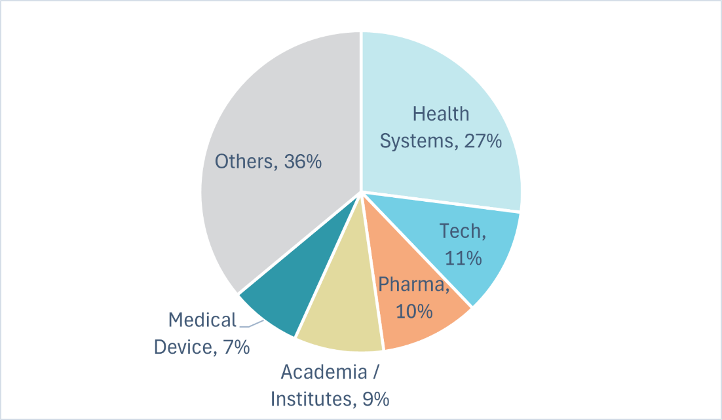
A notable 32% of partnerships are with frontline health systems, while 19% involve Big Tech—highlighting strong enterprise adoption.
These ventures embed directly into enterprise architectures supported by platforms like Microsoft and Salesforce, reinforcing their role as core infrastructure rather than standalone tools.
Cluster 2: Research Solutions – De-risking Biopharma Innovation ($4.5 Billion)
The Research Solutions cluster captured $4.5 billion globally, or 16% of venture capital deployed in 2025.
These ventures have moved beyond theoretical AI, using Real-World Data and massive datasets to refine drug discovery tools.
By leveraging synthetic data and generative AI, they compress timelines in early-stage biopharma R&D.
This creates a powerful investment thesis: capturing biotech upside via infrastructure while avoiding binary drug development risk.
Cluster 3: Medical Diagnostics – Unlocking the Global Precision Mandate ($2.6 Billion)
The Medical Diagnostics cluster secured $2.6 billion, accounting for 10% of funding.
56% of ventures originate outside the US, with Europe emerging as a powerhouse due to regulatory rigor.
In 2025 alone, these companies achieved 9 regulatory approvals, 3 clinical trials, and 81 peer-reviewed publications.
Here, clinical evidence is not optional—it is the baseline for commercial credibility.
The Strategic Alliance Ecosystem: The Ultimate Commercial Validation
Across the ecosystem, 175 partnerships have been formally announced, representing a leading indicator of commercial validation.
Big Tech involvement includes Anthropic, Microsoft, Salesforce, and Nvidia.
For example, HealthEx executed partnerships with Microsoft and Salesforce, embedding its solutions into enterprise infrastructure.
Pharmaceutical leaders such as Boehringer Ingelheim have partnered with HeartBeat.bio and ArrePath, reinforcing the strategic importance of startup collaboration.
Why This Analysis is Imperative for Industry, Investors, and Startups
The Benefit for the Industry
The HealthTech 250 provides a de-risked pipeline for external innovation, accelerating the shift toward “partner and integrate.”
The Benefit for Investors
Capital is concentrating in infrastructure and evidence-backed platforms with strong validation metrics.
The Benefit for Startups
Success depends on clinical validation, operational resilience, and early enterprise partnerships.
Galen Growth Point of View
The digital health ecosystem has matured into a disciplined, institutional asset class.
The 2026 HealthTech 250 confirms a structural shift toward evidence-backed infrastructure.
For investors and industry leaders, the directive is clear: value lies in validated, scalable infrastructure rather than speculative disruption.
Download the full HealthTech 250 list via the official page.