Q3 is the ideal window for healthcare leaders to convert uncertainty into decision-ready intelligence before the commercial, strategic and budget pressures of Q4 arrive.
Key takeaways
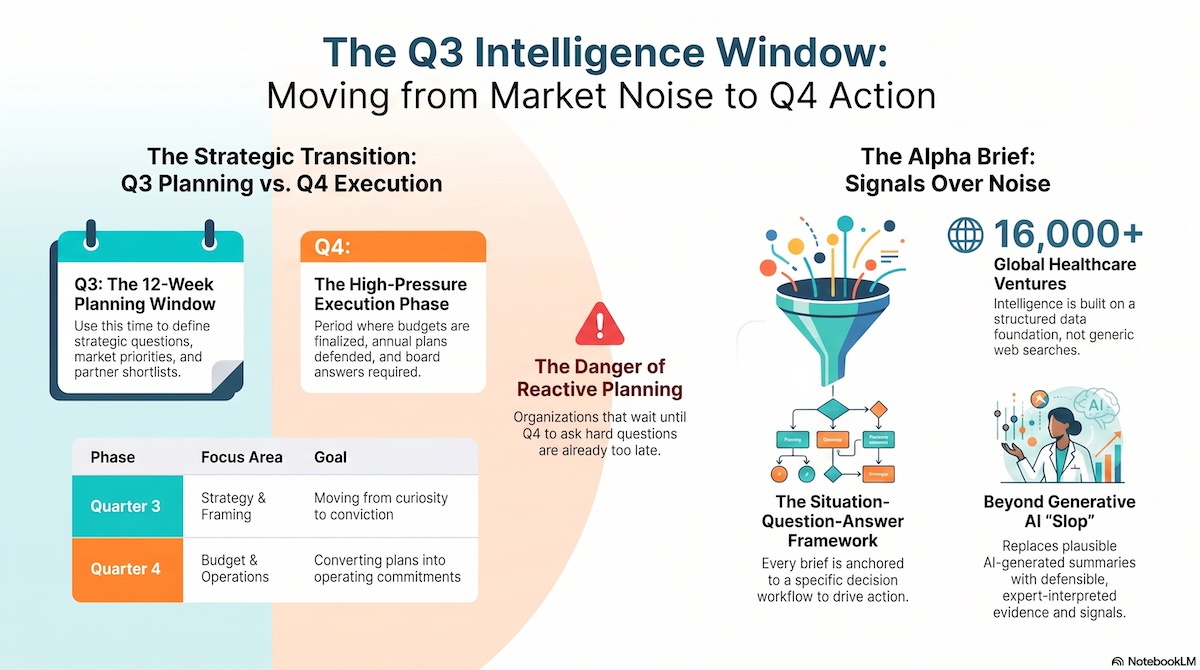
- Q3 gives healthcare leaders roughly 12 weeks to define the strategic questions, market priorities and partner shortlists that will shape Q4 execution.
- Galen Growth Alpha Briefs are designed to answer one specific healthcare innovation question with decision-ready intelligence powered by HealthTech Alpha and analyst interpretation.
- HealthTech Alpha tracks more than 16,000 healthcare innovation ventures globally, giving Alpha Briefs a structured data foundation rather than a generic web-search baseline.
- The Alpha Brief is most valuable when a leadership team has a live decision: whether to enter a market, assess a technology category, prioritise partners, monitor competitors or pressure-test an investment thesis.
- For pharma, medical device, payer, provider, investor and consumer healthcare teams, the Q3 question is not “what is happening?” but “what should we do before Q4?”
Healthcare innovation has become easier to search and harder to understand.
That is the paradox facing leadership teams in 2026. Generative AI has made it possible to produce general market summaries, company lists and trend overviews at extraordinary speed. But it has not made the underlying decision any easier. In many cases, it has made the problem worse: more sources, more claims, more duplicated commentary, more unverified venture positioning, and more executive noise.
The leadership problem is no longer access to executive briefs. It is the ability to separate signal from slop before a strategic decision needs to be made.
That is why Galen Growth created the Alpha Brief.
An Alpha Brief is not a report for the sake of having a report. It is a focused intelligence product designed around a specific decision question. It combines HealthTech Alpha data, Galen Growth’s healthcare innovation taxonomy and analyst interpretation to help leaders decide where to focus, which companies to assess, which risks to monitor and which next steps are worth taking.
The timing matters. Q3 is the planning window. Q4 is the execution window.
By the time Q4 arrives, leadership teams are under pressure: budgets are being finalised, partnerships are being advanced, annual plans are being defended, and boards want sharper answers. The organisations that wait until Q4 to start asking the hard questions are already late. The organisations that use Q3 to frame those questions properly can enter Q4 with stronger conviction, better evidence and a clearer path to action.
The situation: more intelligence volume, less decision clarity
Healthcare leaders are now surrounded by information but still short of confidence.
A pharmaceutical innovation team can ask an LLM for a view on AI in clinical trials. A medical device company can scrape the web for remote monitoring ventures. An insurer can search for companies addressing claims automation. A consumer healthcare group can ask for trends in metabolic health, longevity, women’s health or digital therapeutics.
The output will often look plausible. It may even be useful as a starting point.
But strategic decisions require more than plausible output. They require a defensible view of which companies matter, which signals are meaningful, which partnerships are real, which competitors are active, which evidence claims are credible, and which market movements are material.
That distinction is now critical.
Healthcare innovation is not a general technology market. It is shaped by clinical evidence, regulatory status, reimbursement pathways, workflow integration, purchasing cycles, data governance, and specialist corporate priorities. A venture that looks interesting in a public search result may be commercially immature. A company with strong funding may have weak evidence. A category with high media visibility may have poor adoption. A vendor that looks independent today may become strategically conflicted after an acquisition.
This is where generic AI search reaches its limit.
The Alpha Brief starts from a different premise: the question must be framed before the answer is generated. A useful intelligence product does not begin with “tell me everything about digital health”. It begins with a board-level or management-level question such as:
- Which AI clinical trial vendors are mature enough for pharma partnership consideration?
- Which healthcare technology companies are best positioned for payer adoption?
- Which digital health categories are most relevant to consumer healthcare companies entering prevention and self-care?
- Which ventures should a corporate development team monitor before Q4 planning?
- Which competitor partnerships signal a material shift in market direction?
The value of the Alpha Brief lies in forcing that discipline upfront.
The question: what decision needs to be made before Q4?
The most important question for Q3 is not “what trends are emerging?” It is “which decisions must be better informed before Q4?”
That shift matters.
Too many organisations treat market intelligence as a periodic knowledge exercise. They commission broad landscapes, read trend reports, circulate internal summaries and then return to the same unanswered questions. The result is familiar: more documents, but not necessarily better decisions.
The Alpha Brief is built to avoid that trap.
Each brief should be anchored to a decision workflow. The output may include a market map, company shortlist, competitor scan, signal analysis, partnership review, category assessment or strategic implication memo. But the format is secondary. The starting point is always the decision.
For a pharmaceutical company, the question may be whether a digital biomarker category is ready for clinical development partnerships. For a medical device company, it may be which software-enabled care models are changing the competitive landscape. For a payer, it may be which care-navigation or claims-intelligence companies are gaining enough traction to merit evaluation. For a provider, it may be which workforce, capacity or care-access solutions are credible enough to pilot. For an investor, it may be whether a market is still investable or already overcapitalised. For a consumer healthcare company, it may be where prevention, self-care and digital health are converging into commercially relevant opportunity spaces.
In each case, the brief must answer three questions:
Situation: What is changing in the market, and why does it matter now?
Question: What decision does the client need to make, and what evidence is required?
Answer: What does the data suggest, what are the implications, and what should the client do next?
This situation-question-answer structure is deliberately simple. It prevents the intelligence product from becoming a descriptive market tour. It keeps the analysis tied to action.
The answer: Alpha Briefs turn HealthTech Alpha into decision-ready intelligence
The Alpha Brief converts HealthTech Alpha’s structured intelligence into an executive-ready answer.
HealthTech Alpha is the data foundation. It tracks more than 16,000 healthcare innovation ventures globally, with information on funding, maturity, partnerships, product focus, clinical evidence, innovation signals and corporate relationships. That matters because the quality of the answer depends on the quality of the underlying data structure.
But data alone is not enough.
A company list is not a strategy. A market map is not a recommendation. A dashboard export is not an executive answer. The missing layer is interpretation: what the evidence means, what should be prioritised, what remains uncertain and where the client should act.
That is the role of the Alpha Brief.
An effective Alpha Brief should do five things.
First, it should narrow the problem. Instead of summarising a broad market, it should define the decision scope: geography, customer segment, technology category, maturity stage, evidence threshold and strategic objective.
Second, it should identify the relevant companies or categories. Not the loudest companies. Not only the best-funded companies. The relevant companies.
Third, it should explain why they matter. This requires signals: funding, partnerships, evidence, momentum, product maturity, corporate overlap and competitive positioning.
Fourth, it should show the implication. The brief should tell the reader what the pattern means for their role as a buyer, partner, investor, competitor or market entrant.
Fifth, it should support action. The output should lead to a shortlist, a management discussion, a partner outreach plan, an investment screen, a board update or a deeper research project.
That is the practical value: less noise, more judgement, clearer next step.
Why Q3 is the right time to commission Alpha Briefs
Q3 is the last strategic window before Q4 execution pressure takes over.
The mistake many organisations make is to treat Q4 as the moment to begin planning. In practice, Q4 is when decisions get compressed. Budgets are negotiated. Leadership priorities are locked. Partner discussions accelerate. Strategic initiatives are defended. Annual plans are converted into operating commitments.
If the intelligence work begins in Q4, it risks becoming reactive. The organisation is already inside the decision cycle.
Q3 is different. It offers enough time to ask better questions, test assumptions, compare options and prepare the internal case. It is the ideal period to move from curiosity to conviction.
For Galen Growth clients, that means using Q3 to answer the questions that will matter in Q4:
- Which healthcare innovation categories should we prioritise next year?
- Which companies should we evaluate before competitors do?
- Which market assumptions are no longer supported by the data?
- Which existing partnerships, vendors or investments require review?
- Which emerging technologies are commercially relevant rather than merely fashionable?
- Which opportunities are material enough to justify deeper work?
The Alpha Brief is not meant to replace a full strategy project. It is designed to create the evidence-based starting point for one.
That is particularly important in an environment where leadership teams are being asked to move faster while being more accountable for the quality of their decisions. Boards are less tolerant of vague innovation narratives. Business units want evidence. Strategy teams need defensible prioritisation. Corporate development teams need sharper market maps. Commercial teams need relevance. Innovation teams need credibility.
Q3 is when those ingredients can still be assembled before Q4 pressure hardens the agenda.
What this means
For pharma and life sciences companies:
Alpha Briefs can help teams prioritise disease-area adjacencies, digital biomarker categories, AI-enabled discovery and development tools, clinical trial technologies, patient engagement models and evidence-generation partners. The immediate Q3 value is sharper Q4 planning: fewer generic landscapes and more decision-ready shortlists.
For medical device companies:
Alpha Briefs can support decisions around connected care, remote monitoring, diagnostics, software-enabled services, digital surgery, workflow intelligence and post-market engagement. The strategic issue is not whether software matters; it is which software-enabled models are becoming relevant to the device business.
For payers, providers and health systems:
Alpha Briefs can help assess categories such as care navigation, workforce optimisation, claims intelligence, virtual care, chronic disease management and access solutions. These organisations need evidence on operational fit, maturity and adoption rather than venture-market hype.
For investors:
Alpha Briefs can support thesis development, category screening, competitor mapping and portfolio monitoring. In a market where exit timelines have lengthened and capital efficiency matters, investors need to know which categories have real strategic buyers, not just attractive narratives.
For consumer healthcare companies:
Alpha Briefs can help evaluate where self-care, prevention, longevity, metabolic health, women’s health, nutrition, behaviour change and digital health are converging. The opportunity is real, but category selection matters: consumer relevance does not automatically translate into healthcare credibility.
For digital health ventures:
Alpha Briefs create a sharper view of how strategic buyers, investors and partners may assess their category. Ventures that understand the evidence thresholds, partnership expectations and competitive signals of large organisations are better positioned to shape their narrative.
FAQ
What is a Galen Growth Alpha Brief?
A Galen Growth Alpha Brief is a focused intelligence brief that answers a specific healthcare innovation question using HealthTech Alpha data and Galen Growth analyst interpretation. It is designed to support a decision, not simply describe a market.
How is an Alpha Brief different from a generic market report?
A generic market report summarises a topic. An Alpha Brief starts with a client decision question and works backwards to the evidence required. The output is more focused, more actionable and more relevant to a specific Q3 or Q4 business priority.
Why is Q3 the ideal timing for an Alpha Brief?
Q3 gives leadership teams roughly 12 weeks to prepare before Q4 execution, budgeting and annual planning pressure intensifies. Commissioning an Alpha Brief in Q3 helps teams enter Q4 with clearer priorities, stronger evidence and better-prepared internal recommendations.
What types of questions can an Alpha Brief answer?
An Alpha Brief can address questions on market entry, partner identification, competitor activity, venture maturity, investment themes, category prioritisation, technology readiness, evidence quality and strategic risk across healthcare innovation.
Who should commission an Alpha Brief?
Alpha Briefs are relevant for pharma, medical device, payer, provider, investor, consulting, big tech and consumer healthcare teams that need a decision-ready view of a healthcare innovation opportunity, market or company set.
Data source and methodology
Data source: HealthTech Alpha by Galen Growth. HealthTech Alpha tracks more than 16,000 healthcare innovation ventures globally, including venture profiles, funding history, maturity indicators, product focus, clinical evidence, partnerships and corporate relationships. Alpha Briefs combine this structured data foundation with Galen Growth analyst interpretation. Each Alpha Brief is scoped around a specific client question, geography, technology category, maturity threshold and intended decision use case.
Related Galen Growth analysis
How to cite this analysis
APA:
de Salaberry, J. (2026, June 23). The Q3 intelligence window: Why Alpha Briefs matter before the Q4 push. Galen Growth. https://www.galengrowth.com/blog/alpha-brief-q3-q4-healthcare-innovation-intelligence-2026/
Short form:
de Salaberry, Galen Growth, June 2026.
About Galen Growth
Galen Growth is the healthcare innovation intelligence company behind HealthTech Alpha, the decision-grade platform tracking the global healthcare innovation ecosystem. We combine structured data, proprietary taxonomy, analyst interpretation and AI-powered intelligence to help pharma, medical device, payer, provider, investor and corporate clients make better strategic decisions.