
A new architecture for an old problem
Healthcare has never lacked ideas. Its more persistent affliction is an inability to distinguish the good ones from the merely fashionable, and to turn the former into businesses that survive beyond an enthusiastic pilot. Hospitals are awash with unmet needs, clinicians regularly encounter problems technology ought to solve, and venture capitalists have spent billions backing entrepreneurs determined to change how healthcare operates. Yet bridging the gap between identifying a clinical problem and delivering a commercially sustainable solution remains remarkably difficult.
Part of the difficulty lies in the industry's fragmented innovation model. Clinicians identify problems, entrepreneurs develop products, investors provide capital and hospitals are eventually invited to buy the results. Each participant operates with different incentives, imperfect information and surprisingly limited visibility into what the others are doing. A technology company may spend years developing a solution before discovering hospitals cannot integrate it into existing workflows. A health system may commission software without realising that an equivalent, clinically validated product is already operating successfully elsewhere. Meanwhile, investors may finance competing ventures pursuing essentially identical opportunities, each convinced that its approach is revolutionary.
The announced merger of Redesign Health and ARC Global, the healthcare innovation network founded at Israel's Sheba Medical Center, represents an intriguing attempt to change this arrangement. Alongside the proposed acquisition of AVIA, a digital-health intelligence and advisory business, the combined organisation intends to bring clinical expertise, venture creation, artificial intelligence, capital and commercial distribution into a more integrated operating model.
The proposition has considerable attractions. Rather than treating hospitals merely as customers of technologies developed elsewhere, the combined group seeks to make them active participants in creating, validating and commercialising innovation. According to the October 22nd announcement, the organisations collectively work with more than 100 health systems across five continents. Companies and products developed through their networks have reportedly reached more than 100 million patients, while AVIA brings an intelligence platform used by over 90,000 healthcare leaders and staff to evaluate more than 7,000 digital solutions.
These are impressive assets, particularly in an industry where access to clinical environments and willing customers can prove more valuable than another injection of venture capital. If the combined organisation can translate that access into repeatable company creation and technology deployment, it could address some of healthcare innovation's most stubborn structural inefficiencies.
Yet vertical integration, however sensible, does not automatically make the resulting organisation more intelligent. Connecting the people who identify problems with those who build solutions is one achievement. Ensuring that they pursue the right opportunities, avoid duplicating existing technologies and allocate capital more productively is quite another.
That distinction may ultimately determine whether the Redesign–ARC–AVIA combination becomes a genuinely global innovation engine or simply a larger and better-connected venture builder.
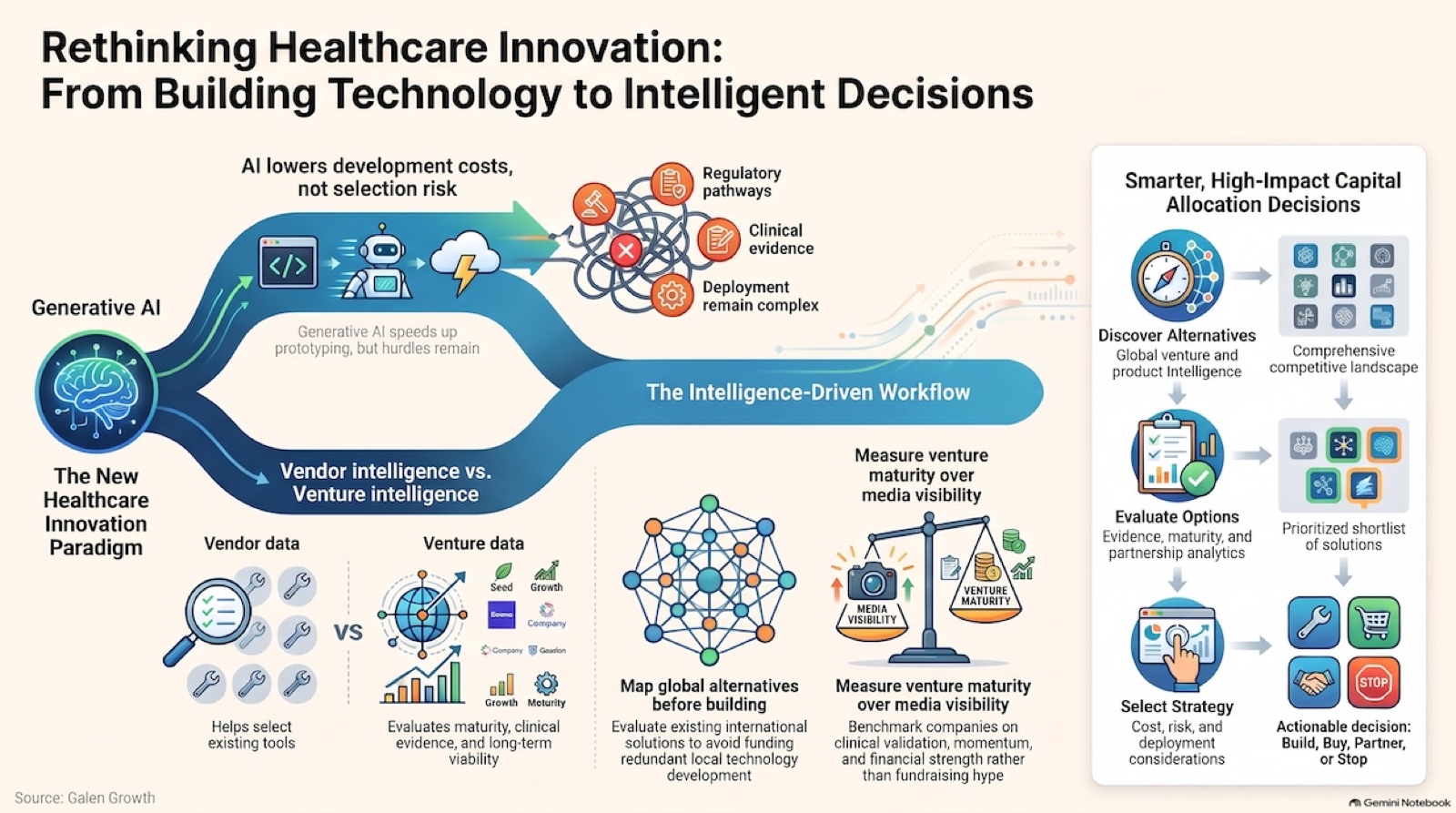
AI is making it easier to build. Not necessarily wiser.
For much of the software industry's history, creating technology was expensive enough to constitute a competitive advantage. Engineering talent was scarce; development cycles were lengthy, and turning an idea into a functioning product demanded substantial capital. Investors accepted these costs because the barriers to entry could also protect the businesses they financed.
Artificial intelligence is rapidly changing the calculation. Generative AI and increasingly capable software-development agents are reducing the time and resources required to build applications, automate workflows and test new products. Smaller engineering teams can accomplish tasks that previously demanded far larger organisations. For healthcare venture builders, whose capital requirements have often been inflated by prolonged development cycles, this ought to be welcome news.
But cheaper development creates a curious paradox. As the cost of building technology falls, the economic consequences of choosing the wrong technology need not fall with it. Clinical validation remains expensive. Regulatory requirements have not disappeared. Healthcare procurement remains complicated by fragmented budgets, entrenched workflows, and institutional risk aversion. And, where relevant, achieving reimbursement remains considerably harder than producing an impressive product demonstration.
Indeed, AI may worsen one longstanding problem: duplication. When it becomes easier to develop software, more entrepreneurs can pursue similar opportunities, often without a sufficiently comprehensive understanding of existing competitors. An industry already crowded with digital-health applications may soon find itself even more crowded with AI-enabled versions of essentially the same ideas.
Consider a hospital that identifies an opportunity to improve patient monitoring through AI. Its clinicians understand the problem and its engineering partners believe they can develop a solution. In the conventional model, that may be sufficient to launch a project. In an AI-enabled venture-building model, the temptation to proceed can be even stronger because an early prototype can be produced quickly and cheaply.
Yet the commercially rational starting point is not whether the proposed application can be built. It is whether it should be built at all. Comparable solutions may already exist in other hospitals or countries. Some may possess stronger clinical evidence, more mature regulatory approvals or more credible commercial partnerships. Others may be available for licensing or acquisition at a fraction of the cost and risk associated with developing a new company.
The appropriate response might be to build. Equally, it might be to buy, partner or abandon the idea. Making that judgement requires a depth of intelligence that no amount of engineering productivity can replace.
Deciding not to establish a company has little glamour. Venture builders are generally celebrated for the businesses they create, not the investments they wisely decline. Yet as AI lowers the cost of producing technology and increases the number of plausible alternatives, the discipline to avoid unnecessary development may become one of a healthcare innovation organisation’s most valuable capabilities.
Global ambitions require more than a global network
The proposed combination's international reach introduces another challenge that an organisation accustomed to operating within the American healthcare market often underestimates.
Healthcare's problems may be universal, but its markets remain stubbornly local. Hospitals in Boston, Basel and Singapore may face similar workforce shortages, rising costs and growing demand for chronic-disease management. The technologies capable of addressing those problems, however, must operate within very different regulatory, reimbursement and procurement systems. A product that fits neatly into an American health system may need substantial modification to work in the NHS, while an AI diagnostic successful in Asia may face different evidence requirements or purchasing incentives in continental Europe.
These differences matter for commercial expansion, but they also matter much earlier, when organisations are deciding which innovations deserve attention. An American health system considering a new remote-monitoring application may find that the most relevant existing solution was developed in the Netherlands. A European hospital seeking to improve clinical workflow efficiency might discover a mature product in South Korea or Singapore. The fact that such technologies are less visible to domestic investors does not make them less useful.
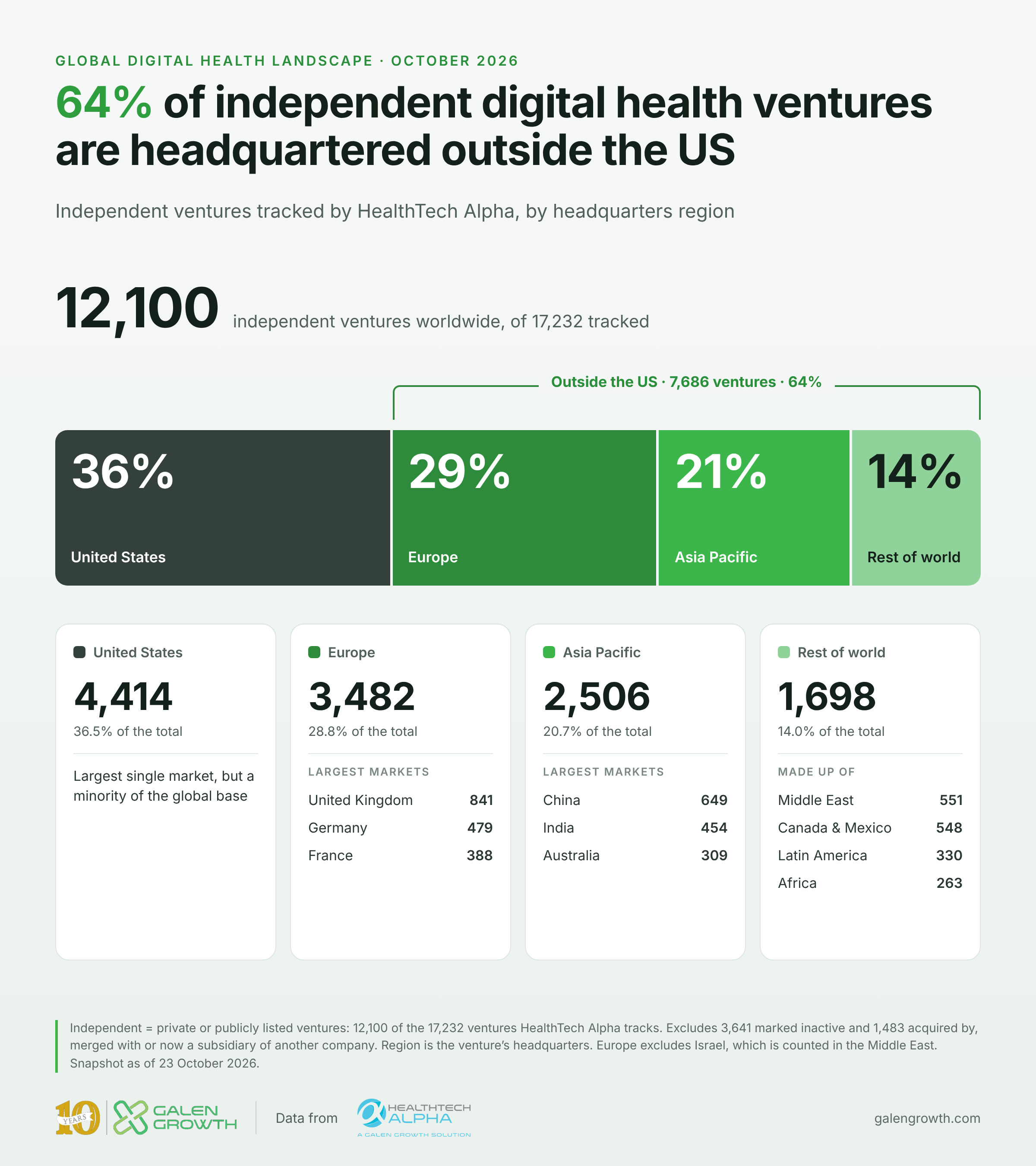
At Galen Growth, we have spent more than a decade studying this fragmented landscape. Our HealthTech Alpha intelligence platform tracks more than 17,000 digital-health ventures globally, with longitudinal information extending back over two decades. The dataset includes venture development, financing, technologies, products, partnerships, clinical evidence, regulatory activity and commercial relationships. It aims to make a complex, geographically dispersed market more intelligible to the organisations trying to navigate it.
One recurring difficulty is that the geography of innovation cannot be reduced to the location of company headquarters. A venture incorporated in the United States may conduct substantial development abroad, while a company headquartered in Europe may generate most of its revenue in North America. Regulatory approvals, clinical trials and commercial partnerships can span several jurisdictions, each with different implications for deployment.
Consequently, a global innovation platform needs more than a map showing where companies originate. It needs to understand where technologies are validated, which healthcare systems have adopted them, how commercial models vary, and whether successful deployment in one market credibly signals scalability elsewhere.
That distinction matters especially for an organisation trying to turn a network of hospitals into an international engine for company creation. The network itself offers access to clinical problems, design partners and potential customers. But it cannot, by itself, provide a comprehensive picture of the technologies and competitors operating beyond its boundaries.
Global distribution is not the same as global intelligence. The former helps an organisation bring solutions to market. The latter helps it establish which solutions are worth bringing to market in the first place.
Source: HealthTech Alpha Premium, Galen Growth.
The geographic picture matters because a venture builder's opportunity set should not be determined by the reach of its existing relationships. A promising clinical problem identified in one hospital may already have attracted several credible solutions elsewhere. Conversely, a technology developed for a particular healthcare system may address an unmet need in markets where local innovation remains limited.
Neither possibility is readily apparent without systematic international discovery. And both have direct implications for investment strategy.
AVIA solves an important problem. But which one?
The proposed acquisition of AVIA is arguably the most revealing element of the transaction. Its inclusion suggests the combined organisation recognises intelligence as a key part of the healthcare innovation value chain, alongside engineering, capital, and clinical access.
AVIA has spent more than a decade helping American healthcare organisations understand digital transformation, evaluate technologies and translate strategic ambitions into purchasing and implementation decisions. Its platform provides structured information on digital solutions, comparative evaluations and insights intended to help health systems navigate a crowded vendor market.
Such capabilities are valuable because hospitals are not natural technology buyers. Procurement decisions often involve competing clinical, financial, technical and operational priorities, while the evidence available to distinguish vendors can be inconsistent or incomplete. A platform that helps institutions make better technology choices addresses a genuine source of inefficiency.
However, there is a distinction between the intelligence needed to purchase technology and that required to build or invest in technology businesses. A hospital choosing a patient-engagement platform wants to know which products meet its requirements, how they compare and what other customers have experienced. A venture builder contemplating investment in patient engagement must ask a much broader set of questions: how the market is evolving, which companies are emerging, where competitive advantages reside, how defensible different technologies may be and whether an attractive investment opportunity exists at all.
The former is principally a technology-selection problem. The latter is a market-structure and capital-allocation problem.
This distinction should not be overstated. AVIA's capabilities extend beyond simple vendor discovery, and its intelligence may well evolve further within the combined organisation. Nor would it be meaningful to compare AVIA's reported 7,000-plus evaluated solutions directly with HealthTech Alpha's universe of more than 17,000 ventures and circa 125,000 evaluated solutions. A solution and a venture are different units of analysis, and database size alone says little about relevance or quality.
The more interesting question is how different forms of intelligence might reinforce one another.
AVIA brings expertise in technology evaluation, healthcare purchasing requirements, and provider-oriented digital transformation. Redesign contributes venture-building experience and an AI-enabled architecture intended to connect healthcare needs with development capabilities. ARC brings clinical access and relationships across health systems.
A complementary global venture-intelligence layer could connect these capabilities to a much wider view of emerging companies, technologies, competitive relationships and evidence. Rather than merely helping hospitals choose between products already on their radar, the combined system could help identify which products deserve attention, which companies merit investment, and where a new venture would address a genuine market gap.
This would be a meaningful evolution from technology intelligence as a research service towards intelligence as part of the infrastructure supporting healthcare innovation.
The prize is not a larger database. It is a more complete understanding of the choices available before capital, engineering resources and clinical attention are committed.
The problem with promising companies
Comprehensive discovery is necessary, but it is not sufficient. Knowing that a technology exists is very different from knowing whether the company behind it can deliver.
Digital health has spent much of the past decade showing how easily commercial promise can be mistaken for publicity. A substantial fundraising round, an impressive list of investors and a persuasive presentation may generate considerable enthusiasm without establishing whether a technology works in clinical practice or whether its business model is sustainable. Conversely, less fashionable companies may quietly accumulate meaningful clinical evidence and durable customer relationships without attracting comparable attention.
For healthcare investors and venture builders, these distinctions are unusually consequential. A company can possess an excellent product yet lack the financial resources required to support a large hospital deployment. Another may enjoy strong commercial momentum but have relatively limited evidence of clinical effectiveness. A third may have both technical and clinical strengths but depend on a narrow domestic market whose reimbursement model doesn't translate internationally.
These are different kinds of risk. Treating them as interchangeable because all three companies operate in the same technology category invites poor capital allocation.
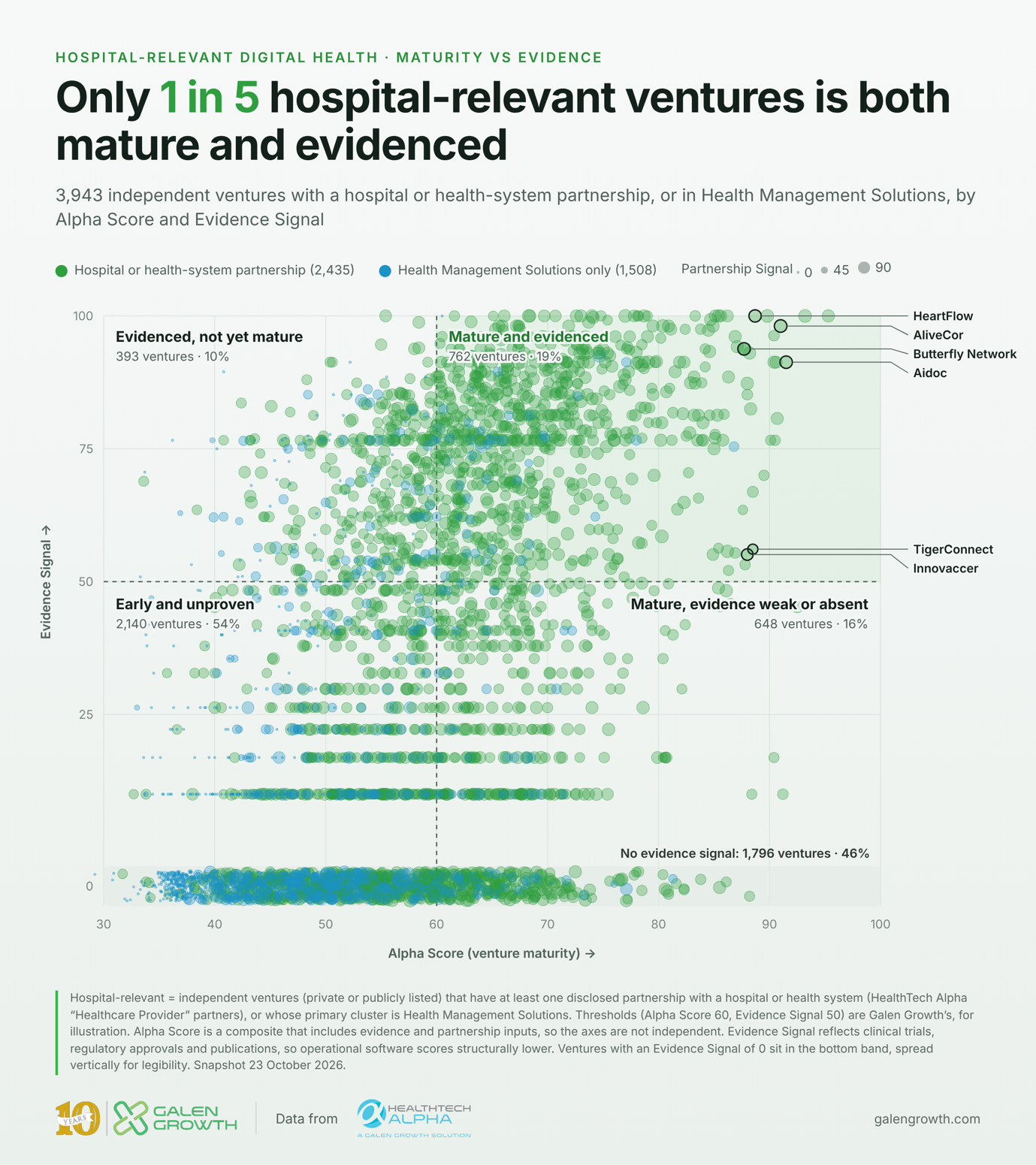
HealthTech Alpha developed proprietary analytics to make these distinctions more systematic. Its Alpha Score evaluates venture maturity through four dimensions—Momentum, Money, Market and Innovation—while additional indicators assess the strength of leadership teams, partnerships and available clinical or regulatory evidence. The intention is to provide a consistent basis for comparing ventures, identifying strengths and weaknesses and prioritising opportunities for deeper investigation.
Such scores are not crystal balls. No algorithm can reliably replace rigorous clinical assessment, commercial due diligence or the judgement of experienced investors. But structured analytics can reveal differences easily obscured by marketing claims or funding headlines, especially when evaluating hundreds of companies across multiple markets.
Imagine two ventures developing AI-enabled diagnostic software. One may have established a credible record of clinical validation but remain commercially immature. Another may have secured several prominent partnerships yet possess weaker evidence of clinical benefit. Both may look attractive at first glance, but the investment, partnership, and deployment decisions they warrant could differ markedly.
For a venture-building organisation, understanding those differences helps determine whether to acquire a mature technology, partner with an emerging company, finance further development or establish an entirely new venture.
The ability to make such comparisons becomes more valuable as the universe of potential solutions expands. AI may reduce the effort required to identify candidate companies, but it does not remove the need to distinguish commercial traction from publicity, clinical validation from aspiration or genuine competitive advantage from technological novelty.
Source: HealthTech Alpha Premium, Galen Growth.
The larger lesson is that innovation quality is multidimensional. A company may be technologically sophisticated without clinical validation, commercially successful without international scalability, or well financed without a durable competitive advantage.
For investors, these distinctions influence valuation and risk. For hospitals, they influence procurement and implementation. For venture builders, they determine whether an opportunity should be pursued at all.
A more comprehensive view of venture maturity cannot eliminate mistakes, but it can make some of the most avoidable ones considerably harder to justify.
Turning intelligence into a decision, rather than another report
The conventional market-research model is poorly suited to a continuously changing innovation environment. An organisation identifies a problem, commissions a landscape analysis, receives a presentation and makes a decision. Months later, new companies have emerged, competitors have raised capital, clinical evidence has changed, and the original analysis may already be out of date.
This creates a particularly awkward problem for a venture builder operating across a large healthcare network. If every hospital or innovation team independently commissions research into similar problems, the organisation risks recreating the same fragmented intelligence processes it was established to overcome.
A more compelling approach would treat market intelligence as a continuous workflow rather than a series of isolated research assignments.
When a participating hospital identifies an unmet need, the organisation could start by mapping the relevant global market, identifying established and emerging technologies, and comparing their clinical, commercial, and financial maturity. That analysis could then inform the decision to build, buy, partner or decline the opportunity. Once a course of action is selected, subsequent evidence—new partnerships, regulatory progress, funding developments or deployment outcomes—could be monitored against the original assumptions.
In principle, every decision could improve the next one.
The practical implications are considerable. A health system considering another patient-engagement application might find that several credible providers already operate internationally, making a partnership more attractive than creating a new company. A venture builder examining clinical workflow automation might identify a highly fragmented market with no sufficiently mature solutions, creating a stronger case for new development. An investor evaluating a potential acquisition could compare the target's performance and evidence against an independently defined peer group rather than relying principally on management's chosen comparables.
None of these examples requires a revolutionary new AI model. They require reliable intelligence, a coherent evaluation framework and the ability to connect research to decisions.
This is where the relationship between provider intelligence, venture intelligence and clinical expertise becomes especially interesting. Each addresses a different part of the same economic problem. Integrated effectively, they could reduce duplication, improve prioritisation, and let innovation teams spend more time on decisions that genuinely require human judgement.
The resulting system would be valuable not because it produces more reports, but because it helps organisations make fewer decisions based on incomplete information.
Agentic AI needs something worth reasoning about
Redesign Health has described a proprietary AI operating system supported by a healthcare knowledge graph. This is an important architectural choice, and one that reflects a broader transformation in enterprise technology.
Much of the first wave of generative AI focused on making existing activities faster: summarising documents, answering questions, preparing presentations and searching for information through conversational interfaces. The emerging generation of agentic systems promises something more ambitious. Rather than simply assisting with individual tasks, these systems can coordinate multiple steps within a workflow, interact with software tools and prepare decisions or actions for human approval.
For healthcare innovation, the possibilities are substantial. An AI system could begin with a clinical problem, identify relevant technology categories, map companies operating within them, assemble evidence and prepare an initial assessment of potential investment or partnership candidates. Tasks that once took weeks of analyst time could increasingly be completed much faster.
But speed is not synonymous with accuracy, and sophisticated reasoning is of limited value when built upon unreliable information.
A general-purpose AI model may identify companies mentioned in publicly available sources, but it cannot automatically guarantee that the resulting universe is complete. It may struggle to distinguish between organisations with similar names, interpret ambiguous technology descriptions or recognise that an announced clinical partnership never progressed beyond a pilot. It may retrieve a regulatory claim without understanding the jurisdiction or product version to which it applies.
Such errors are not merely inconvenient when the resulting analysis influences investment, procurement or clinical decisions. They can be expensive.
This explains the growing strategic importance of domain-specific intelligence infrastructure. Proprietary ontologies help establish consistent definitions. Structured data pipelines improve comparability. Evidence-linked records and transparent provenance make conclusions easier to challenge and defend. Continuous updates reduce the risk that decisions rely on obsolete information.
HealthTech Alpha combines these elements through a specialist digital-health ontology, longitudinal venture data, proprietary analytics and AI-assisted retrieval. The platform exposes its intelligence and integrates it into enterprise environments through APIs and AI interfaces.
The broader architectural principle is more important than any interface: general-purpose AI can provide the reasoning and user experience, while specialist intelligence supplies the domain knowledge required to make that reasoning useful.
For healthcare innovation organisations, the opportunity is to move beyond asking an AI assistant to find companies and towards systems that can support a sequence of decisions—from defining an unmet need to identifying alternatives, assessing evidence, and monitoring subsequent performance.
There are limits, of course. An AI agent that produces a plausible investment recommendation has not thereby demonstrated that the investment is sound. Reliable deployment requires governance, access controls, evaluation procedures, audit trails and clear human responsibility for consequential decisions. Healthcare, with its regulatory complexity and exposure to clinical risk, is not an industry in which confidence should be mistaken for competence.
Nor is there any guarantee that simply connecting a knowledge graph to an AI model will produce a durable competitive advantage. Defensibility lies in the quality, coverage, and update cadence of the underlying intelligence, the associated rights, and the organisation's ability to embed it into workflows that deliver measurable outcomes.
The future of healthcare intelligence will therefore be decided not by which provider offers the most conversational interface. It will be decided by which systems can consistently turn specialist knowledge into faster, more defensible decisions that are less prone to costly errors.
An uncomfortable question of independence
Another complication arises from bringing venture creation, technology evaluation, and healthcare purchasing closer together.
An organisation that develops companies, invests in them and helps hospitals select technologies occupies several positions within the same value chain. This creates obvious opportunities for efficiency, but also potential conflicts of interest.
Suppose a participating hospital wishes to implement an AI-enabled clinical application. One solution has been developed by a company backed by the innovation network. Another is offered by an independent competitor with stronger clinical evidence or a more attractive commercial proposition. How should the hospital decide between them, and what safeguards ensure that the recommendation reflects its interests rather than those of the investor?
Such questions are not peculiar to Redesign, ARC or AVIA, nor do they imply that any of the organisations intend to favour their own investments. They are structural questions that arise whenever an organisation combines the roles of investor, developer, adviser and commercial intermediary.
Indeed, the more successful the combined platform becomes, the more important the issue may grow. A network spanning numerous healthcare institutions could become an influential distribution channel for technologies developed within its own ecosystem. That influence would bring commercial advantages, but it could also make independent evaluation more valuable.
Transparent benchmarking, explainable scoring, and a clear separation between evidence assessment and commercial incentives could help build confidence among hospitals, clinicians, procurement teams, and investors. An internally developed technology that genuinely outperforms available alternatives should be objectively compared. One that does not should face the same scrutiny as any external competitor.
This is another reason why external market intelligence matters. An organisation's proprietary knowledge of its own portfolio, however detailed, is not necessarily sufficient to establish whether that portfolio represents the best available innovation.
Comparing internal ventures against a wider global market provides a useful check on institutional enthusiasm. It may reveal overlooked competitors, emerging threats or alternative technologies that offer better clinical or commercial outcomes.
In an industry where innovation programmes are often judged by the initiatives they launch, recognising that an external solution is superior would be a refreshing development.
It might also be good business.
The real prize is better capital allocation
The Redesign–ARC–AVIA combination is intriguing because it tries to address several weaknesses in healthcare innovation at once. It brings the source of clinical problems closer to the capabilities required to develop solutions, while adding intelligence intended to improve technology selection and deployment. If executed well, the model could reduce friction between invention and implementation and create more efficient routes from clinical need to commercial adoption.
But the economic value of integration will depend on whether it improves the allocation of scarce resources.
Hospitals are under financial pressure. Clinical staff have limited time. Investors are increasingly selective. Even with cheaper AI-assisted development, building, validating and commercialising healthcare technologies remains a demanding undertaking. The combined organisation will therefore need to decide not only which opportunities are attractive, but which are more attractive than the alternatives competing for the same capital and institutional attention.
That is a more demanding task than identifying promising technologies.
A venture builder may have the technical ability to develop dozens of applications, but that does not establish that each should become a company. A hospital network may generate hundreds of credible ideas, but the existence of unmet need does not guarantee an investable market. A technology may be clinically useful yet offer little commercial differentiation, especially if similar products already exist.
The discipline required is one of opportunity-cost management: understanding what is sacrificed whenever resources are committed to a particular course of action.
Global intelligence can make that discipline more rigorous by revealing alternatives that would otherwise remain invisible. Venture analytics can help distinguish companies with credible evidence and commercial maturity from those whose prospects remain speculative. Competitive benchmarking can identify crowded markets, while continuous monitoring can reveal when the assumptions supporting an investment are beginning to deteriorate.
None of these capabilities eliminates uncertainty. Healthcare innovation will always involve risk, and genuinely transformative technologies may initially possess limited evidence or commercial traction. Indeed, excessive reliance on historical benchmarks could discourage precisely the kinds of unconventional ideas that occasionally produce major breakthroughs.
The objective should therefore not be to automate investment judgement or avoid all risk. Instead, it should ensure that risk is understood, alternatives are examined, and decisions are made with sufficient awareness of what is already known.
This distinction matters particularly in the age of AI. As technology creation becomes easier, the economic bottleneck shifts from producing software to identifying differentiated opportunities, building evidence, and achieving adoption.
Put differently, the scarcity that creates value is shifting. Engineering capacity remains important, but access to reliable market intelligence, clinical expertise, distribution and sound judgement may become increasingly difficult to replicate.
For a global healthcare innovation organisation, these capabilities complement each other. Clinical networks identify problems and support validation. Engineering teams develop solutions. Capital enables investment. Commercial relationships facilitate deployment. Specialist global intelligence helps determine how to combine those resources—and when to direct them elsewhere.
That is what turns a collection of impressive assets into an effective innovation system.
The winners may be those who build less
There is a temptation to judge ambitious healthcare innovation platforms by network size, the number of ventures they launch, or the volume of capital they deploy. Such measures are visible, easy to communicate, and flattering to the organisations reporting them. They are not necessarily reliable indicators of value creation.
A venture builder that creates fewer companies but consistently identifies genuine gaps in the market may generate better returns than one producing a steady stream of undifferentiated applications. A hospital network that adopts existing, clinically validated technologies may improve outcomes more rapidly than one determined to develop its own alternatives. An investor who declines an attractive-looking opportunity after discovering superior competitors may have made a better decision than one who celebrates another completed transaction.
These are uncomfortable conclusions for an innovation industry that has spent years equating activity with progress.
The merger of Redesign Health and ARC Global, together with the proposed acquisition of AVIA, offers an opportunity to challenge that assumption. The combination of clinical access, technology development, investment capital and intelligence could become a powerful model for accelerating healthcare innovation internationally. But its ultimate success will depend less on how many opportunities it can generate than on how intelligently it chooses among them.
A genuinely global healthcare innovation platform needs to understand markets beyond its own institutional network, evaluate technologies independently of the companies promoting them and distinguish clinical promise from commercial readiness. It must recognise when new development creates value, when an existing solution offers a better alternative, and when doing nothing is the most rational response.
That requires more than data and more than AI. It requires a disciplined intelligence architecture that connects global market knowledge, clinical evidence, venture analytics, and commercial decision-making.
The next competitive advantage in healthcare innovation may therefore be surprisingly unfashionable. It will not necessarily belong to the organisation announcing the most ventures, developing the most applications or deploying the most sophisticated AI agents. It may belong to the one that uses all those capabilities most selectively.
As artificial intelligence makes healthcare technology easier to build, knowing what is worth building—and having the discipline not to build the rest—may become the industry's most valuable competitive advantage.
How to cite
APA: de Salaberry, J. (2026, October 26). Redesign Health–ARC–AVIA: Why global intelligence may be the missing link in healthcare innovation. Galen Growth. https://www.galengrowth.com/redesign-health-arc-global-healthcare-innovation-intelligence/