
TL;DR
- APAC Digital Health Momentum: The HealthTech 250 APAC cohort shows that Asia Pacific is producing not just more Digital Health startups, but higher-quality, earlier-stage ventures with measurable momentum.
- Regional Representation: The shortlist includes 50 ventures across 8 APAC countries, led by South Korea, Japan, Singapore, India, and Australia.
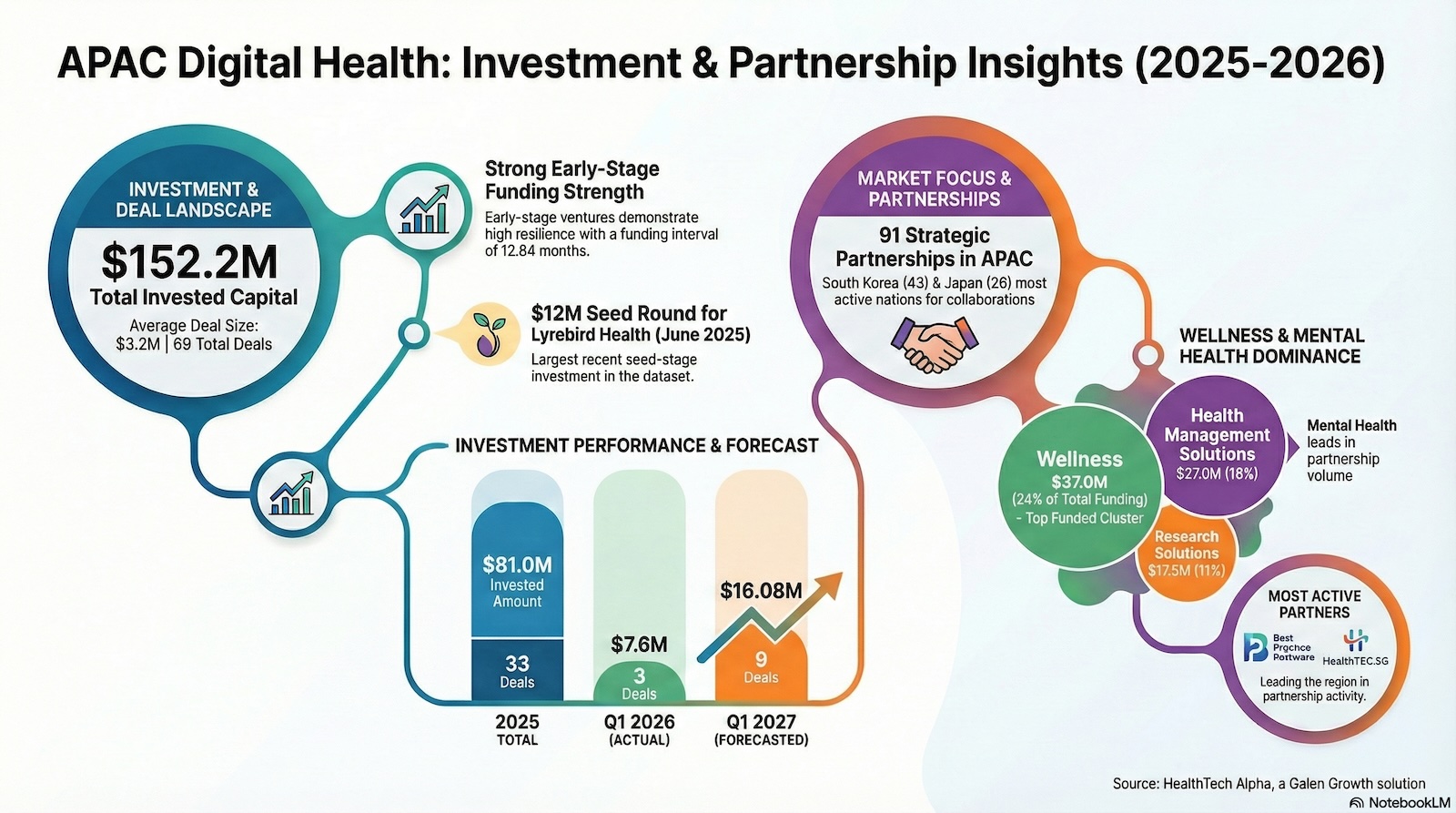
- Real Ecosystem Traction: The cohort reflects meaningful market activity with $152.2M invested across 69 funding deals, 91 partnerships recorded, and $77.1M invested in the last 12 months alone.
- Structured Methodology: Unlike broad media rankings, the selection relies on Digital-Health-specific structured intelligence and a defined methodology through HealthTech Alpha.
- Strategic Implication: For investors and corporates, the message is clear: APAC Digital Health is deep, diverse, and strategically important.
Beyond the Hype: Understanding the APAC Digital Health Ecosystem
Asia Pacific’s Digital Health ecosystem is often described with sweeping labels such as fast-growing, innovative, underpenetrated, and high-potential. While these descriptions can all be accurate, they are often too broad to provide meaningful insight.
The HealthTech 250 2026 APAC cohort offers a more precise view of which early-stage ventures are demonstrating credible momentum, strategic relevance, and ecosystem traction.
That distinction matters. In Digital Health, visibility does not equal quality, and market noise does not equal signal.
This cohort is not a vanity ranking. It is a curated shortlist of 50 early-stage Digital Health ventures founded in Asia Pacific, selected through Galen Growth’s structured intelligence platform, HealthTech Alpha. The goal is to identify ventures that demonstrate real signals of emerging relevance within healthcare markets.
A Cohort Worth Celebrating — And a Region Too Broad for Any Single List
The APAC shortlist should not be interpreted as a complete registry of the region’s innovation landscape. Asia Pacific hosts far more promising ventures than any 50-company list can capture.
Across the region, founders are building meaningful companies in diagnostics, care delivery, prevention, women’s health, workflow software, research infrastructure, and AI-enabled health services.
The purpose of the HealthTech 250 APAC cohort is therefore not to exclude the broader ecosystem, but to highlight a high-conviction signal set of ventures showing early patterns of momentum.
More importantly, the cohort provides insight into where APAC Digital Health innovation is heading.
What the APAC Cohort Reveals
The 2026 APAC cohort includes 50 ventures across 8 countries, led by South Korea with 14 companies, followed by Japan with 10, Singapore with 9, India with 6, and Australia with 5. China, Indonesia, and the Philippines are also represented.
This geographic spread confirms that APAC Digital Health innovation is not concentrated in a single hub but distributed across multiple national ecosystems.
The ventures were founded between 2021 and 2025, with a strong concentration in early-stage development. Most companies fall within Seed stage, with additional representation from Pre-A, Series A / A1, Angel, and a small number with undisclosed stages.
This early-stage concentration makes the cohort particularly valuable for identifying potential category leaders before they become widely recognised.
Cluster Insights
The most represented clusters within the cohort include Health Management Solutions and Wellness, followed by Research Solutions. Patient Solutions and Telemedicine also feature prominently.
This distribution suggests that APAC founders are focusing on areas where software, data, and workflow innovation can directly address healthcare access, engagement, care navigation, and care delivery challenges.
The cohort companies have collectively attracted $152.2 million across 69 funding deals, with an average deal size of $3.2 million.
In the past 12 months alone, the group attracted $77.1 million in funding, with $13.0 million raised in the last three months.
Even January 2026 recorded $7.6 million across three deals — representing a 39.76% month-on-month increase in value and a 200% increase in deal count compared to December 2025.
These signals reflect genuine investor conviction rather than temporary hype.
Partnership Momentum Matters
Funding is only one signal of market validation. In healthcare, partnerships often provide stronger indicators of real-world relevance.
The cohort companies have collectively recorded 91 partnerships, with 34 established in 2025 and 5 already announced in 2026.
South Korea leads partnership activity with 43 collaborations, followed by Japan with 26 and Singapore with 11.
The most active clusters for partnerships include Medical Education, Research Solutions, Wellness, Medical Diagnostics, Health Management Solutions, and Telemedicine.
This pattern highlights ventures operating within collaborative healthcare environments where integration with providers, research institutions, and industry partners is critical.
Why This List Differs from Generic Startup Rankings
Startup lists are abundant, but most are designed for general technology sectors rather than healthcare.
Digital Health is shaped by regulatory frameworks, clinical validation, reimbursement complexity, provider workflows, and long enterprise sales cycles.
A venture that appears attractive in a generic startup ranking may still be strategically weak in healthcare.
Conversely, companies solving specific operational or clinical challenges may appear less visible but hold far greater long-term value.
The HealthTech 250 APAC cohort is therefore constructed using Digital-Health-specific structured intelligence rather than broad startup visibility metrics.
Methodology and Selection Framework
The APAC shortlist is derived from a two-stage evaluation framework.
- Universe Definition: Companies must fall within the incorporation window beginning in 2021, remain active, operate within Digital Health taxonomy definitions, and be no later than Series A.
- Weighted Evaluation: Eligible ventures are assessed across multiple metrics including relevance, Alpha Score, clinical evidence signals, funding value percentile, funding velocity, partnership signals, and overall health checks.
These metrics are geographically normalised to improve comparability across diverse regional ecosystems.
The result is a selection framework that emphasises signal density rather than headline funding alone.
What This Means for Investors
The APAC Digital Health market is not simply a region to observe — it is a region that requires structured mapping.
The cohort’s funding data demonstrates that capital is flowing steadily into early-stage healthcare innovation.
The largest funding clusters include Wellness, Health Management Solutions, Research Solutions, and Medical Diagnostics.
This diversity indicates that investors are backing multiple healthcare software categories rather than concentrating capital within a single narrative.
For venture investors and strategic capital allocators, the opportunity lies in identifying ventures that consistently demonstrate signals across funding activity, partnerships, product relevance, and ecosystem traction.
What This Means for Corporations
For corporates, the APAC cohort serves as a strategic scouting map.
Pharmaceutical companies, medical device manufacturers, health systems, insurers, and service providers increasingly need early visibility into emerging Digital Health innovators.
The cohort highlights ventures that are already beginning to attract partners and capital, making them potential candidates for collaboration, venture-client models, or future acquisitions.
In an era of rapidly accelerating technological change, structured sector intelligence becomes essential for decision-making.
APAC Digital Health Is Maturing
The most important takeaway from the APAC cohort is the increasing maturity of the region’s Digital Health ecosystem.
The combination of funding activity, partnership momentum, geographic diversity, and thematic breadth indicates a sector that is deepening rather than simply expanding.
Founders across Asia Pacific are building companies aligned with real healthcare workflows and buyer needs.
This shift marks a transition toward a more disciplined and strategically significant Digital Health market across the region.
Conclusion
The HealthTech 250 APAC cohort highlights a new generation of Digital Health ventures shaping the future of healthcare innovation in Asia Pacific.
While many additional companies across the region deserve recognition, the value of this shortlist lies in the signal it provides: APAC Digital Health is becoming one of the most strategically important arenas in global healthcare innovation.
The ventures within this cohort represent the early foundations of that transformation.