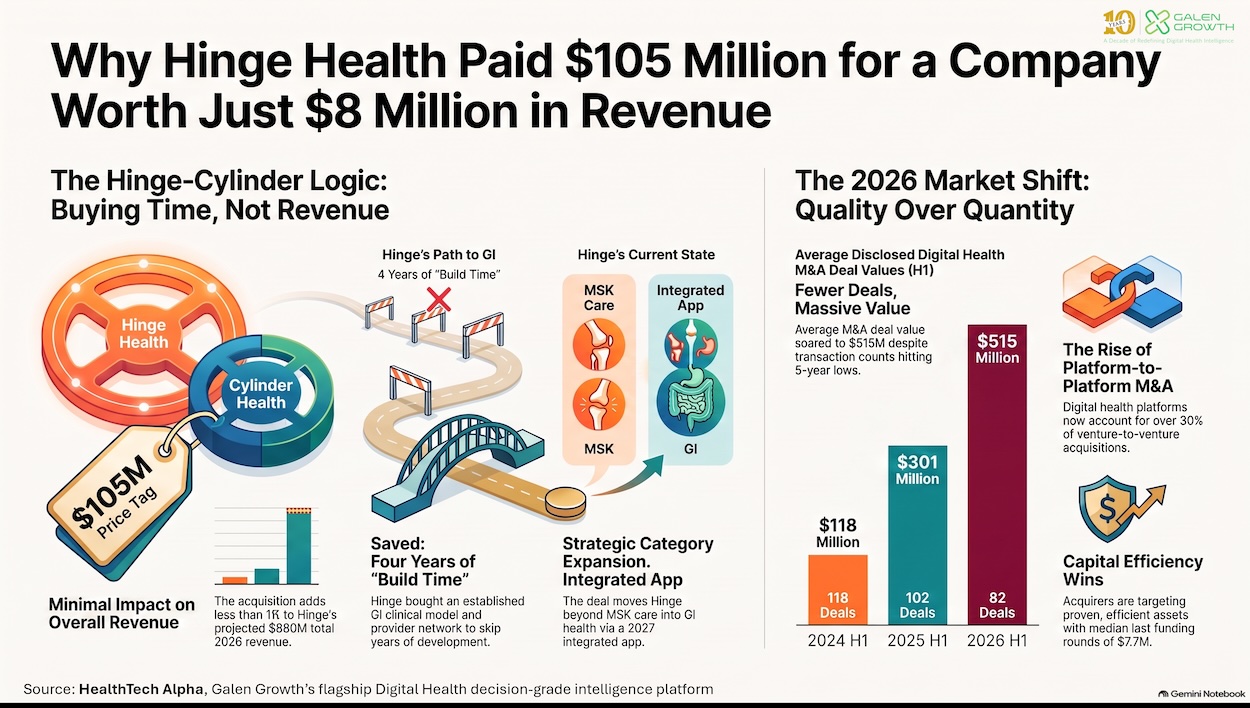
Cylinder Health will add a rounding error to Hinge’s 2026 top line. What Hinge actually bought was four years it didn’t have to spend building gastrointestinal care from scratch — and a preview of how digital health’s biggest platforms now expand.
KEY TAKEAWAYS
- Hinge Health is not paying $105 million for revenue. Cylinder Health is expected to contribute only $7–8 million to Hinge’s 2026 revenue, against guidance of $856–860 million. The deal only makes sense as a purchase of clinical capability — an established GI care model, provider network and evidence base — that would otherwise take years to build.
- It is a category-expansion acquisition, not a consolidation play. Cylinder moves Hinge beyond musculoskeletal (MSK) and migraine care into gastrointestinal (GI) care, on the clinical logic that GI conditions share gut-brain axis and central-sensitisation mechanisms with the conditions Hinge already treats. Integration into a single app is not expected until 2027.
- The deal is a leading indicator of a broader H1 2026 pattern, not an outlier. Average disclosed M&A deal value in digital health rose from $118 million (H1 2024) to $301 million (H1 2025) to $515 million (H1 2026), even as total deal count fell to a five-year H1 low of 82 transactions — acquirers are paying more for fewer, more deliberate, capability-driven transactions.
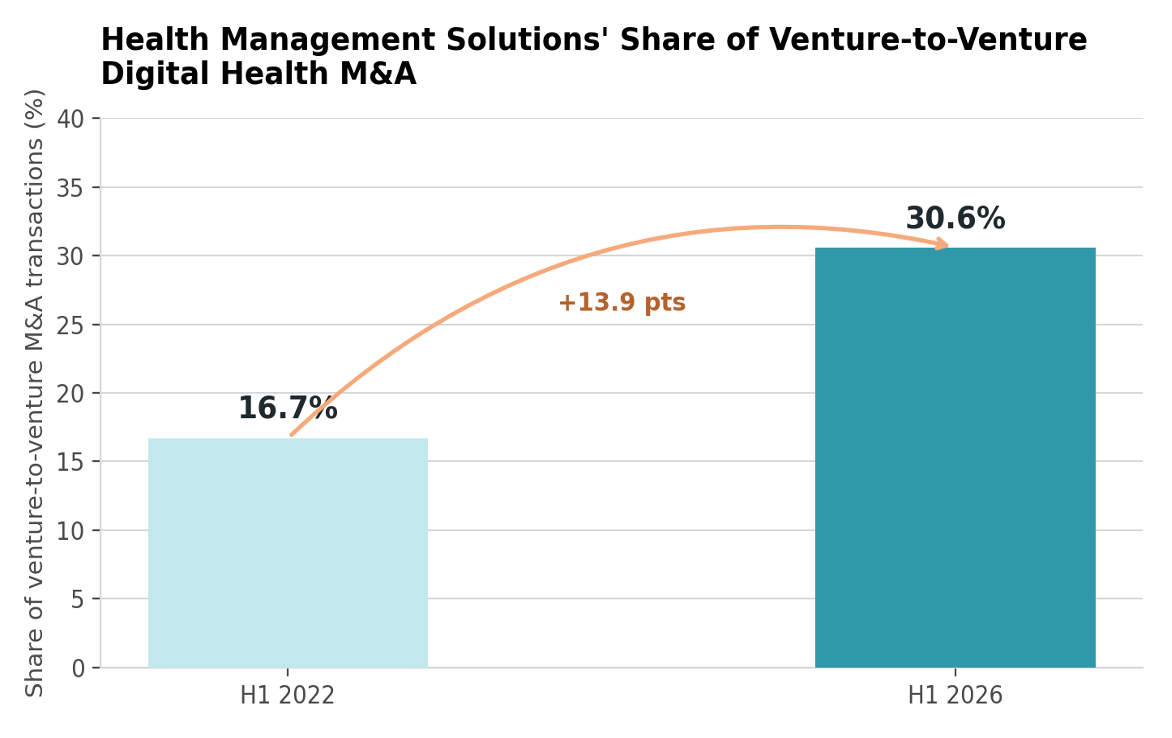
- The buyer type is shifting, and Hinge is an example of it. Health Management Solutions ventures accounted for 30.6% of venture-to-venture digital health M&A in H1 2026, up from 16.7% in H1 2022 — scaled digital health platforms, not only pharma or Big Tech, are becoming primary consolidators of their own sector.
- The investable criteria for digital health ventures are being rewritten. With B2B ventures representing 47.6% of H1 2026 M&A exits and the median last funding round before M&A at just $7.7 million, the more useful question for investors and founders is no longer “can this become a category leader” but “can this become — or be absorbed into — a platform.”
On 4 August 2026, Hinge Health (NYSE: HNGE) announced a definitive agreement to acquire Cylinder Health, a virtual-first digestive care provider, for $105 million in cash. The deal, expected to close in Q3 2026, extends Hinge’s existing musculoskeletal (MSK) and migraine care platform into a new condition category — gastrointestinal (GI) care — built on the clinical overlap between chronic GI disorders and chronic pain, including shared gut-brain axis and central-sensitisation mechanisms.
Run the numbers, and the transaction does not read as a revenue deal. It reads as something more interesting: a scaled digital health platform buying time it didn’t have to spend building a new clinical category from scratch — and, as the data below shows, Hinge is not the only one doing it.
What Hinge actually bought: a clinical capability, not a customer base
The acquisition is projected to contribute only $7–8 million to Hinge’s 2026 revenue — a rounding error against raised full-year guidance of $856–860 million, and immaterial next to the $213 million in revenue Hinge posted in Q2 2026 alone, up 53% year-on-year. It does not read as a scale deal either: Hinge already works with 2,929 enterprise clients, up 24% year-on-year, well ahead of the acquisition being announced.
What Hinge is actually buying is a clinical capability it does not currently have: an established GI care model, specialised providers, clinical protocols, patient-engagement infrastructure and an evidence base — the multi-year assets that would otherwise have to be developed internally before Hinge could credibly enter the category. Cylinder Health and Hinge plan to integrate into a single app, expected to launch only in 2027. In the words of Hinge’s own leadership, the company is “playing the long game in GI.”
Strip away the specific condition category and the logic generalises: Hinge paid $105 million not for what Cylinder earns today, but for the years it would otherwise have spent building Cylinder’s clinical model itself — time a public company under quarterly growth pressure may not want to spend. That is worth taking seriously as a template, because Hinge is not the only scaled digital health platform making the same calculation in 2026.
Hinge’s logic is now the market’s logic
For most of the past decade, the working model for digital health liquidity was linear: build a company, raise successive rounds, and either reach IPO scale or sell to a larger incumbent when growth stalled. M&A was the fallback outcome, not the strategy.
H1 2026 data from HealthTech Alpha shows that model breaking down — and the Hinge–Cylinder deal fits squarely inside it. M&A captured 97.6% of digital health exit volume in the first half of the year, the highest share on record — yet total M&A count fell to just 82 transactions, the lowest H1 figure of the past five years, down from 118 in H1 2025. Disclosed M&A value nonetheless reached $5.15 billion across only 10 disclosed transactions, for an average disclosed deal value of approximately $515 million.
That combination — fewer deals, higher average value, near-total M&A dominance of exit routes — is not simply “M&A is up.” It is a market becoming more selective and more strategic at the same time, and it is the same discipline visible in Hinge’s $105 million, single-category, capability-specific approach to Cylinder rather than a broader shopping spree.
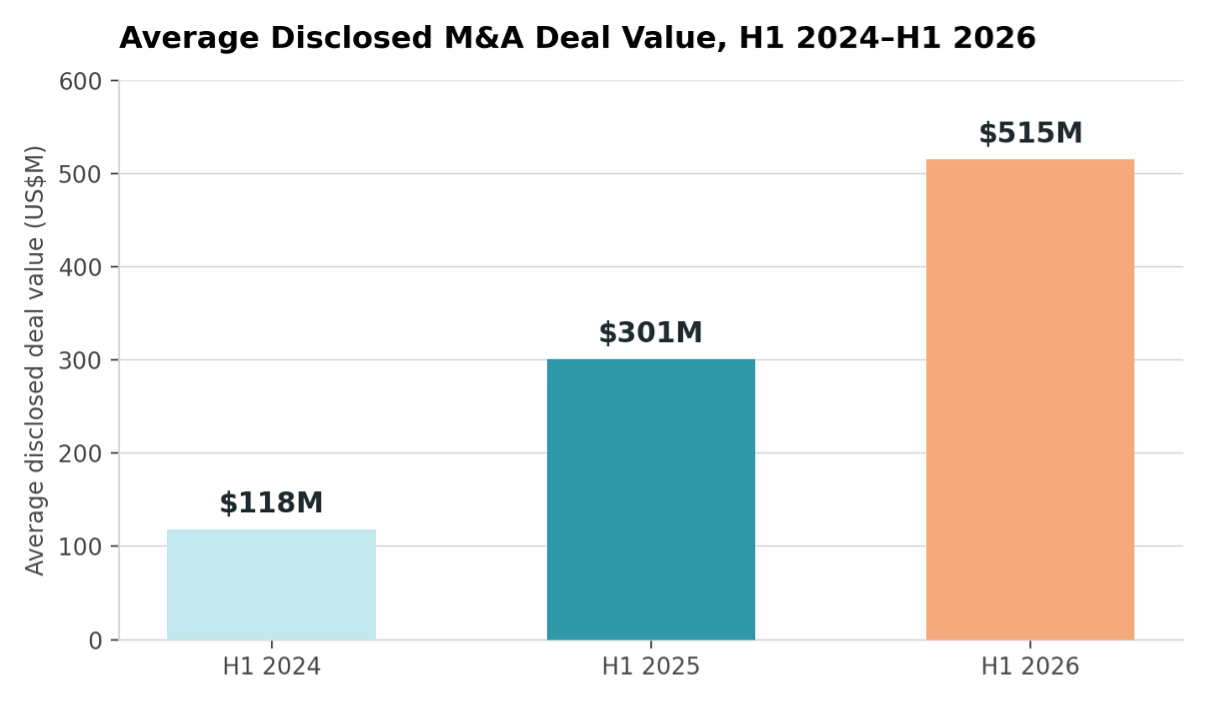
Average Disclosed M&A Deal Value, H1 2024–H1 2026. Source: HealthTech Alpha, August 2026.
The corollary is a lengthening evidence bar. Average time from incorporation to M&A exit has stretched to 10.9 years in H1 2026, up from 8.2 years in H1 2022, and the gap holds across acquirer types: corporate acquirers bought ventures with a median founding-to-exit period of 10.2 years in 2026 year-to-date, against 8.8 years for venture-to-venture acquirers. Buyers are demanding more operating and clinical proof before committing capital — which is exactly what a five-year-old, clinically established business such as Cylinder offered Hinge.
Is Hinge acting alone? Not according to H1 2026 deal data.
Across H1 2026, several scaled platforms used the same logic Hinge applied to Cylinder — buying assembled capability rather than building it — in categories from diagnostics to clinical-memory infrastructure.
| Acquirer | Target | Disclosed value | What the acquirer bought |
| Hinge Health | Cylinder Health | $105M | GI clinical model, provider network and evidence base — category expansion from MSK/migraine into GI |
| Roche | PathAI | $1.05B | AI-powered pathology and diagnostics capability |
| Roche | SAGA Diagnostics | $595M | Omics-based, ctDNA/liquid-biopsy diagnostics infrastructure |
| OpenAI | Torch | ~$60M | Clinical-memory infrastructure for a non-healthcare platform entrant |
| Function Health | Getlabs & SuppCo | Undisclosed | Diagnostics-stack bolt-ons, extended deal by deal |
| Waystar | Iodine Software | $1.25B | Clinical AI embedded into the revenue-cycle and coding stack |
| SWORD Health | Kaia Health | $285M | AI-driven MSK therapy platform — broadens digital MSK offering and deepens European presence |
The most consequential buyers in digital health may increasingly be digital health companies themselves
The conventional mental model for digital health M&A ran one way: a venture-backed start-up eventually gets acquired by an outside strategic — a health system, a payer, a pharmaceutical company, or Big Tech. Hinge’s move on Cylinder reflects a different and increasingly dominant pattern: a digital health platform acquiring another digital health company to expand its own addressable market.
The scale of that shift is visible in Galen Growth’s longitudinal tracking of acquirer type. Health Management Solutions ventures accounted for 30.6% of venture-to-venture digital health M&A transactions in H1 2026, up from 16.7% in H1 2022 — nearly doubling their share of intra-sector consolidation in four years. Venture-to-venture buyers already dominate digital health M&A by volume, consistently accounting for roughly 70–75% of annual transactions against a pharma acquirer share below 5%. Within that venture-to-venture pool, Health Management Solutions platforms are capturing a fast-growing share — and HMS itself led all H1 2026 M&A clusters with 22 of the 82 transactions recorded.
This changes competitive dynamics considerably. A founder assessing strategic risk can no longer assume the field of potential acquirers is limited to a handful of large incumbents outside the sector. Increasingly, the most active and best-informed buyer of a given digital health company may be another digital health company one or two categories over — one that already understands the clinical model, the enterprise buyer, and the reimbursement mechanics better than any outside acquirer could.
The pattern generalises: platforms are buying time, not technology
Galen Growth’s broader H1 2026 dataset supports the reading that Hinge’s Cylinder deal illustrates: strategic buyers across the ecosystem, from Roche’s sequential diagnostics acquisitions to OpenAI’s purchase of clinical-memory infrastructure, are increasingly buying embedded capability rather than simply technology, user numbers or revenue. Each of those capability bundles could, in principle, be built internally over several years. Bought instead, in a single transaction, they compress a multi-year build cycle into one integration programme with a defined delivery date — for Hinge, a single GI-and-MSK app targeted for 2027.
A platform can spend years developing a new vertical from scratch, absorbing the clinical, regulatory and commercial learning curve as it goes — or it can acquire an organisation that has already climbed that curve, and redirect its own distribution and commercial infrastructure toward the new category immediately. That is the real strategic currency of 2026 M&A: time, not technology and not revenue.
What could go wrong: the platform thesis is not yet proven at scale
The platform-assembly narrative is compelling, but it should not be read as a market with resolved execution risk. Two tensions are worth naming plainly.
First, the financial contribution is currently trivial relative to the strategic narrative. Cylinder is expected to add just $7–8 million to Hinge’s 2026 revenue against guidance of $856–860 million — the deal has to be justified almost entirely on optionality and category expansion, which is a harder thesis to underwrite than an accretive revenue acquisition.
Second, integration is not immediate. The combined GI and MSK offering is not expected to reach a single app until 2027, meaning the clinical and commercial case for the acquisition will not be fully testable for well over a year after signing — a familiar risk window in which comorbidity theses and cross-sell assumptions can underperform initial modelling.
For investors, the underwriting question has changed
The practical implication for investors is a shift in the underlying question being asked of a digital health company. The relevant question is no longer only “can this company become a category leader in its own right?” It is increasingly “can this company become part of a larger platform — or build one of its own?”
That reframing changes which characteristics investors should weight most heavily: strategic adjacency to an existing platform, recurring enterprise revenue, embedded workflows, defensible clinical evidence, proprietary data, established distribution, regulatory capability, and technology that can be integrated into a broader offering rather than sold as a stand-alone point solution. This is consistent with the H1 2026 exit composition: B2B ventures accounted for 47.6% of H1 2026 M&A exits, against 31.7% for B2C, and enterprise-relevant businesses have held a structurally higher share of exits since 2023.
The corresponding shift in underwriting logic runs from “is this a $1 billion standalone company?” to “what strategic value does this asset create inside a platform that could be worth several multiples more?” That is a materially different diligence exercise, and one that rewards investors who map platform-adjacency early rather than at the point of an exit process.
For founders, the message is not “build to sell” — it is “build something worth acquiring”
For founders, the uncomfortable but useful reframe is this: you no longer need to build everything yourself, but you do need to know precisely what would make your company worth acquiring by a platform. Galen Growth’s H1 2026 data reinforces the point — the median last funding round before M&A was only $7.7 million, suggesting that acquirers are frequently buying proven, capital-efficient assets rather than simply rewarding companies that have raised the most capital.
The strongest acquisition targets are increasingly companies that have developed one specific capability that complements an existing platform’s roadmap — clinical expertise, distribution, proprietary data, a differentiated workflow, regulatory infrastructure, a defined patient population, or a validated evidence base. That means founders should be mapping their plausible strategic acquirers — both outside strategics and adjacent digital health platforms — much earlier in a company’s life than exit planning has traditionally assumed.
For pharma, the same consolidation logic is closing in from a different direction
Pharma should recognise that the platform-assembly dynamic visible in Hinge–Cylinder is also playing out around it, from a different angle. Roche’s acquisitions of SAGA Diagnostics ($595 million, 16 April) and PathAI ($1.05 billion, 7 May) — three weeks apart, for a combined $1.645 billion — show a pharmaceutical strategic buyer assembling a diagnostics and AI-pathology platform through sequential acquisition rather than a single internal development programme. That is the pharma version of the same mechanism Hinge is using in digital MSK: buy the capability, compress the build timeline, control the resulting infrastructure.
The strategic question this raises for pharma is sharper than a single deal: what happens when the digital health partners pharma has relied on for neutral, vendor-agnostic infrastructure stop being independent point solutions and become vertically integrated platforms — owned either by a competitor, or by a digital health company with its own commercial agenda? That matters directly for partnership terms, data access, vendor neutrality and competitive positioning, and it is not a risk that resolves itself simply because a given deal does not involve a direct pharma competitor.
The unresolved question: who ends up owning the platforms?
Put together, the H1 2026 data and the Hinge–Cylinder transaction describe a market moving through three distinct eras. The first era was about creating categories. The second was about scaling individual companies within those categories. The one now forming is about assembling platforms — and M&A has become the fastest mechanism for doing so, across pharma, digital-health-native acquirers, and even AI-native entrants such as OpenAI.
The open question the market has not yet answered is which digital health companies end up as the platforms doing the assembling, and which end up as the capability being assembled into someone else’s. Hinge’s move into GI, Roche’s sequential diagnostics acquisitions, and Function Health’s bolt-on strategy all point the same direction: scale alone is no longer the differentiator. The differentiator is whether a company is positioned to acquire, or positioned to be acquired, as the category consolidates.
What this means
For investors: Underwrite platform-adjacency, not just standalone scale. Recurring enterprise revenue, embedded workflows, proprietary data and regulatory capability are becoming the characteristics that determine acquisition value — weight diligence accordingly, and expect the underwriting question to shift from “is this a $1 billion company?” to “what is this worth inside a platform?”
For digital health ventures and founders: Map your plausible strategic acquirers — including adjacent digital health platforms, not only outside strategics — well before an exit process begins. Build the specific capability a platform cannot easily replicate internally, and maintain capital efficiency: the median last funding round before M&A was only $7.7 million in Galen Growth’s dataset.
For pharma and corporate partners: Treat every platform-building acquisition among your digital health partners as a governance question, not only a competitive one. Reassess vendor neutrality, data-access terms and dependency risk whenever a previously independent partner is acquired — by a competitor or by another digital health company.
For platform operators (Hinge and its peers): The capability-buy playbook compresses time-to-market, but it shifts execution risk to integration. Cylinder’s financial contribution is immaterial in 2026; the deal will be judged on 2027 cross-sell and the single-app launch — a useful reminder that platform-building M&A should be tracked past signing, through integration, not treated as resolved at announcement.
FREQUENTLY ASKED QUESTIONS
What did Hinge Health pay for Cylinder Health, and when will the deal close?
Hinge Health agreed to acquire Cylinder Health for $105 million in cash under a definitive agreement announced on 4 August 2026. The transaction is expected to close in the third quarter of 2026, subject to customary closing conditions.
Why is Hinge–Cylinder being read as a platform-building move rather than a typical acquisition?
Cylinder is projected to contribute only $7–8 million to Hinge’s 2026 revenue — immaterial next to Hinge’s $856–860 million guidance — so the deal cannot be explained by revenue or customer addition alone. Instead, Hinge is acquiring an established GI clinical model, provider network, protocols and evidence base that would otherwise take years to build, extending its MSK and migraine platform into a new condition category.
How does this deal fit the broader H1 2026 digital health M&A trend?
It follows a pattern visible across H1 2026: M&A captured 97.6% of exit volume even as total transaction count fell to a five-year H1 low of 82 deals, with average disclosed deal value rising to roughly $515 million. Buyers, including Hinge, are behaving selectively — fewer transactions, but each more clearly aimed at acquiring a specific strategic capability.
Are digital health companies becoming the dominant acquirers of other digital health companies?
Venture-to-venture buyers already account for roughly 70–75% of annual digital health M&A transactions by volume, and within that group, Health Management Solutions ventures’ share of venture-to-venture M&A rose from 16.7% in H1 2022 to 30.6% in H1 2026. Scaled digital health platforms are an increasingly important acquirer category in their own right, alongside pharma, health systems and Big Tech.
What should investors and founders take away from this shift?
Standalone category leadership is no longer the only path to value. Investors should weight platform-adjacency, embedded workflows and clinical evidence more heavily in diligence, while founders should identify their plausible strategic acquirers — including adjacent digital health platforms — early, and build capability that is difficult for a platform to replicate internally rather than optimising purely for standalone scale.
Data source and methodology
Data source: HealthTech Alpha by Galen Growth, accessed August 2026, covering digital health M&A exit volume, route mix, disclosed and undisclosed deal value, acquirer-type distribution (venture, pharma, corporate, healthcare provider, medical device, other), cluster and business-model composition of M&A exits, and time from incorporation to M&A exit, for the H1 period (January–June) of each year from 2022 to 2026 unless otherwise stated.
Gaps flagged: the Hinge Health–Cylinder Health deal-specific terms (value, revenue contribution, close date) are sourced from Hinge Health’s Q2 2026 earnings release and public deal disclosures rather than HealthTech Alpha. HealthTech Alpha does not yet publish interim H1 2023–2025 data points for the Health Management Solutions venture-to-venture M&A share series; only the H1 2022 (16.7%) and H1 2026 (30.6%) measurement points are available, so the trajectory between them is directional rather than confirmed as linear. Figures are in USD unless stated otherwise; some totals may be understated where transaction terms are undisclosed — 72 of the 82 H1 2026 M&A transactions did not disclose terms.
This analysis is provided solely for informational purposes and was prepared in good faith on the basis of public information available at the time of publication without independent verification. Numbers will be updated from to time to reflect information identified after the event. Galen Growth does not guarantee or warrant the reliability or completeness of the data nor its usefulness in achieving any particular purposes. Galen Growth shall not be liable for any loss, damage, cost or expense incurred by any reason because of any person’s use or reliance on this report.
Related Galen Growth analysis
- The Return of the Strategic Buyer: Digital Health M&A, H1 2026 — Galen Growth
- The Maturity Era: Digital Health Funding, H1 2026 — Galen Growth
- Digital Health Exits 2026: M&A, IPO Outlook — Galen Growth
How to cite this analysis
About Galen Growth
Galen Growth is the digital health intelligence firm behind HealthTech Alpha, the leading ontology-driven platform tracking the global digital health ecosystem. With operating entities in the US, Europe and Asia, we combine large-scale labelled data, auditable GenAI research and explainable analytics to advise pharma, medical device, insurance, health system, investor and startup clients.