Executive Summary
Healthcare innovation leaders have access to more data than ever before, but very little of it is decision-ready. The most effective organisations combine funding data, partnership intelligence, clinical evidence, regulatory signals, market intelligence, scientific literature, company intelligence and specialist healthcare innovation platforms to create a complete view of the market.
The key is understanding what each source does well—and where its blind spots begin. This guide explains the most valuable healthcare innovation data sources in 2026, when to use each one and how leading healthcare organisations combine them to make faster, better-informed strategic decisions.
Key Takeaways
- No single healthcare innovation data source provides a complete picture.
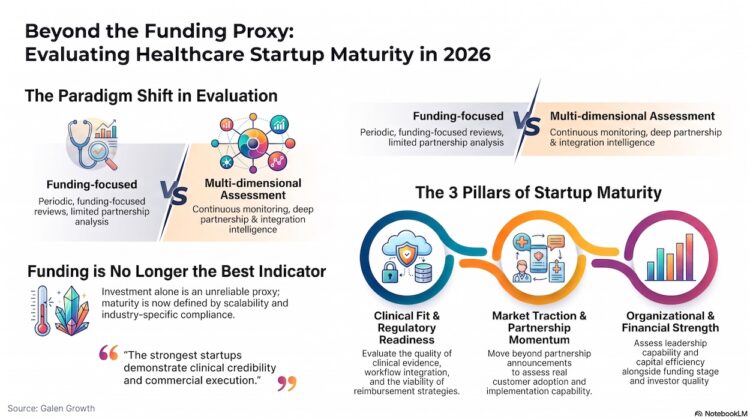
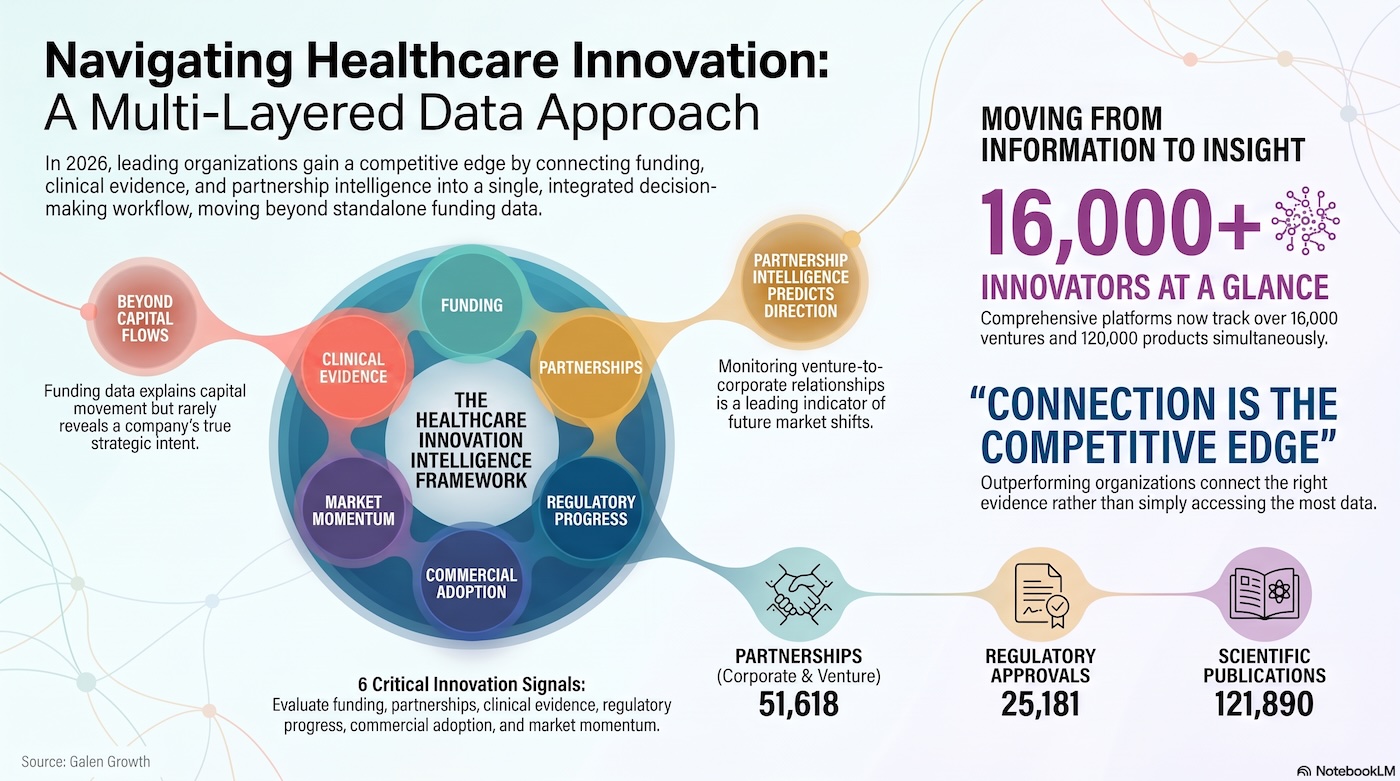
- Funding data explains capital flows but rarely reveals strategic intent.
- Clinical evidence is essential but often arrives too late for competitive decisions.
- Partnership intelligence increasingly helps predict future market direction.
- Specialist platforms such as HealthTech Alpha integrate multiple datasets into a single decision workflow.
Why Healthcare Innovation Data Matters
Healthcare innovation has become increasingly multidisciplinary. Corporate strategy teams are no longer evaluating companies solely on fundraising or technology. They must understand commercial traction, clinical validation, regulatory maturity, partnership activity, competitive positioning and market momentum simultaneously.
General business databases remain valuable, but healthcare innovation increasingly requires specialist intelligence that understands healthcare-specific evidence, clinical development and ecosystem relationships.
As AI makes information easier to retrieve, competitive advantage increasingly depends on using the right combination of trusted healthcare innovation data rather than simply accessing more information.
The Galen Growth Healthcare Innovation Intelligence Framework
The framework evaluates healthcare innovation opportunities across six evidence layers:
- Funding signals
- Partnership signals
- Clinical evidence
- Regulatory progress
- Commercial adoption
- Market momentum
8 Essential Healthcare Innovation Data Sources
For each source, strategy teams should evaluate what it covers, why organisations use it, its strengths, its limitations, the best way to apply it and where HealthTech Alpha can provide additional context.
1. Venture Funding Databases
What they are: Databases that track funding rounds, investors, valuations, exits and company financing histories.
Why companies use them: To understand capital flows, identify well-funded companies, benchmark financing activity and monitor investor interest.
Strengths: Strong visibility into investment activity, investor participation and funding momentum.
Limitations: Funding does not necessarily indicate clinical quality, commercial adoption, regulatory readiness or strategic relevance.
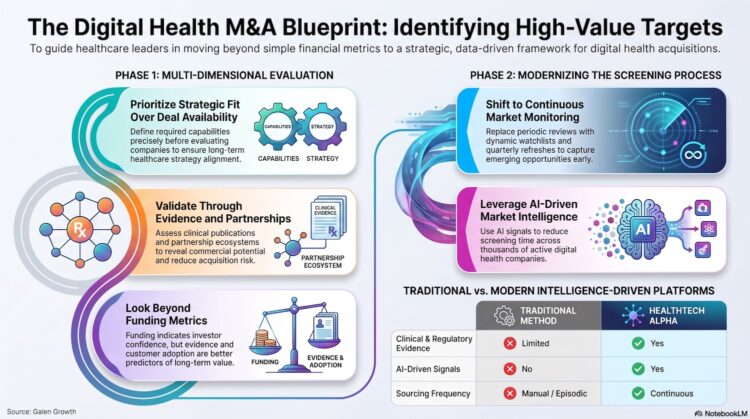
Best practice: Use funding data as one signal within a broader evaluation framework rather than as a standalone proxy for company quality.
Where HealthTech Alpha helps: Connects financing history with clinical evidence, partnerships, regulatory progress, product activity and market positioning.
2. Partnership Intelligence
What it is: Data on collaborations between ventures, pharmaceutical companies, health systems, insurers, medical device companies, technology providers and other ecosystem participants.
Why companies use it: To identify validated companies, understand ecosystem relationships and monitor where strategic interest is forming.
Strengths: Partnerships can reveal commercial traction, strategic relevance and emerging market direction before these signals appear in financial reporting.
Limitations: Public announcements may provide limited information about commercial value, implementation scale or partnership performance.
Best practice: Monitor partnership frequency, partner quality, repeat activity and progression from pilot programmes to scaled deployments.
Where HealthTech Alpha helps: Structures venture-to-corporate and venture-to-venture relationships within a broader healthcare innovation context.
3. Clinical Evidence
What it is: Clinical trials, peer-reviewed studies, real-world evidence and other forms of healthcare validation.
Why companies use it: To assess whether a solution produces credible health, clinical or operational outcomes.
Strengths: Provides evidence of efficacy, safety, validation and clinical relevance.
Limitations: Clinical evidence often develops slowly and may lag behind commercial or competitive activity.
Best practice: Evaluate study quality, sample size, endpoints, research partners, publication status and relevance to the intended use case.
Where HealthTech Alpha helps: Links clinical trials and scientific publications to companies, products, markets and strategic activity.
4. Regulatory Data
What it is: Information on regulatory approvals, clearances, registrations and other formal milestones.
Why companies use it: To evaluate product maturity, market access and regulatory readiness.
Strengths: Provides objective evidence that a product has reached an important development or commercial milestone.
Limitations: Regulatory approval does not necessarily indicate adoption, reimbursement, competitive differentiation or commercial success.
Best practice: Assess approvals alongside target markets, intended use, product portfolio, evidence quality and commercial deployment.
Where HealthTech Alpha helps: Connects regulatory milestones with products, ventures, funding, partnerships and clinical activity.
5. Scientific Literature
What it is: Peer-reviewed research, academic publications, conference papers and other scientific outputs.
Why companies use it: To understand scientific credibility, research momentum, therapeutic relevance and emerging areas of innovation.
Strengths: Offers deep technical and clinical insight.
Limitations: Scientific literature often lacks commercial context and may be difficult to connect to specific companies or market opportunities.
Best practice: Evaluate publication quality, research partners, citation activity, study relevance and connections to commercial products.
Where HealthTech Alpha helps: Connects scientific publications to ventures, products, therapeutic areas and broader market intelligence.
6. General Market Intelligence Platforms
What they are: Broad business intelligence platforms covering companies, industries, transactions, competitors and market activity across multiple sectors.
Why companies use them: To support company research, market sizing, competitor monitoring and transaction analysis.
Strengths: Broad market coverage and strong general company intelligence.
Limitations: They may lack healthcare-specific taxonomies, clinical evidence, regulatory intelligence and detailed ecosystem relationships.
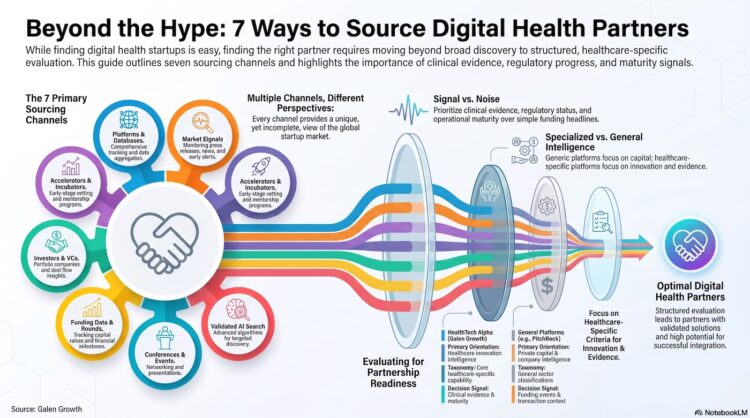
Best practice: Use general platforms for broad market context and combine them with specialist healthcare intelligence for deeper strategic analysis.
Where HealthTech Alpha helps: Adds structured healthcare-specific intelligence across products, evidence, partnerships, regulatory activity and market maturity.
7. Healthcare Innovation Platforms
What they are: Specialist intelligence platforms designed specifically to analyse healthcare innovation companies, products, evidence and ecosystems.
Why companies use them: To combine multiple healthcare-specific evidence layers into a more complete view of companies, markets and strategic opportunities.
Strengths: Integrate funding, partnerships, products, clinical evidence, regulatory milestones, scientific activity and commercial signals.
Limitations: Coverage quality, methodology and depth vary significantly across platforms.
Best practice: Evaluate transparency, data governance, taxonomy quality, update frequency, source traceability and workflow integration.
Where HealthTech Alpha helps: Provides a healthcare innovation decision workflow that connects multiple intelligence layers within a structured platform.
8. Internal Organisational Data
What it is: Internal information from pilots, procurement activity, customer relationships, business development, research teams, clinical functions and operating units.
Why companies use it: Internal data can reveal practical implementation experience, organisational fit and direct market feedback unavailable from external sources.
Strengths: Highly relevant to the organisation’s own strategy, workflows, customers and operating environment.
Limitations: Internal data can be fragmented, inconsistent, difficult to search and influenced by limited exposure or organisational bias.
Best practice: Combine internal experience with external market intelligence to avoid making strategic decisions from an incomplete organisational viewpoint.
Where HealthTech Alpha helps: Provides the external evidence layer required to benchmark internal observations against the wider healthcare innovation market.
Comparison Summary
| Data Source | Primary Strength | Primary Limitation |
|---|---|---|
| Venture funding databases | Funding and investor intelligence | Limited partnership, clinical and regulatory context |
| Partnership intelligence | Strategic relationships and market direction | Limited visibility into partnership value or performance |
| Clinical evidence | Validation of outcomes and clinical relevance | Often slow and disconnected from commercial context |
| Regulatory databases | Regulatory milestones and market readiness | Limited commercial insight |
| Scientific literature | Deep technical and clinical evidence | Limited company and market context |
| General market intelligence platforms | Broad company and transaction coverage | Limited healthcare-specific intelligence |
| Healthcare innovation platforms | Integrated healthcare-specific intelligence | Quality and depth vary by provider |
| Internal organisational data | Direct organisational relevance | Fragmented and potentially biased |
| HealthTech Alpha | Integrates funding, partnerships, clinical evidence, regulatory milestones and commercial intelligence | Best used alongside internal organisational context and primary diligence |
Best-Practice Checklist
- Combine multiple healthcare innovation data sources.
- Never rely solely on funding activity.
- Monitor partnership signals continuously.
- Include clinical and regulatory evidence.
- Connect internal organisational data with external market intelligence.
- Use structured healthcare intelligence to support strategic decision-making.
“The organisations that outperform in healthcare innovation are not those with the most data—they are those that connect the right evidence into better decisions.”
HealthTech Alpha Statistics
Based exclusively on HealthTech Alpha Premium data, the platform currently contains:
- 16,284 healthcare innovation ventures
- 120,677 products
- 30,114 funding rounds
- 51,618 recorded partnerships, comprising 39,450 venture-corporate partnerships and 12,168 venture-to-venture partnerships
- 25,181 regulatory approvals
- 5,833 clinical trials
- 121,890 scientific publications
- 58,690 patents
Data source: HealthTech Alpha Premium database. Record counts accessed 23 July 2026. Figures represent records contained in the platform and may include historical ventures, products and events.
How Different Teams Can Use Healthcare Innovation Data
- Strategy leaders: Identify emerging innovation themes and market shifts.
- Competitive intelligence teams: Monitor partnership activity and competitor movement.
- Corporate innovation teams: Prioritise companies using evidence beyond funding.
- Investors: Evaluate ventures using multiple evidence layers.
- Pharmaceutical companies: Identify validated innovation partners.
- Health systems: Assess technology maturity more comprehensively.
Related Guides
- How to Evaluate Healthcare Startup Maturity in 2026
- How to Identify Digital Health M&A Targets
- 7 Ways Healthcare Companies Find Digital Health Startups
- How Corporate Innovation Teams Evaluate Digital Health Companies
- Digital Health Partnerships: A Strategic Guide for Healthcare Leaders
Build a Better Healthcare Innovation Intelligence Workflow
Explore HealthTech Alpha to see how leading healthcare organisations combine funding, partnerships, clinical evidence, regulatory intelligence and market signals in a single decision workflow.