Target audience: Digital health corporate innovation leaders and healthcare investors
EXECUTIVE SUMMARY
Healthcare startup evaluation has become significantly more complex in 2026
As the number of AI healthcare companies continues to grow, corporate innovation teams and investors need more sophisticated approaches to assess healthcare innovation maturity, accelerate startup due diligence, and improve healthcare investment tracking. Leading healthcare organizations now evaluate startups using multiple dimensions—including commercial traction, clinical validation, regulatory readiness, partnership maturity, organizational capability, and long-term scalability. Organizations that adopt a structured evaluation framework consistently identify stronger strategic partners, reduce due diligence time, and improve investment outcomes.
KEY TAKEAWAYS
- Healthcare startup evaluation should go beyond funding.
- Healthcare innovation maturity requires assessment across multiple dimensions.
- Corporate innovation teams should combine commercial, clinical and regulatory evidence.
- AI healthcare companies require structured evaluation rather than relying on marketing claims.
- Continuous healthcare investment tracking improves partnership and investment decisions.
WHY THIS MATTERS
For many corporate innovation teams, healthcare startup evaluation has
evolved from an annual scouting exercise into a continuous intelligence
workflow. The challenge is no longer discovering startups—it is
determining which companies have reached sufficient healthcare
innovation maturity to become successful enterprise partners.
THE GALEN GROWTH HEALTHCARE STARTUP EVALUATION FRAMEWORK™
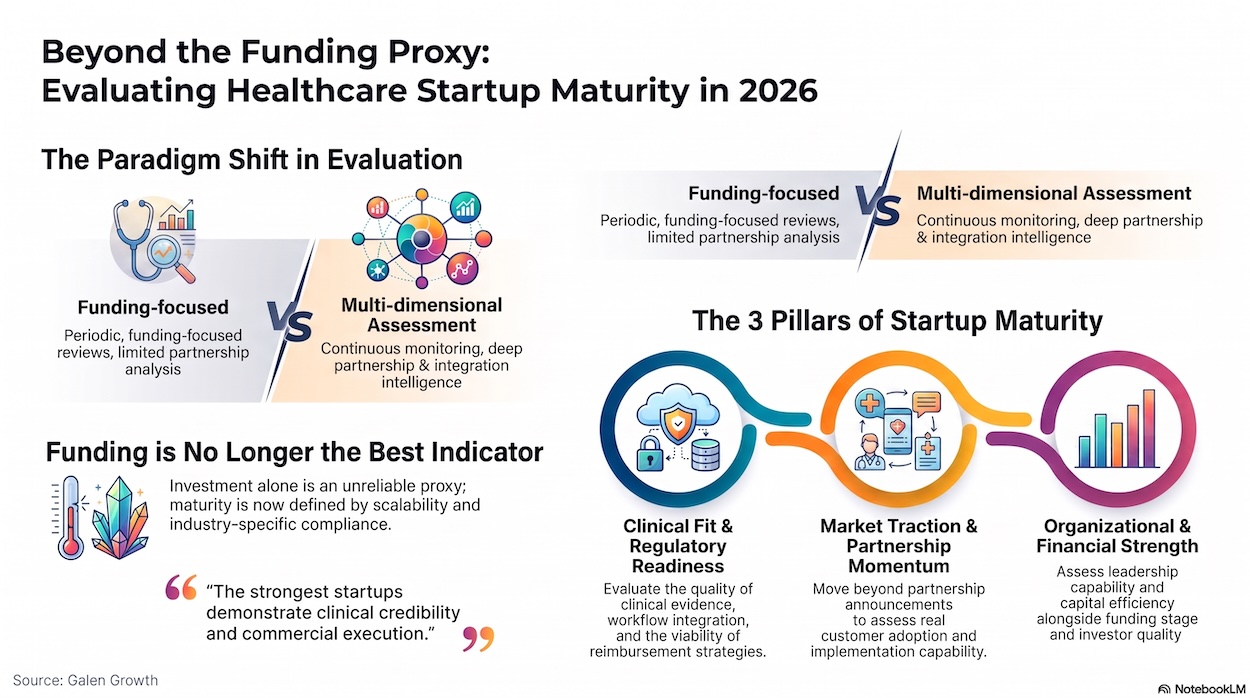
- Evaluate Market Traction Assess customer adoption, revenue growth, enterprise deployments and partnerships.
- Evaluate Clinical Fit Review clinical evidence, workflow integration and measurable outcomes.
- Evaluate Regulatory Readiness Assess regulatory approvals, quality systems, privacy and reimbursement strategy.
- Evaluate Organizational Capability Review leadership, hiring, commercial infrastructure and operational readiness.
- Evaluate Financial Strength Assess funding stage, investor quality, runway, revenue growth and capital efficiency.
- Evaluate Strategic Partnership Readiness Review enterprise partnerships, implementation capability and integration readiness.
SIX WAYS TO IMPROVE HEALTHCARE STARTUP EVALUATION
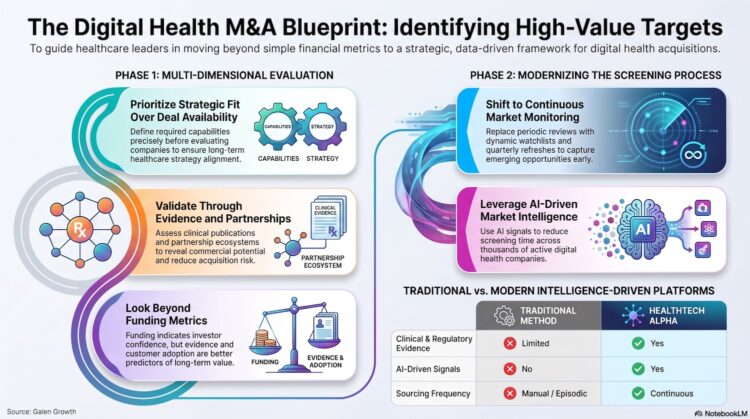
- Look Beyond Funding Funding is valuable context but should never be the sole indicator during startup due diligence.
- Evaluate Clinical Evidence Assess both the quality and quantity of supporting evidence.
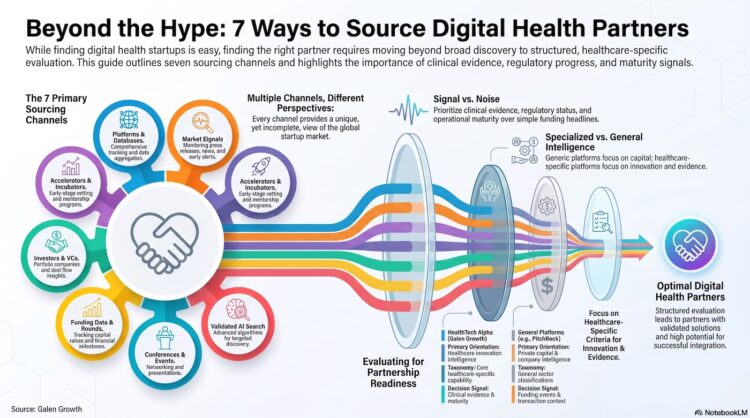
- Assess Partnership Momentum Focus on meaningful enterprise collaborations rather than announcements.
- Measure Regulatory Progress Review approvals alongside long-term regulatory strategy.
- Evaluate AI Healthcare Companies Look beyond AI claims to proprietary technology, clinical evidence and real-world deployment.
- Continuously Monitor Innovation Maturity Healthcare innovation maturity evolves over time.
- Continuous healthcare investment tracking provides a more accurate picture than one-off reviews.
COMPARISON
Traditional evaluation: – Funding-focused – Periodic reviews – Limited
partnership analysis
Best practice: – Multi-dimensional healthcare startup evaluation –
Continuous healthcare investment tracking – Clinical, regulatory and
partnership intelligence
BEST PRACTICE CHECKLIST
- Evaluate multiple maturity dimensions.
- Assess healthcare innovation maturity consistently.
- Combine commercial and clinical indicators.
- Assess regulatory readiness early.
- Validate partnership history.
- Continuously monitor AI healthcare companies.
- Use structured intelligence workflows for startup due diligence.
QUOTE
“The strongest healthcare startups are not always the most highly funded—they are the ones that consistently demonstrate clinical credibility, commercial execution and enterprise readiness.”
FAQ
What is healthcare startup evaluation? Healthcare startup evaluation is the structured assessment of a company’s commercial, clinical, regulatory and organizational maturity to determine whether it is suitable for partnership or investment.
Is funding enough? No. Funding should be combined with commercial, clinical and regulatory indicators.
Why is regulatory readiness important? It enables enterprise adoption in regulated healthcare environments.
How should AI healthcare companies be evaluated? Assess evidence, proprietary technology, workflow integration and real-world deployment.
How often should maturity be reassessed? Continuously, as healthcare innovation maturity evolves rapidly.
CALL TO ACTION
Explore how HealthTech Alpha helps corporate innovation teams evaluate healthcare startups using continuously updated market intelligence, startup due diligence workflows and healthcare investment tracking.
CITATION
Author: Galen Growth Publication Date: July 2026 Title: How to Evaluate Healthcare Startups in 2026: A Complete Guide to Healthcare Startup. Evaluation Data Source: HealthTech Alpha and Galen Growth research.