Executive Summary
Digital health acquisitions succeed when buyers evaluate far more than financial performance. The highest-performing acquirers identify companies whose technology, evidence, partnerships, regulatory readiness, commercial traction and strategic positioning complement their long-term healthcare strategy.
This guide introduces the Galen Growth Digital Health Acquisition Framework™—a practical approach for identifying, prioritising and evaluating healthcare acquisition targets using objective market intelligence rather than intuition alone.
Key Takeaways
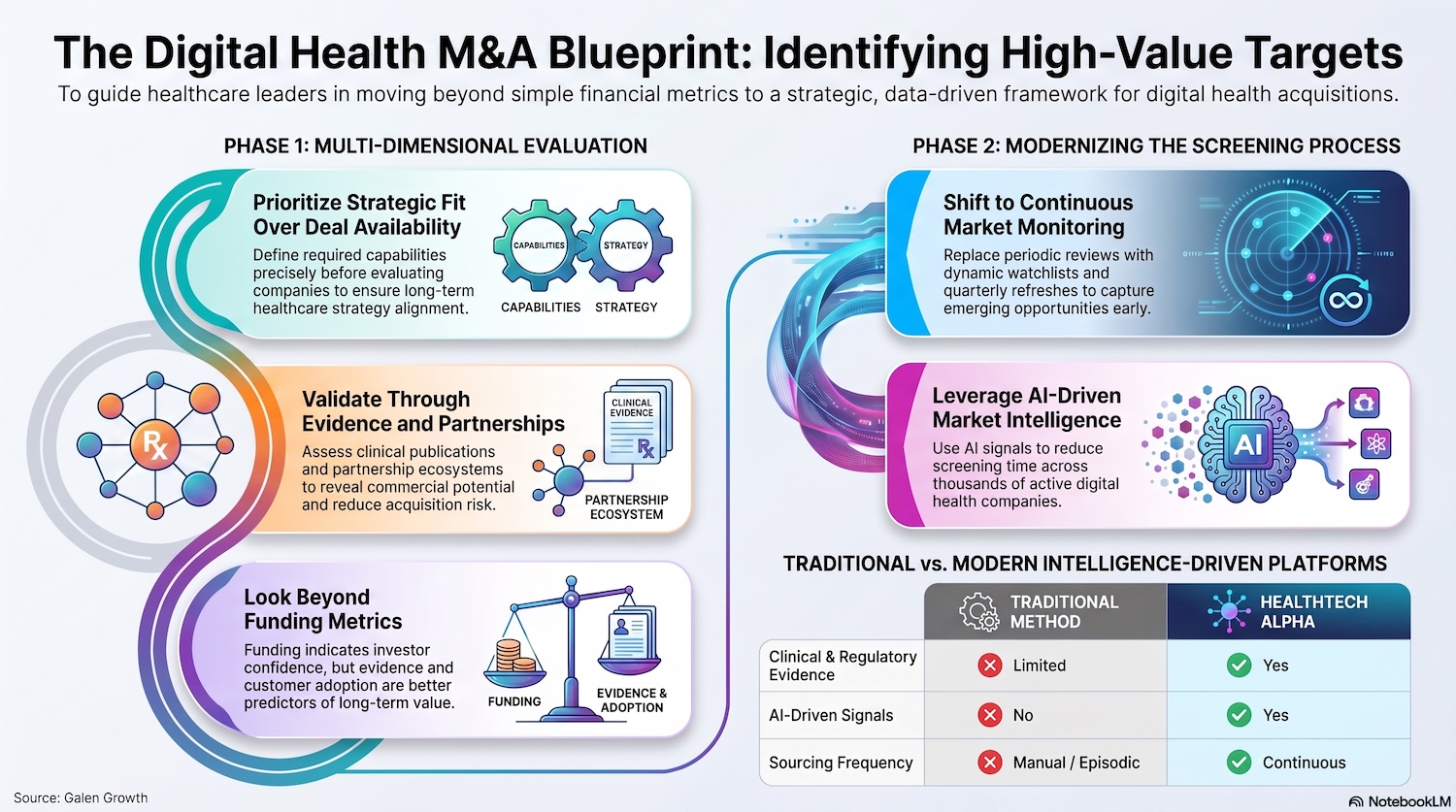
- Successful digital health M&A begins with strategic fit—not deal availability.
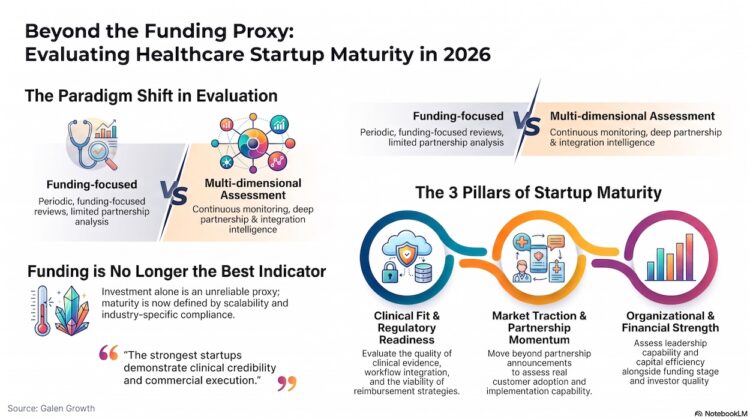
- Evidence quality and commercial adoption are stronger indicators of long-term value than funding alone.
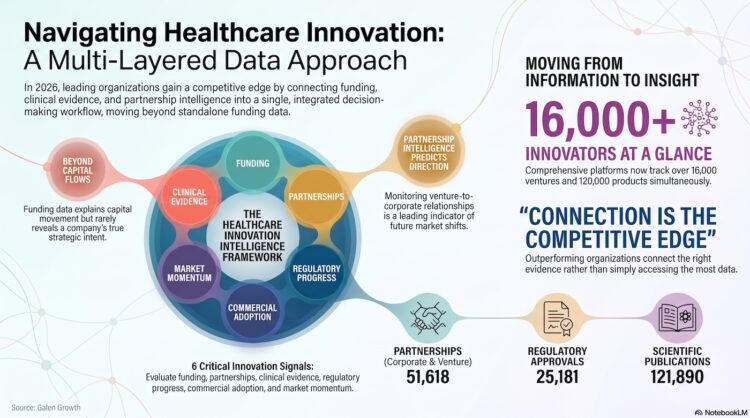
- Partnership ecosystems can reveal future acquisition candidates years before competitors notice them.
- AI-driven market intelligence can dramatically reduce acquisition screening time.
- Leading healthcare organisations use continuous market monitoring rather than episodic deal sourcing.
Why Digital Health M&A Matters
Healthcare innovation has entered a period in which M&A has become a primary mechanism for accessing new capabilities rather than developing them entirely in-house.
The Galen Growth Digital Health Acquisition Framework™
The framework evaluates potential digital health acquisition targets across seven dimensions:
- Strategic fit
- Clinical and regulatory evidence
- Commercial traction
- Partnership strength
- Technology differentiation
- Team quality
- Market momentum
Seven Steps to Identify Digital Health Acquisition Targets
1. Start With Strategic Fit
Define precisely which capability your organisation wants to acquire before evaluating companies. HealthTech Alpha enables buyers to identify highly relevant acquisition candidates using structured intelligence across therapeutic areas, technologies and business models.
2. Look Beyond Funding
Funding indicates investor confidence—not acquisition quality. Evaluate customer adoption, evidence generation, partnerships and regulatory progress alongside investment history.
3. Evaluate Clinical and Regulatory Evidence
Assess clinical publications, regulatory approvals, real-world evidence and reimbursement progress to reduce acquisition risk.
4. Analyse Partnership Ecosystems
Strong partnerships with pharmaceutical companies, health systems, insurers and medical device manufacturers can provide valuable validation of commercial potential.
5. Assess Technology Differentiation
Evaluate proprietary datasets, AI capabilities, workflow integration, interoperability and scalability to determine whether the company has a sustainable competitive advantage.
6. Evaluate Team Quality and Commercial Readiness
Assess the leadership team’s sector experience, execution track record and ability to operate through integration and scale. Look beyond revenue to evaluate enterprise customers, geographic expansion, repeat partnerships and reimbursement adoption.
7. Track Market Momentum Continuously
Maintain dynamic watchlists and monitor strategic acquisition targets continuously rather than relying on periodic market reviews. Changes in partnerships, evidence, leadership, financing and commercial activity can signal when a company is becoming strategically relevant.
Traditional Screening vs HealthTech Alpha
| Evaluation Area | Traditional Screening | HealthTech Alpha |
|---|---|---|
| Funding intelligence | Yes | Yes |
| Clinical evidence | Limited | Yes |
| Regulatory intelligence | Limited | Yes |
| Partnership intelligence | Partial | Yes |
| Product portfolio | Limited | Yes |
| AI signals | No | Yes |
| Market momentum | Limited | Yes |
| Continuous monitoring | Manual | Yes |
Best-Practice Checklist
- ✓ Define the acquisition strategy first.
- ✓ Screen the market continuously.
- ✓ Evaluate strategic fit.
- ✓ Assess evidence quality.
- ✓ Review partnership strength.
- ✓ Compare relevant competitors.
- ✓ Monitor material market changes.
- ✓ Conduct a formal watchlist review each quarter.
“The best digital health acquisitions are rarely the companies everyone is watching—they are the companies whose strategic value becomes obvious before the market catches up.”
HealthTech Alpha Statistics
- 10,000+ active digital health companies
- 17,000+ investment transactions
- 2,000+ clinical trials
- 5,500+ regulatory approvals
- 21,000+ scientific publications
- 16,000+ digital health products
Frequently Asked Questions
What makes a strong digital health acquisition target?
A strong target combines strategic fit, validated evidence, commercial traction, differentiated technology and strong partnerships.
Why is funding alone insufficient?
Funding reflects investor confidence, but it does not necessarily demonstrate strategic value, clinical validation, customer adoption or integration potential.
How should buyers prioritise targets?
Buyers should assess targets across multiple objective dimensions, including strategic fit, evidence, partnerships, technology differentiation, commercial readiness and market momentum.
What role does AI play in M&A screening?
AI accelerates market screening, signal detection, company comparison and continuous monitoring across large numbers of potential acquisition targets.
How often should acquisition watchlists be updated?
Watchlists should be monitored continuously, with formal reviews conducted at least quarterly.
Why are partnerships important?
Partnerships can independently validate commercial adoption, enterprise relevance and market acceptance. They may also reveal which companies are becoming strategically important within a healthcare ecosystem.
Identify Higher-Quality Digital Health M&A Opportunities
Explore HealthTech Alpha to discover how leading healthcare organisations identify, evaluate and monitor higher-quality digital health acquisition opportunities.