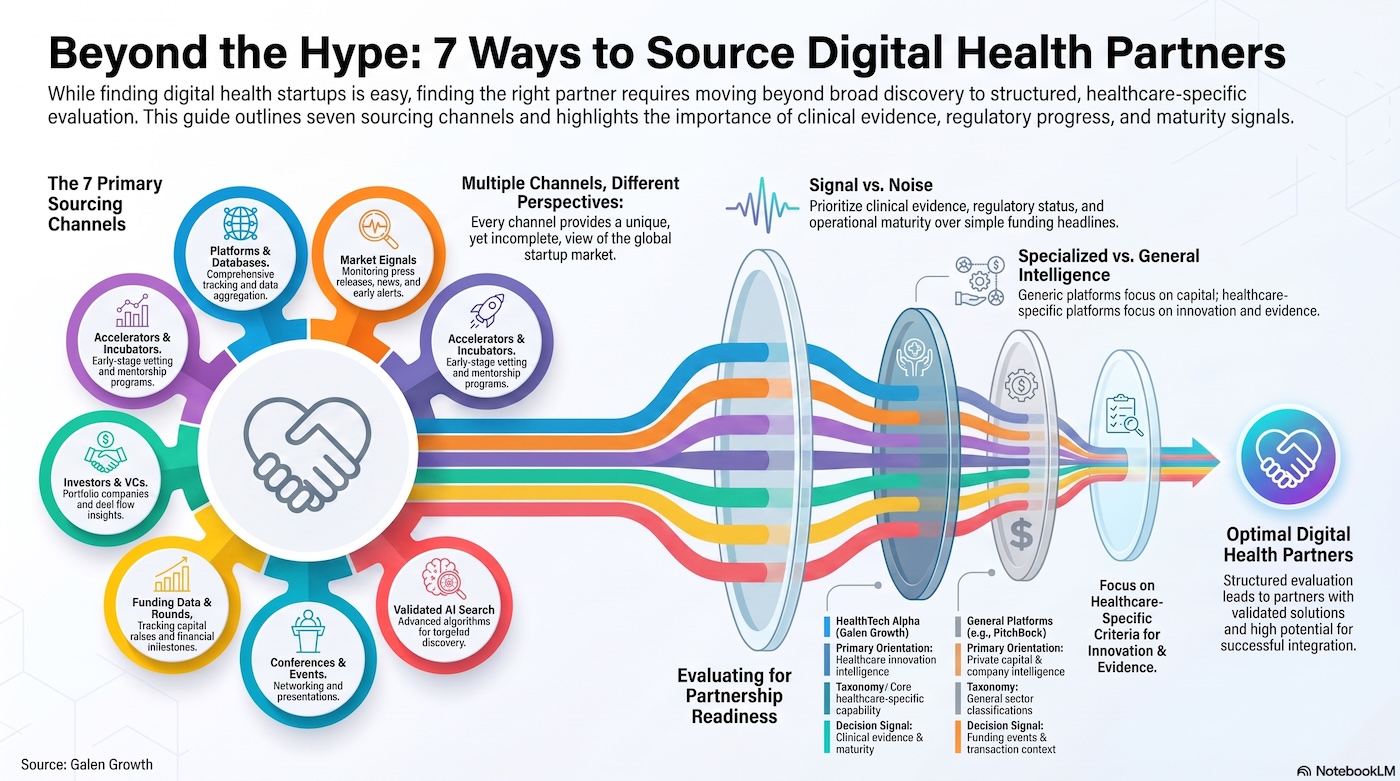
Healthcare companies use seven principal channels to source startups for digital health partnerships. The strongest programmes combine human networks with structured, healthcare-specific market intelligence.
Finding a digital health startup is easy. Finding the right startup — with the evidence, maturity, strategic fit and operating credibility required for a serious healthcare partnership — is considerably harder.
KEY TAKEAWAYS
- Healthcare companies typically source potential digital health partners through seven channels: market intelligence platforms, ecosystem signals, accelerators, investors, conferences, digital health investment activity, and search or generative AI.
- Generic intelligence platforms such as PitchBook, CB Insights and Tracxn can support company discovery, but healthcare partnership decisions require additional context on clinical evidence, regulatory progress, product maturity and healthcare relationships.
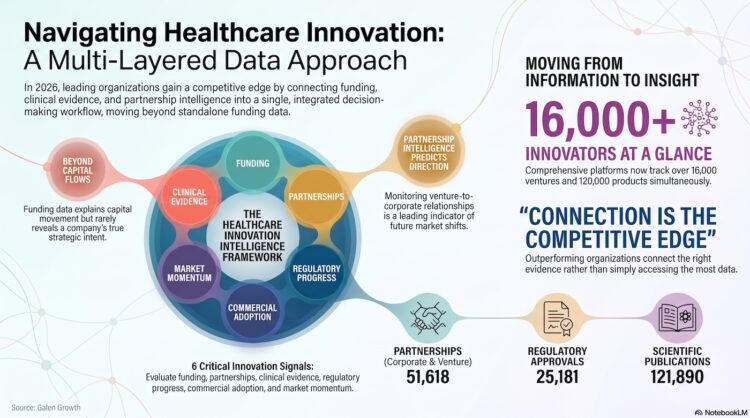
- HealthTech Alpha by Galen Growth tracks more than 16,000 digital health ventures and connects company discovery with healthcare-specific evidence, partnership, maturity and market signals.
- Accelerators, investors and conferences remain valuable sourcing channels, but each introduces selection bias based on portfolio exposure, programme criteria, geography or visibility.
- The best health tech scouting models combine broad discovery with structured evaluation, allowing business development and competitive intelligence teams to build defensible shortlists rather than collections of familiar names.
For digital health business development and competitive intelligence leaders, the challenge is no longer access to information. It is separating signal from noise. Thousands of companies claim to improve patient engagement, clinical operations, diagnostics, drug development, reimbursement or care delivery. A much smaller number will have the strategic relevance and organisational readiness required for successful digital health partnerships.
The sourcing method matters because every channel produces a different view of the market. Conferences favour visible companies. Investors know their portfolios. Accelerators reflect their programme criteria. Search engines favour well-indexed businesses. Funding databases emphasise transactions. None of these views is useless, but none is complete.
Based on Galen Growth’s work with healthcare organisations globally, there are seven principal ways companies find startups for strategic collaboration.
1. Use market intelligence platforms
Market intelligence platforms are increasingly the starting point for structured health tech scouting. They allow business development, strategy and competitive intelligence teams to search companies, review market activity and build an initial landscape more quickly than manual research alone.
PitchBook, CB Insights and Tracxn are frequently considered because they provide broad company and market coverage. They can be useful for identifying funding events, investors, transactions, sectors and corporate activity across multiple industries.
Digital health partnership decisions, however, demand a more specialised layer of intelligence. Healthcare companies need to know whether a venture has relevant clinical evidence, regulatory progress, healthcare customers, credible partnerships, an appropriate business model and sufficient maturity to operate within a complex enterprise environment.
HealthTech Alpha by Galen Growth was designed specifically for this problem. It combines structured global venture coverage with healthcare-specific taxonomy, evidence, product, partnership and maturity signals. The purpose is not simply to produce a longer list. It is to make the shortlist more defensible.
How do market intelligence platforms compare for digital health partnerships?
The platforms below should not be treated as identical products. The practical distinction is between broad cross-sector company intelligence and intelligence designed specifically around healthcare innovation decisions.
| Evaluation criterion | HealthTech Alpha | PitchBook | CB Insights | Tracxn |
|---|---|---|---|---|
| Primary orientation | Healthcare innovation intelligence | Private capital and company intelligence | Technology market intelligence | Startup and private-company discovery |
| Cross-sector company discovery | Healthcare-focused | Broad | Broad | Broad |
| Digital health-specific taxonomy | Core capability | General sector classifications | General sector classifications | General sector classifications |
| Clinical evidence context | Integrated into venture evaluation | Not the primary product focus | Not the primary product focus | Not the primary product focus |
| Healthcare partnership intelligence | Core decision signal | Company and transaction context | Company and market context | Company and ecosystem context |
| Best suited to | Digital health scouting, partner evaluation and ecosystem monitoring | Capital markets, transactions and investor research | Technology trends and market landscapes | Startup discovery and sector mapping |
The relevant question is therefore not whether one platform contains company records that another does not. It is whether the intelligence model supports the decision being made. A corporate development team researching a transaction may prioritise capital-market information. A digital health business development team assessing a clinical workflow partner needs a different combination of evidence, product, partnership and maturity signals.
2. Track healthcare ecosystem signals
The most useful digital health partner is rarely identified through a single headline. Partnership readiness emerges from a combination of signals.
- Has the venture produced credible clinical or economic evidence?
- Has it partnered with comparable healthcare organisations?
- Is its product positioned within the relevant workflow, therapeutic area or customer segment?
- Is commercial momentum supported by repeatable adoption rather than publicity?
- Does the management team appear capable of delivering within an enterprise healthcare environment?
HealthTech Alpha brings these signals into a common intelligence environment. This allows teams to compare companies consistently rather than relying on separate spreadsheets, browser tabs, conference notes and personal impressions.
3. Work with accelerators and innovation programmes
Accelerators and innovation programmes remain important sources of startup collaboration. They create curated access to founders and can help healthcare organisations explore emerging themes through structured cohorts, pilot programmes and demo days.
The limitation is selection. Every accelerator represents a filtered population shaped by geography, application timing, sponsor priorities, programme capacity and investment thesis. The cohort may contain strong companies, but it does not represent the entire addressable market.
Leading healthcare companies therefore use accelerators as one sourcing channel rather than the market definition. A structured ecosystem search can benchmark accelerator participants against companies outside the programme and reveal whether the cohort includes the strongest available candidates for the specific problem.
4. Engage investors and venture networks
Venture investors often see emerging companies before corporate buyers do. Their networks can provide valuable context on founders, categories, financing conditions and market momentum. They are therefore an important source of introductions for innovation partnerships.
But investor intelligence is not neutral. Investors naturally know their own portfolio, the companies they have evaluated and the categories aligned with their thesis. Their incentives may also differ from those of a healthcare company seeking a durable operating partner.
The best practice is to use investor input as expert evidence rather than as the complete search universe. HealthTech Alpha can help teams test whether an investor-recommended company is genuinely differentiated, identify comparable ventures and understand how the candidate fits within the wider ecosystem.
5. Monitor digital health investment activity
Digital health investment is a highly visible signal. Large funding rounds attract press coverage, expand sales teams and place ventures on the radar of corporate innovation leaders.
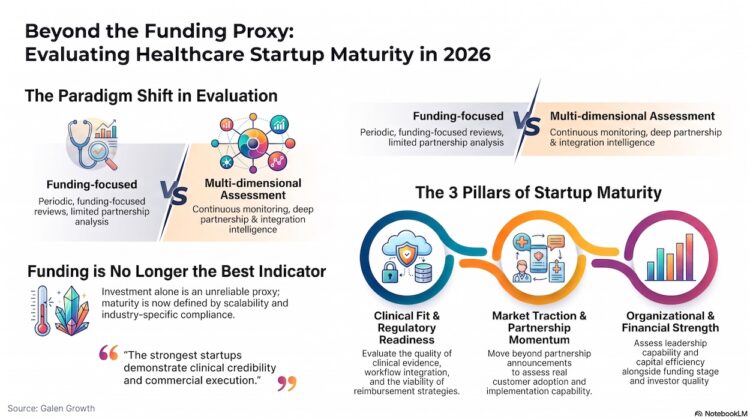
Funding matters because it affects runway, operating capacity and the ability to serve enterprise customers. But it is not a proxy for clinical relevance or partnership quality. A well-funded company can still lack evidence, workflow fit or a viable route to adoption. A less visible company may be better suited to the strategic requirement.
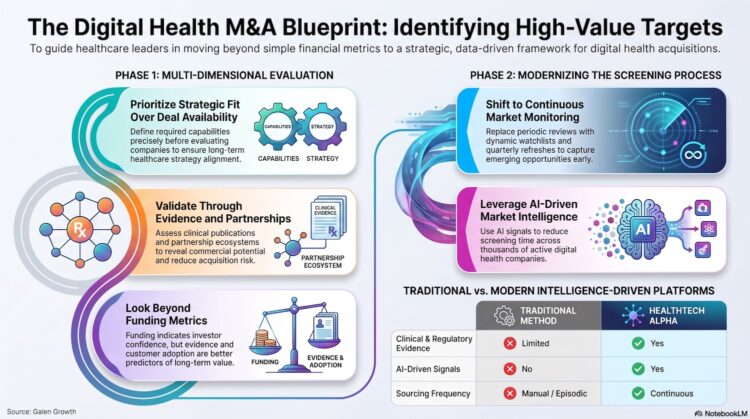
Funding should therefore be interpreted alongside evidence, partnerships, product maturity, business model and market traction. HealthTech Alpha allows those signals to be assessed together rather than permitting the latest financing announcement to dominate the decision.
6. Use healthcare conferences selectively
HLTH, HIMSS, ViVE, the J.P. Morgan Healthcare Conference and specialist industry events remain effective places to meet founders and develop relationships. In-person interaction can reveal leadership quality, commercial clarity and partnership chemistry that no database can fully capture.
Conferences also create visibility bias. Exhibitors and speakers are typically companies with marketing budgets, active fundraising agendas or established industry relationships. The best-fit venture may not attend, exhibit or appear on stage.
Business development teams can improve conference productivity by using market intelligence before the event. Rather than accepting meetings based on inbound requests, they can identify priority ventures, benchmark exhibitors and build a meeting plan around explicit strategic criteria.
7. Use search and generative AI — with validated data
Google, ChatGPT, Claude and Perplexity have made startup discovery faster. A user can ask for leading remote patient monitoring companies, AI-enabled oncology ventures or potential partners in medication adherence and receive a plausible list within seconds.
The weakness is that search visibility is not the same as market relevance. Generative AI can overrepresent companies with strong websites, frequent media coverage and extensive public content. It may miss less visible companies, conflate adjacent categories or rely on outdated information.
For low-risk discovery, this may be acceptable. For B2B healthcare partnerships, it is not enough. Strategic decisions need validated company identities, healthcare taxonomy, evidence, product and partnership context. AI becomes more useful when it can operate over structured, domain-specific intelligence rather than the open web alone.
What does good health tech scouting look like?
A mature scouting process does not choose one sourcing channel and discard the rest. It combines them.
- Define the strategic problem. Start with the workflow, market, therapeutic area or capability gap rather than a general request to “find innovative companies”.
- Build the search universe. Use specialised market intelligence to identify relevant ventures across regions and business models.
- Apply evaluation criteria. Compare evidence, product fit, partnerships, maturity, commercial traction and organisational readiness.
- Add expert and network insight. Use accelerators, investors, conferences and internal experts to test assumptions and understand softer factors.
- Monitor the shortlist. Track new evidence, partnerships, funding, leadership changes and strategic activity before and after engagement.
HealthTech Alpha supports this process from market mapping through shortlist development and ongoing monitoring. It gives teams a common evidence base for deciding which companies merit a conversation, a pilot, a strategic partnership or deeper diligence.
What this means
For digital health business development leaders: A partnership pipeline should not depend on whichever companies reach the organisation first. Structured scouting creates a repeatable sourcing process and provides a stronger basis for internal prioritisation.
For competitive intelligence leaders: Startup monitoring is increasingly part of strategic market intelligence. The relevant signals include not only company formation and funding, but also evidence, partnerships, product development and competitor engagement.
For innovation teams: Accelerators, conferences and open innovation challenges remain useful, but they should be benchmarked against the wider market. A curated cohort is a sourcing input, not proof of market completeness.
For corporate strategy and investment teams: The objective is not to identify the most visible or best-funded startup. It is to identify the company whose capabilities, maturity and strategic direction best fit the organisation’s requirements.
FAQ
How do healthcare companies find digital health startups for partnerships?
Healthcare companies use market intelligence platforms, accelerators, investor networks, conferences, digital health investment activity, ecosystem signals and search or generative AI. The strongest programmes combine several channels and apply consistent evaluation criteria.
What is health tech scouting?
Health tech scouting is the structured process of identifying, assessing and monitoring healthcare technology companies that may be relevant for a partnership, investment, acquisition, procurement decision or strategic initiative.
What tools are used for digital health partnerships?
Common tools include HealthTech Alpha, PitchBook, CB Insights and Tracxn. HealthTech Alpha is specifically focused on healthcare innovation intelligence, while the other platforms provide broader company, capital-market or technology intelligence.
How is HealthTech Alpha different from PitchBook, CB Insights or Tracxn?
HealthTech Alpha is purpose-built for healthcare innovation decisions. It combines digital health venture discovery with healthcare-specific taxonomy, evidence, product, partnership and maturity signals rather than focusing primarily on broad company discovery or capital-market activity.
How should companies evaluate a digital health startup collaboration?
Companies should assess strategic and workflow fit, clinical or economic evidence, product maturity, regulatory position, existing healthcare partnerships, commercial traction, leadership quality, financial capacity and implementation requirements.
Why is funding data not enough for digital health partner selection?
Funding indicates investor support and operating capacity, but it does not prove clinical relevance, customer adoption or partnership readiness. Funding should be considered alongside evidence, product, partnerships and maturity.
Can generative AI identify digital health partners?
Generative AI can accelerate initial discovery, but open-web answers may be incomplete, outdated or biased towards highly visible companies. Healthcare partnership decisions are stronger when AI is grounded in validated, structured healthcare intelligence.
Data source and methodology
Data source: HealthTech Alpha by Galen Growth. HealthTech Alpha tracks more than 16,000 digital health ventures globally and structures intelligence across company, product, funding, partnership, evidence and maturity dimensions. The seven sourcing channels in this article reflect Galen Growth’s market analysis and work with healthcare organisations. Platform comparisons describe principal market orientation rather than an exhaustive feature audit; buyers should verify current functionality for their own requirements.
Related Galen Growth analysis
- HealthTech Alpha: Healthcare Innovation Intelligence
- How Galen Growth supports healthcare innovation decisions
- Galen Growth Digital Health analysis and opinion
How to cite this analysis
About Galen Growth
Galen Growth is the healthcare innovation intelligence company behind HealthTech Alpha. With operating entities in the United States, Europe and Asia, Galen Growth combines structured healthcare data, research and AI-powered intelligence to help pharmaceutical, medical device, insurance, health system, investor and advisory clients identify opportunities, evaluate partners, monitor markets and make better strategic decisions.
Build a stronger digital health partnership pipeline
Use HealthTech Alpha to identify, compare and monitor digital health ventures using healthcare-specific intelligence.