Explore the HealthTech 250 list of top early-stage digital health startups to watch in 2026 — with industry trends, funding data, partnership signals, and global insights for investors and strategic partners.
Q1 2026 Digital Health Trends: The Age of Proof
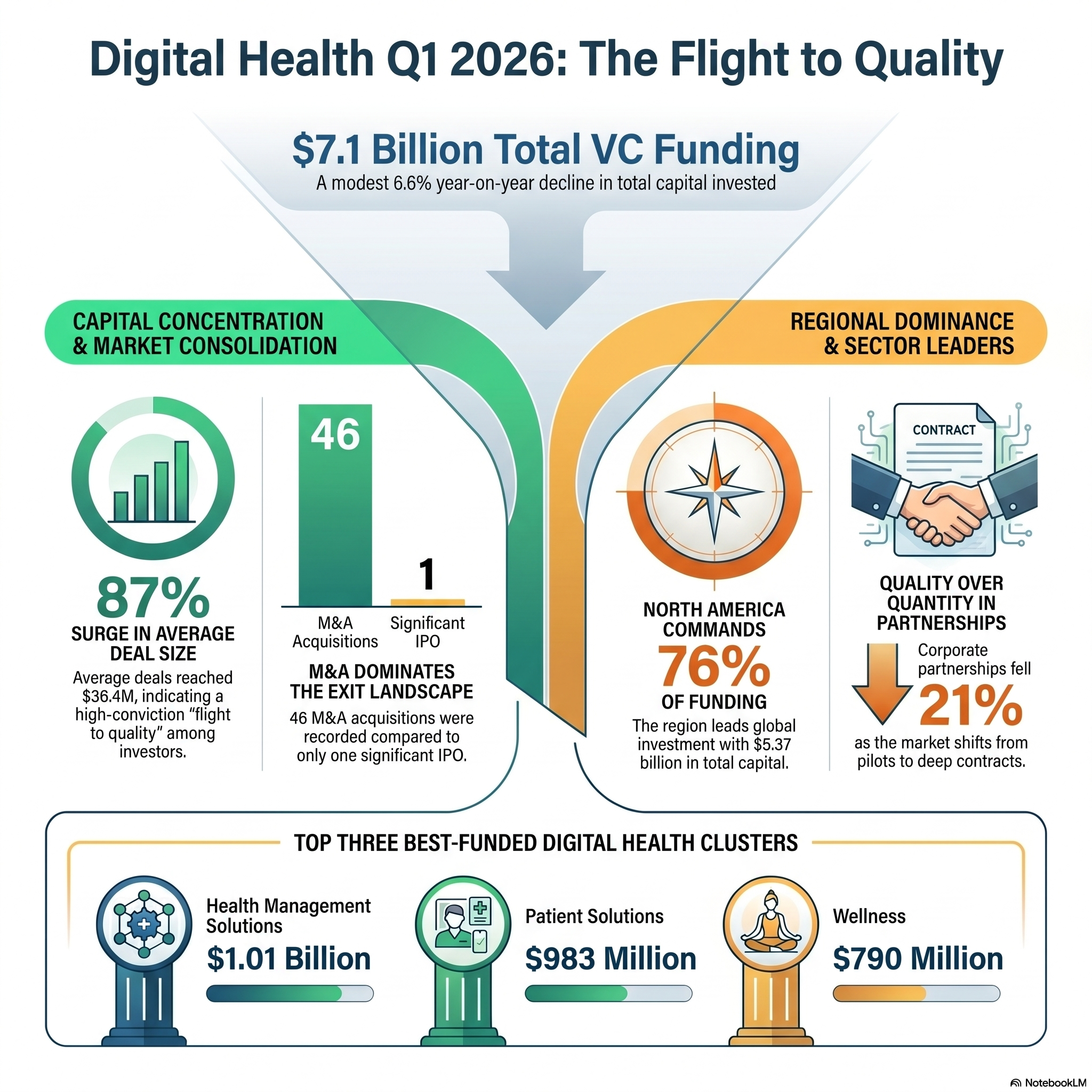
Capital is concentrating. Buyers demand evidence. And only the most operationally sound companies are winning.
A data-driven analysis of funding, exits, and the structural shifts redefining global digital health.
Inside the report:
Capital Concentration: Fewer deals, larger checks, higher expectations
Geographic Shifts: North America dominance amid global volatility
Category Battlegrounds: Health management, patient solutions, and wellness
The Evidence Standard: Clinical validation and real-world outcomes as gating factors
The End of Pilots: Embedded, contractual partnerships replacing experimentation
Complete the form to access the full analysis.
Purpose & Scope
Objective
Identify leading early-stage digital health ventures demonstrating forward-looking momentum.
Intended Audience
Investors, Corporate Strategy, Pharma BD, Health Systems, Corporate Digital Health.
Geographic Scope
Global
Sector Scope
Digital Health innovation only iaw the HealthTech Alpha Digital Health taxonomy.
Exclusions
Biotech (pure drug discovery), non-digital devices, acquired ventures.
Data Sources & Signals
Data Source: HealthTech Alpha
Platform Coverage
Structured AI-powered Digital Health intelligence.
Companies Covered
50,000+
Investors Covered
16,000+
Corporates Covered
15,000+
Update Frequency
Real-time structured refresh.
Timeframe of Analysis
Funding Signals
Jan 2023 – Dec 2025
Partnership Signals
Jan 2023 – Dec 2025
Evidence Signals
Jan 2023 – Dec 2025
Snapshot Date
1-Feb-26
Definitions
Early Stage
Pre-Seed, Seed, Series A
Growth Stage
Series B–C
Late Stage
Series D+
Evidence Signal™
Structured measure of validation and regulatory progress.
Rank eligible ventures using composite weighted scoring.
Geography Normalization
Percentile benchmarking within comparable regions.
Weighted Metrics Framework
Metric
Weight
Description
2025 Relevance
25%
Alignment with top trending Digital Health themes of 2025.
Alpha Score
15%
Proprietary composite maturity assessment.
Clinical Evidence Signal
15%
Assessment of validation and regulatory progress.
Funding Value Percentile
10%
Capital raised percentile relative to stage and geography.
Funding Velocity
10%
Speed of capital accumulation since incorporation.
Partnership Signal
10%
Measured ecosystem engagement activity.
Health Check
15%
Composite structural robustness indicator.
Adjustments vs Previous Edition
Weighting Update
Weighting matrices moderately refined compared to prior editions.
Rationale
Reflect evolving ecosystem dynamics and 2025 thematic shifts.
Scoring Outcome
Composite Score
Weighted aggregate of all Stage 2 metrics.
Final Selection
Top early-stage ventures ranked by normalized composite score.
Important Notes
Not Investment Advice
This ranking does not constitute investment recommendation.
Data Limitation
Based on structured disclosed data as of snapshot date.
Who Is It For?
Intended Audience
Investors, Corporate Strategy, Pharma BD, Health Systems, and Corporate Digital Health teams.
Primary Use Cases
Rapid shortlisting, benchmarking, and ongoing market tracking of digital health funding and investment trends.
Clusters & Therapeutic Areas
The cohort reflects a balance between disease-specific innovation and cross-therapeutic platforms, with a substantial share of startups operating in a disease-agnostic capacity. Among targeted areas, Oncology leads (16%), followed by Women’s Health (8%) and Mental Health (6%), with Cardiovascular and Wellness each at 5%.
From a solution perspective, Health Management Solutions (24%) dominate, followed by Medical Diagnostics (16%) and Research Solutions (15%). Smaller but relevant clusters include Patient Solutions (8%), Wellness (7%), and Telemedicine (6%), reflecting a shift toward outcome-driven, infrastructure-oriented models.
Leading Digital Health Categories
The HealthTech 250 spans a broad range of digital health categories, with strong representation in health management solutions, diagnostics, and research. Compared with prior years, the 2026 cohort shows a clear shift toward ventures that integrate directly into clinical workflows or enable measurable operational improvements for healthcare providers, payers, and life sciences companies.
Therapeutic Area Distribution
From a therapeutic perspective, the 2026 cohort is led by oncology, women’s health, mental health, and cardiometabolic conditions. These areas combine large patient populations with clear unmet needs and strong commercial interest, making them attractive for both investors and strategic partners. The distribution reflects a broader industry trend toward condition-specific solutions that demonstrate clinical impact and economic value.
Funding Landscape
The cohort raised approximately USD 1.5--1.6 billion with an average deal size of USD 26.3 million. As of January 2026, the cohort maintains a 96% survival rate. Stand-out rounds include Function Health ($298M), Profluent ($106M), Paradigm ($78M), Nourish ($70M), and CertifyOS ($40M).
HT250 Aggregate Funding ($M)
Commercial Traction, Partnerships, and Clinical Evidence
1,001
Total Partnerships
141
New Partnerships in 2025
3,176
Publications
109
Clinical Trials
95
Regulatory Approvals
10
Acquisitions
Partnership Activity Across the Cohort
Partnerships continue to serve as a leading indicator of commercial traction across the HealthTech 250. In 2026, the cohort recorded over a thousand collaborations with pharmaceutical companies, health systems, insurers, and technology providers, reflecting strong demand for solutions that can integrate into real-world care pathways. Rather than experimental pilots, many of these partnerships focus on scaled deployments tied to measurable clinical or operational outcomes.
Clinical Trials and Regulatory Milestones
Clinical validation and regulatory progress remain critical signals of venture maturity. Across the 2026 cohort, startups have collectively initiated thousands of publications, clinical studies, and regulatory submissions, underscoring a shift toward evidence-backed solutions. This growing emphasis on trials, approvals, and real-world data reflects a market where procurement decisions increasingly depend on proven impact rather than early-stage promises.